Smoked Salmon Time Calculator
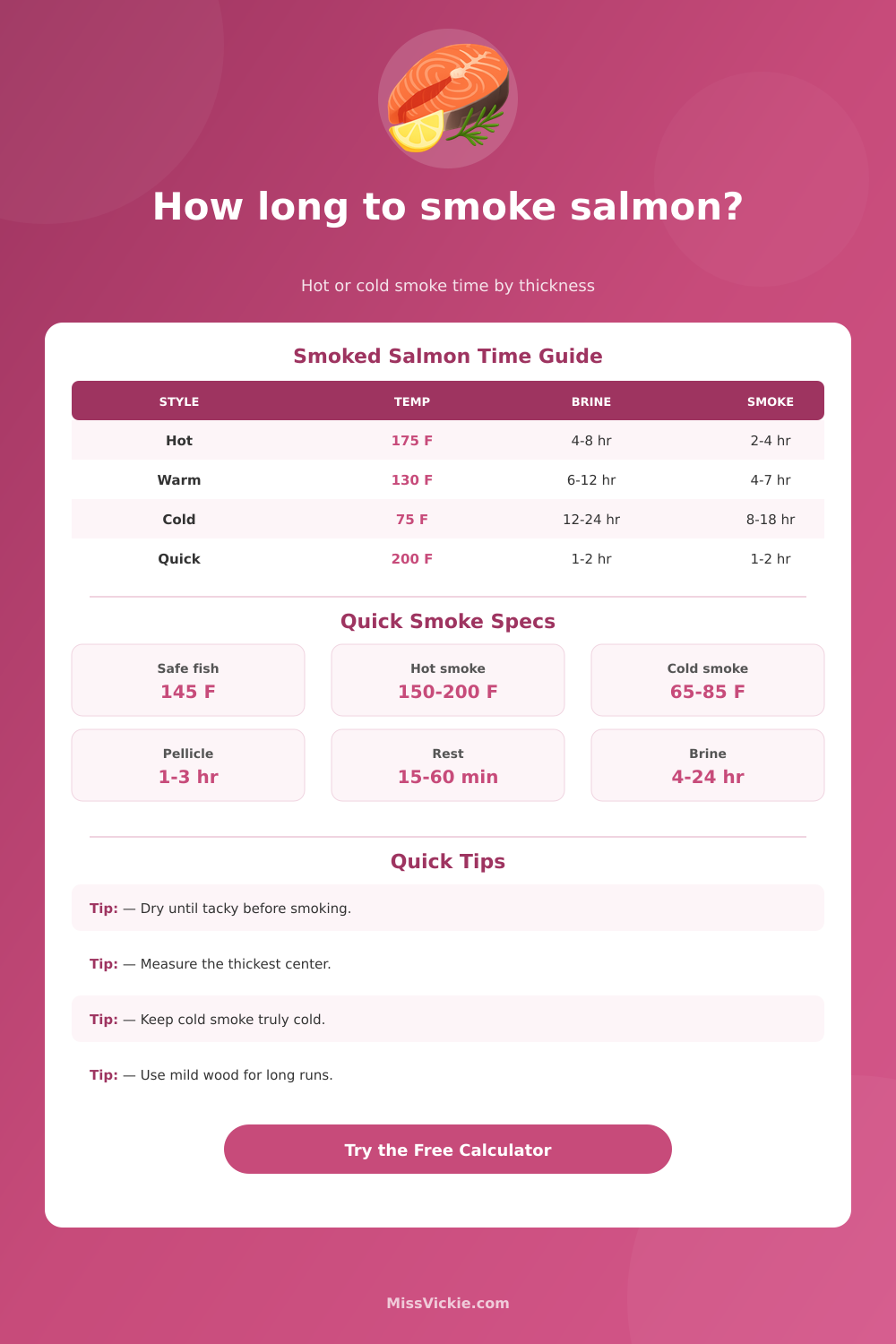
Plan hot smoked, warm smoked, or cold smoked salmon by fillet thickness, brine style, brine time, smoker temperature, pellicle, wood intensity, target temperature, humidity, and rest.
📌Quick salmon presets
Cold-smoked salmon depends on fully cured fish, strict chilling, and a low chamber temperature. Use this calculator for timing and planning, then verify food safety with reliable curing and temperature controls.
⚙Smoke and brine inputs
Smoked salmon schedule
Adjust the inputs and calculate to build a smoke plan.
Timing breakdown
Smoke logic
🌡Smoked salmon quick specs
📊Seafood target temperature table
| Seafood or style | Silky pull | Flaky pull | Food-safe endpoint |
|---|---|---|---|
| Hot smoked salmon portions | 125-130 F | 135-140 F | 145 F |
| Whole side of salmon | 128-132 F | 138-142 F | 145 F at thickest center |
| Warm smoked salmon | 118-125 F | 128-135 F | Cook further if serving high-risk guests |
| Cold smoked cured salmon | Not cooked | Not cooked | Requires proper cure and refrigeration |
| White fish reference | 130-135 F | 140-145 F | 145 F |
A thermometer is still the final check for hot smoked fish. Cold smoked salmon is a curing and refrigeration process, not a normal cooking endpoint.
🔥Hot, warm, and cold smoke timing table
| Smoke style | Chamber range | Best thickness | Typical smoke time |
|---|---|---|---|
| Quick hot smoke | 190-215 F | 0.5-1.0 in portions | 60-130 min, watch glaze closely |
| Classic hot smoke | 160-185 F | 0.75-1.5 in fillets | 2-4 hr to target internal temp |
| Warm smoke | 105-145 F | 0.75-1.25 in cured fillets | 4-7 hr for silky texture |
| Cold smoke | 65-85 F | Thin cured sides or slices | 8-18 hr depending smoke strength |
| Thick king salmon | 150-175 F | 1.5-2.0 in center cuts | 4-6 hr, verify center temperature |
🧂Brine, cure, and pellicle table
| Prep step | Best use | Timing guide | Calculator adjustment |
|---|---|---|---|
| Light wet brine | Hot smoked dinner fillets | 3-6 hr per inch | Short brine lowers readiness score |
| Strong wet brine | Firm party salmon | 2-5 hr per inch | Long brine raises salt warning |
| Dry cure | Cold smoke, nova, pastrami | 8-18 hr per inch | Needed for long cold smoke runs |
| Equilibrium cure | Precise salt level | 18-36 hr per inch | Slow but forgiving |
| Pellicle drying | All smoked salmon | 1-3 hr until tacky | No pellicle adds drying time |
🪵Wood and humidity smoke data
| Wood or chamber condition | Smoke effect | Best salmon use | Timing effect |
|---|---|---|---|
| Alder, apple, maple | Mild and sweet | Cold smoke and delicate fillets | Supports longer smoke windows |
| Cherry or pecan blend | Medium color and aroma | Hot smoked portions | Balanced default timing |
| Hickory blend | Assertive smoke | Pastrami rub or thick cuts | Shorten if bitterness appears |
| Humid chamber | Slower surface drying | Thick fillets with steady airflow | Adds 8-22 percent time |
| Dry strong airflow | Faster surface set | Glazed hot smoked salmon | Can shorten the smoke phase |
🔄Smoking style comparison grid
Flaky, moist, and dinner-ready. Time is mostly driven by thickness, chamber heat, and pull temperature.
A lower chamber gives a softer texture. It needs a better cure and a longer, steadier smoke window.
Thin, glossy, and sliceable. It is cured and smoked cold, so chamber temperature control matters most.
Good for weeknight portions. The higher chamber speeds cooking but gives less time for deep smoke flavor.
💡Smoked salmon timing tips
When you’re smoking salmon: Your experiment shifts into a disaster when the fish is raw in the middle but gray, bitter and ruined on the outside. Or maybe it’s ready on the surface, so you pull it, only to discover it’s rubbery all the way through.
What we call “smoke time” isn’t simply about time on the clock. It’s about texture, too, smooth versus tough. That’s why I created the calculator at the top. It lets you plan ahead for both instead of guessing, by estimating brine, pellicle, smoke and rest time.
How to Smoke Salmon Perfectly
Most folks think of “smoke time” as something that stay the same. They don’t. How long it takes reacts to three other factors… Fish thickness, temperature, humidity, and how much moisture the fish lost while drying. Knowing this relationship change the entire process.
Normally, the thickest spot in the fillet is the most important data point. Thick protein doesn’t conduct heat very well. Dry spots hold onto smoky flavors better then wet ones. If you measure thickness from the narrow tail section, the ends will cook long before the middle are done. You should look at where the bulk of flesh is thickest and apply that data point instead.
That’s why the tool factors in both density (thick vs thin) as well as how much heat penetrate into the fish. Because you might be cold smoking a pre-cure piece for bagel lox. Or maybe you’re hot smoking to achieve an internal temp that’s considered safe. These two goals are fundamentally different. One require using heat to cook the fish. The other depends on time and salt to preserve the fish while keeping the chamber temperature below the danger zone.
Before the fire ever touches the wood chips, though, that’s when the texture gets determined: during brining. For example, if you want your fillet dinner to be moist and flakey, use a light wet brine (it goes without saying). Want to cold smoke? Then you’ll need a stronger dry cure or something closer to an equilibrium method. This is because salt must work its way deep into the fish to bind up the proteins while still allowing the fish to be edible.
Depending on the type of brine you select, it compares your planned soaking time against what is recommended for that style. So if you said you only used a light brine for two hours on a thick side and then intend to cold smoke it for eighteen hours, it knows there won’t be any match there. And that’s where folks go off track. They believe smoke preserves. Smoke doesn’t preserve. Salt does. By this point, all smoke does is add aroma and color.
The other not-to-be-skipped part of this process is creating the pellicle. That tacky layer of gooey goodness on the salmon surface will stick the smoke to the fish. If there is no pellicle, the smoke will simply wash off in the steam, leaving you with wet, bland-looking salmon. The tool checks pellicle conditions because if the surface is too moist, heat won’t transfer well, which cause inconsistent color throughout.
Just dry the fish enough so that it appears cured-jerky-like on the exterior but stays firm and cool inside. Drying it takes some time, which increases the overall project duration. However, this prevents you from having to pull the meat apart at a later date.
Selecting the right kind of wood is far less critical than most believe (unless the fish is delicate and you’re using something harsh such as mesquite or even oak). Maple, apple and alder are all popular for good reasons. They burn cleanly and mildly without overshadowing the natural sweetness of the salmon. The chart on the page breaks this down, matching smoke time with wood strength. Shorter is better; it prevents any bitterness from developing in stronger wood types.
Humidity in the chamber also makes things evaporate slower. So the skin will take longer to set and the interior temperature increase more slowly. The calculator accounts for environmental factors like this so you aren’t sitting there with a thermometer in your hand looking up at it asking “what’s going on here?”
When it comes out, let the salmon rest. The smoke will mellow and juices will return to the flesh. If you cut open warm salmon, those scent molecules gets blown away with all that steam. Slice now and you’ll lose some moisture and aroma. Covering it and leaving it in the cooler for half-an-hour or an hour really does make a difference when it goes on your plate. The color deepens from pink to more of a translucent orange and it binds together better.
That’s not just waiting. That’s part of the cook. Your total time is built around that rest period in the tool so you’re not planning dinner service that’s late. Smoke is smoke, after all, and the bottom line with smoking salmon is how you apply heat and control moisture loss at the same time. How do you cook it enough to dry it out and intensify flavors without overcooking it? Keep in mind that you’re trying to concentrate the flavor by removing some moisture, yet retain enough moisture to keep it tender.
The numbers will point you in the right direction, but your eyes and nose confirm if it’s done. Once the smell transitions from sweet woodsy smoke to something more like a sharper, drier odor, you know you’re getting closer to the end of the window. The math gets you there, and then your eyes and nose tell you when to pull the trigger. It’s that balance that turns raw fish into something worth waiting for.