Whole Chicken Cooking Time Calculator
Estimate whole-bird cook time from weight, method, oven heat, stuffing, spatchcocking, start temperature, altitude, rest time, and carryover.
🍲Popular whole chicken presets
📏Enter your chicken details
Use an instant-read thermometer in the thickest breast and thigh. Time estimates help you plan; temperature confirms the bird is done.
Whole chicken timing estimate
🌡Whole-bird safety checkpoints
📊Method comparison grid
📘Reference tables
| Method | Typical heat | Base timing | Best use |
|---|---|---|---|
| Standard oven roast | 350°F / 177°C | About 18 to 22 min per lb plus setup time | Balanced skin, white meat, and dark meat |
| High-heat oven roast | 400 to 425°F / 204 to 218°C | About 15 to 18 min per lb | Crisper skin on smaller birds |
| Convection roast | 325 to 375°F / 163 to 191°C | Roughly 10 to 15% faster than standard | Even browning with moving air |
| Smoker or pellet grill | 225 to 275°F / 107 to 135°C | About 30 to 40 min per lb | Smoke flavor and slower planning |
| Slow cooker | Low or high setting | About 45 to 70 min per lb depending setting | Soft meat for pulling, not crisp skin |
| Chicken weight | Roast estimate | Spatchcock estimate | Servings |
|---|---|---|---|
| 3 to 3.5 lb / 1.4 to 1.6 kg | 65 to 85 minutes | 40 to 55 minutes | 3 to 4 portions |
| 4 to 4.5 lb / 1.8 to 2 kg | 85 to 105 minutes | 50 to 65 minutes | 4 to 5 portions |
| 5 to 5.5 lb / 2.3 to 2.5 kg | 105 to 130 minutes | 65 to 80 minutes | 5 to 6 portions |
| 6 to 7 lb / 2.7 to 3.2 kg | 130 to 165 minutes | 80 to 100 minutes | 6 to 8 portions |
| Adjustment | Timing effect | Why it matters | Calculator handling |
|---|---|---|---|
| Light aromatics in cavity | Adds a small amount | Airflow drops but heat still moves | Adds a modest cavity factor |
| Dense bread stuffing | Adds a large amount | The center must heat safely too | Adds up to about one third more time |
| Partially frozen center | Adds significant time | Cold mass delays the thickest area | Adds a start-temperature multiplier |
| High altitude kitchen | Adds a small amount | Evaporation and heat transfer shift | Adds a staged altitude factor |
| Rest plan | Carryover expectation | Pull target | Serving note |
|---|---|---|---|
| Short 5 to 10 minute rest | Low carryover | Pull closer to final safe reading | Good when dinner is already waiting |
| Normal 12 to 18 minute rest | Medium carryover | Pull a few degrees early if desired | Best default for a whole chicken |
| Long 20 to 30 minute rest | Higher carryover | Useful after high-heat roasting | Tent loosely to protect the skin |
| Shreddable dark meat | Carryover is less important | Cook longer for collagen breakdown | Best for slow cooker or covered pans |
🍗Typical cooked portion notes
💡Cooking time tips
Then it hits: 40-minutes ‘til company arrives and the chicken has been sitting in the refrigerator. Will it reach doneness in another 20 minutes? Better call for delivery? That’s why the above cooking time chart for a whole chicken exists. So the stress doesn’t start until it’s already started.
Enter the size (weight) of your bird, the technique, and even your kitchen altitude, and get an answer on how long to expect everything to take. You don’t have to guess anymore.
How to Cook Chicken Perfectly Every Time
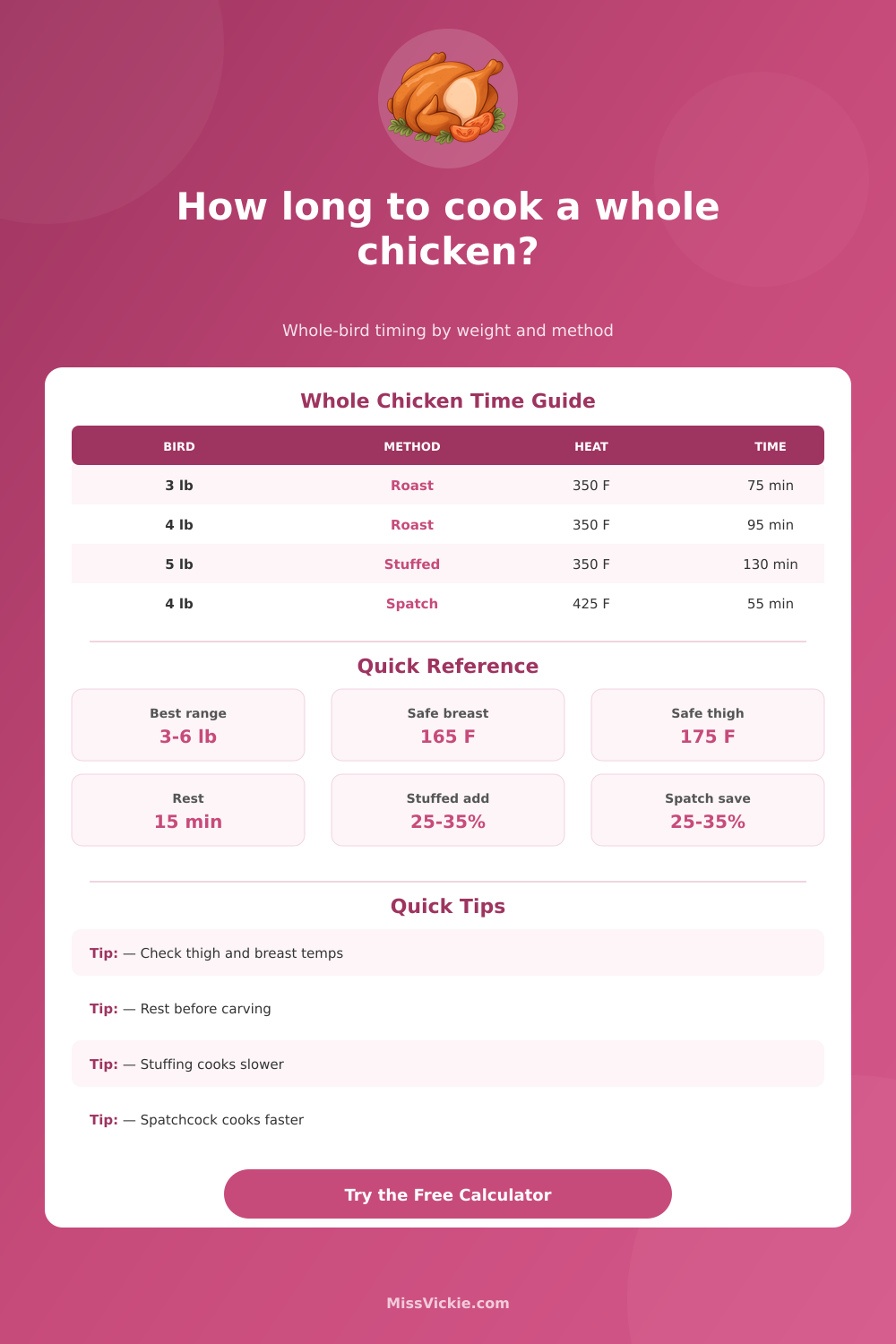
Most recipes will tell you to roast a four-pound chicken in a 350-degree oven for an hour and a half. It’s a good start, but forgets all about the variables that alter how fast heat passes through meat. Did you pull the bird directly out of the fridge? Or did it have some time to warm up on the counter for half an hour? That makes a difference: a cold center means the whole thing will take longer. Because core has to get to safe temperatures first, cooking time changes to match, adding more time when necessary.
If you’re planning to stuff the bird (with bread, let’s say), then the tool takes this into account by adding a nice cushion. Stuffing is dense and thus insulates the rest of the meat, slowing heat transfer to the interior portions of the meat. This explains why stuffed birds requires more time than basic roast guidelines indicate.
Shape matters too. If you’ve ever spatchcocked a chicken (removed the backbone and flattened it to lay evenly in your pan) the calculator takes that into account. Laying the bird flat increases the surface area exposed to the heat. This helps the white meat cook quicker and keeps the dark meat moist while waiting for the white meat to cook through. Selecting the spatchcock option shortens the estimated cooking time, since now all parts of the bird is getting hit by the heat more directly. It requires a little less preparation but saves a lot of cooking time.
And then there’s altitude. I learned about this after my dinners didn’t turn out well. Living high above sea level means the boiling point of water are lower. This means things will take longer to cook. It also causes evaporation to happen more quickly, which could cause the skin to dry out before the interior has cooked through. To account for this, the tool adjusts the timing a bit upwards (depending on where you’re living). It’s a small tweak, but keeps the breast meat from drying out while the thighs continue to cook through.
Over a year of roasting, these tweaks makes all the difference. Maybe you won’t even see it in one meal, but it adds up, and makes each dinner turn out better then ever.
It doesn’t just give you a number; it also tells you when you should begin testing with your thermometer. It also tells you when to remove it from the oven, depending on how long you want it to rest. Resting is not fluff, the idea that if you want moist meat, you let it rest for a bit. No. You have to wait because otherwise all the juice leaks out and then the meat goes all dry. It takes that time for the inside of the bird to reach temperature and then continue to cook after you take it off the heat through something called carryover cooking. The calculator knows about this. It helps you know when to pull the bird off the heat several degrees early. This way, it can still reach the right temperature and rest perfectly without going too far and getting too dry.
Cooking time is an estimate, of course it is. Average conditions don’t apply when you use a thin stainless steel pan or a heavy cast-iron one. Your oven may be hot or cool. It’s up to us to decide if our dish is done, and that comes down to our senses. The calculator gives you the framework so use your senses to confirm it.
Let this tool help you plan your night, not replace your attention. Prep the bird while the oven preheats, and have the thermometer ready before the timer expires. Look at the clock… But believe what the thermometer tells you first.
There are no hard-and-fast rules to cooking a whole chicken; rather, it’s a matter of knowing what happens when you apply heat to something round versus something flat, warm or cold. When you understand why spatchcocking makes it cook faster (or why stuffing it makes it take longer), the math begin to make sense. You don’t fret over the precise moment, just the way the meat feels.
This changes dinner from an anxiety-filled exercise into a comforting routine. Put the bird in, let it cook through, retrieve it, and it will be moist and evenly cooked. Everyone sits down together, and no one checks the time.