Chicken Wing Cooking Time Calculator
Estimate chicken wing cooking time for whole wings, split flats and drumettes, oven baking, convection, air fryer baskets, and grilled batches using heat, load, sauce timing, crispness, start temperature, and target internal temperature.
🍗 Chicken Wing Presets
Choose a real wing scenario, then fine tune the piece style, cooker heat, batch load, sauce timing, crispness, and pull temperature.
⚖ Wing And Heat Inputs
Your Wing Timing Plan
Adjust inputs to calculate a wing cooking window.
Timing Breakdown
Cook Plan
📌 Wing Timing Anchors
Use for safety, then decide if you want more tenderness.
Higher internal temps soften the joints and cartilage.
A short rest keeps hot sauce from steaming the skin.
Plan about 4 to 6 ounces raw wings per appetizer serving.
🔥 Method Time Reference
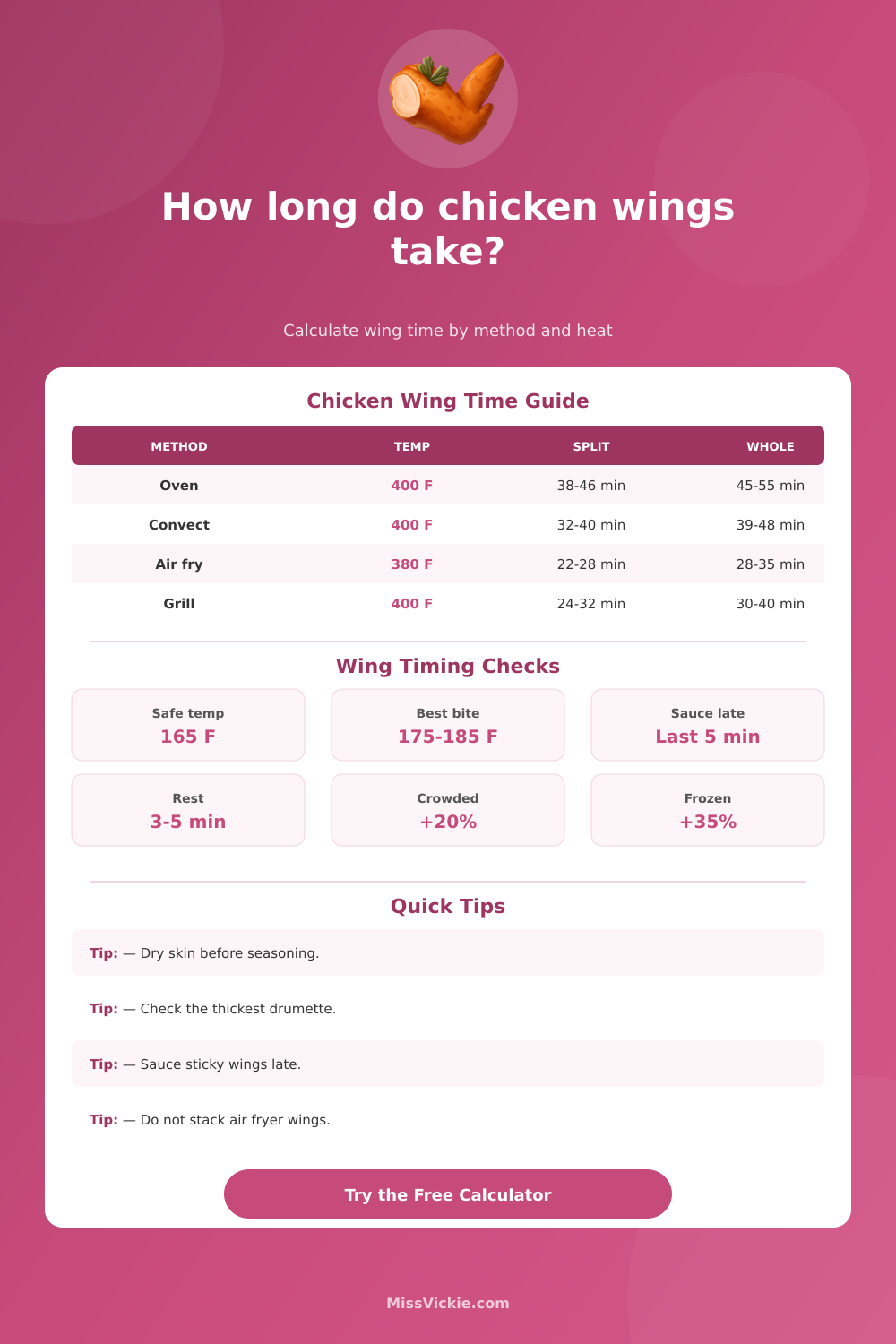
| Method | Typical Temp | Split Wings | Whole Wings | Best Use |
|---|---|---|---|---|
| Oven bake on rack | 400 to 425 degrees F | 38 to 46 minutes | 45 to 55 minutes | Large trays with even browning |
| Convection oven | 375 to 400 degrees F | 32 to 40 minutes | 39 to 48 minutes | Faster crisping with fan heat |
| Air fryer basket | 370 to 400 degrees F | 22 to 28 minutes | 28 to 35 minutes | Small batches and crisp skin |
| Indirect grill | 375 to 425 degrees F | 24 to 32 minutes | 30 to 40 minutes | Charred edges with smoky flavor |
| Two-zone grill | 350 indirect, hot sear | 28 to 36 minutes | 34 to 44 minutes | Finish over direct heat for color |
Times assume thawed wings in a single layer. The calculator adjusts for load, piece size, coating, start temperature, and target internal temperature.
📊 Load And Start Temperature Adjustments
| Condition | Timing Change | Why It Matters | Best Fix |
|---|---|---|---|
| Single layer with space | Base time | Air reaches the skin evenly. | Use a rack, basket, or open grill space. |
| Crowded sheet or basket | Add 18 to 25 percent | Moisture lingers and skin browns slowly. | Turn more often or cook in batches. |
| Partly frozen centers | Add 18 to 25 percent | The middle must thaw before cooking quickly. | Use lower heat at first, then crisp hotter. |
| Frozen solid wings | Add 35 to 45 percent | Ice delays rendering and browning. | Separate pieces once they loosen. |
| Wet skin or marinade | Add 8 to 15 percent | Surface water steals browning heat. | Pat dry or sauce near the end. |
🍯 Sauce And Crispness Guide
| Sauce Or Finish | When To Add | Timing Effect | Cooking Note |
|---|---|---|---|
| Dry rub or plain wings | Before cooking | Fastest browning | Salt early and keep skin dry. |
| Buffalo sauce | Toss after cooking | No extra cook time | Best for crisp skin that stays snappy. |
| BBQ or honey glaze | Last 5 minutes | Adds 2 to 4 minutes | Brush thinly so sugar does not burn. |
| Double glaze | Final 10 minutes | Adds 4 to 6 minutes | Lower heat slightly for sticky wings. |
| Extra crisp finish | After safe temp | Adds 3 to 8 minutes | Finish dry, then sauce on the side. |
🌡 Internal Temperature Targets
| Target | Texture | Pull Temp | Best For |
|---|---|---|---|
| 165 degrees F | Safe, firmer bite | 162 to 165 degrees F | Lean flats or reheated wings |
| 175 degrees F | Juicy with softer joints | 171 to 173 degrees F | Most split wings |
| 180 degrees F | Tender pub-style bite | 176 to 178 degrees F | Drumettes and mixed trays |
| 185 degrees F | Very tender, rendered skin | 181 to 183 degrees F | Whole wings and jumbo pieces |
📝 Cooking Method Comparison
Best for 3 to 8 pounds because a rack lifts wings above the juices.
Best for 1 to 2 pounds in a true single layer with shaking or turning.
Use lid-down indirect heat, then move briefly over direct heat for color.
Useful for sticky color, but sugar can darken in under two minutes.
💡 Wing Timing Tips
The sauce was not terrible, but there were too many wing being cooked at once in rushed, crowded trays. Tough meat, rubbery skin, stuck in the cartilage; you yank it out of the oven to get ahead of the crowd.
A chicken wing cooking time calculator (above) takes care of those variables that most home cook never bother with; the initial temperature, the density of your batch, but which make all the difference. It transforms what’s a crazy guesswork exercise into a straightforward timeline, leaving you free to focus on company rather than the oven clock.
How to Cook Perfect Chicken Wings
But here’s the problem with wings: Wings don’t cook evenly. Drumettes has thick muscle and dense connective tissue that takes longer to tenderize; on the other hand, a flat have thin skin that crisps quickly. One gets burnt, the other stays chewy if you apply exact same treatment. So the device accounts for your style of wing, whether it’s all jumbo drums or mixed trays, as well as how you’re cooking it.
Air fryers and convection ovens blow around a ton of hot air which reduces the cooking time dramatically (versus a traditional static oven). When you do that, though, the estimated window decreases, by a few minutes if you’re using an air fryer, since its blowing hot air against your skin will strip moisture off a lot quicker. That’s where everybody goes wrong. People take the cooking time from their old oven and throw it into there new machine. They come out black instead of crunchy.
Batch loading is another quiet assassin. When wings is packed onto a sheet pan, they’re not being roasted anymore; they’re being steamed by their own juices. With a crowded or stacked load, the calculator will automatically add time since the water needs to cook off first before any browning has a chance to start. For really crisp pub-style, space your wings so they have some breathing room. You’ll lift them on a wire rack which lets steam blow down and exposes the skin to hot air from every direction. This is a simple physics trick that sometimes makes as much (or more) of a difference different than tacking on an extra ten minutes of cooking time.
When to add sauce is equally important: Chicken cooks safely at much higher temperatures then sugar-based sauces like honey glazes or barbecue sauce burn at. If you add sauce too early, the outside will be burnt by the time the chicken is safe to eat inside. The chart on page suggests brushing on sticky finishing sauces in the final few minutes of cook time, or better yet, toss finished wings in sauce afterwards, to avoid bitter caramelizing while preserving the integrity of skin. Rubs with no liquid are different. In fact, they draw moisture out first via the salt, then allow the exterior to dry more throughout cooking to help it get crispy. Ideally, you’ll have that exterior bone-dry before you get it up against the heat.
There’s another element of temperature: targets. Food standards says you need to hit 165 degrees Fahrenheit as your floor of safety, but most people won’t find their favorite wings hitting their sweet spot anywhere near there. Cartilage and wing joint collagen are made up of proteins called collagens, which begin to break down and convert to gelatin starting somewhere between 175 to 185 degrees Fahrenheit. That’s why professional spots pull wings past what you might think is the safe mark. The calculator lets you hit your target so you aren’t just reaching pasteurization goals, but making sure your wings has time to become tender in the meat. Respect the melting point of connective tissue and you’ll enjoy that falling off the bone goodness.
What about frozen wings? Those come with their own challenge: Cooking from solid frozen brings an additional chunk of time since it has to thaw inside while browning on the outside. If you rush it at high heat, you’ll typically just get raw meat underneath and burned skin on top. To accommodate, the tool will extend the window quite a bit if you say that they were frozen at the beginning. While it’s generally best to thaw out wings beforehand for consistency, you can work with what you’ve got; the math checks out there too.
So, in conclusion: Great wings come down to mastering two things, heat and moisture. Hot meat is tender; dry skin are crunchy. The calculator gives you a framework for how to hit that sweet spot, so there’s no need to keep checking on it. Set your first timer, then go by feel at the finish line. Are the wings getting dark? Is the thickest one ready yet? Pull them out when they’re deeply golden-colored (and poke ’em with a thermometer). Trust yourself, don’t be in a hurry. You get better wings each time by learning to work with how the meat cooks instead of racing against the clock.