Air Fryer Potato Time Calculator
Estimate air fryer potato cooking time from cut style, potato type, batch weight, piece size, temperature, basket load, oil amount, shake interval, crispness, and preheat.
🥔 Potato Air Fryer Presets
Choose a real potato scenario, then adjust the cut, variety, basket load, oil, temperature, shake rhythm, and crispness for your air fryer.
⚖ Potato And Air Fryer Inputs
Standard fries timing
Cook about 17 minutes at 390 degrees F. Shake every 6 minutes and start checking around 14 minutes.
Timing Breakdown
Cooking Schedule
⏱ Fast Potato Timing Cards
📋 Air Fryer Potato Reference Tables
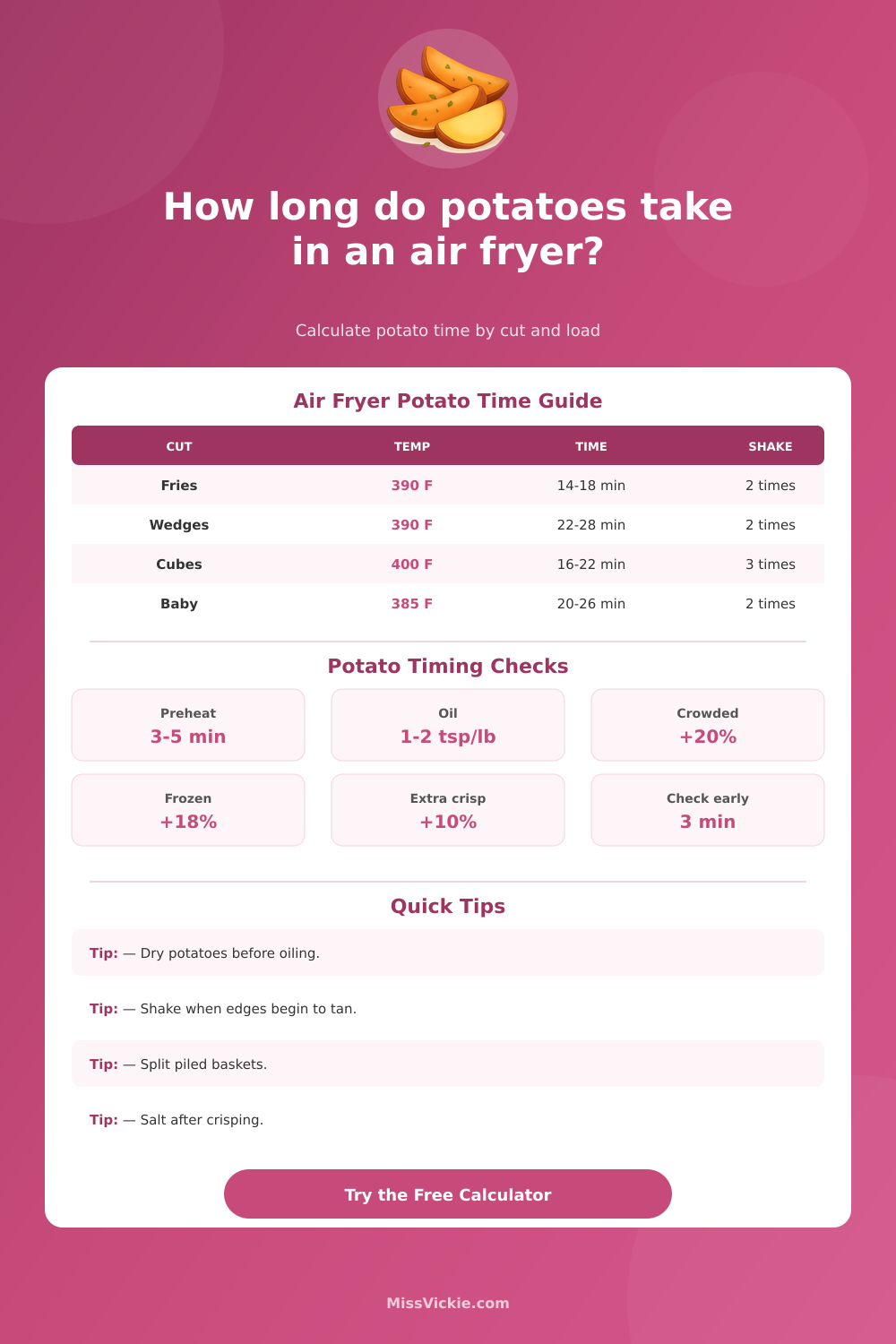
| Cut Style | Typical Thickness | Baseline Temp | Baseline Time | Best Shake Plan |
|---|---|---|---|---|
| Shoestring fries | 1/4 inch / 0.6 cm | 390°F / 199°C | 12 to 16 min | Every 4 to 5 min; small pieces brown fast. |
| Standard fries | 3/8 inch / 1 cm | 390°F / 199°C | 14 to 19 min | Every 5 to 6 min; spread fries after each shake. |
| Steak fries | 5/8 inch / 1.6 cm | 390°F / 199°C | 18 to 24 min | Shake twice, then check the center with a fork. |
| Wedges | 3/4 inch / 1.9 cm | 385°F / 196°C | 22 to 28 min | Turn cut sides toward airflow at halfway. |
| Cubes | 3/4 inch / 1.9 cm | 400°F / 204°C | 16 to 22 min | Shake every 5 min for crisp edges on all sides. |
| Whole baby potatoes | 1 to 1 1/4 inch / 2.5 to 3.2 cm | 385°F / 196°C | 20 to 28 min | Roll or shake twice; fork test the largest potato. |
| Potato Type | Best Uses | Timing Effect | Browning Note | Texture Cue |
|---|---|---|---|---|
| Russet | Fries, wedges, hash browns | Baseline | High starch crisps quickly when dry. | Fluffy center, crisp outside. |
| Yukon Gold | Cubes, wedges, sliced potatoes | Add about 3% | Waxy-creamy flesh browns a little slower. | Creamy center with browned edges. |
| Red potato | Halves, cubes, roasted potatoes | Add about 7% | Moist flesh needs airflow and a hot finish. | Tender skin and creamy middle. |
| Sweet potato | Fries, cubes, wedges | Add about 4% | Sugar browns early, so lower heat can help. | Soft center; crisp edges are more delicate. |
| Frozen prepared | Fries, tots, hash patties | Add about 12% | Surface ice slows early browning. | Hot center and dry crisp shell. |
| Basket Load | Airflow Condition | Time Adjustment | Shake Interval | When To Split |
|---|---|---|---|---|
| Single layer with gaps | Best airflow | No change | Once or every 6 min | No split needed. |
| Pieces touching | Good but crowded edges | Add 8% | Every 5 to 6 min | Split if pieces cannot move when shaken. |
| Full shallow basket | Some steaming | Add 18% | Every 4 to 5 min | Split for extra crisp fries. |
| Crowded pile | Weak airflow | Add 30% | Every 4 min | Split for wedges, cubes, or fresh fries. |
| Air fryer oven tray | Wide but slower recovery | Add 8% | Rotate tray once | Use two trays only if airflow remains open. |
| Oil And Start | Time Effect | Surface Effect | Best For | Calculator Note |
|---|---|---|---|---|
| No oil | Add 8% | Dryer, paler surface | Frozen prepared fries | May need a longer crisp finish. |
| 1 tsp per lb | Baseline | Balanced browning | Fresh fries, cubes, wedges | Enough oil to carry seasoning. |
| 2 tsp per lb | Subtract 3% | Faster browning | Thick wedges, roasted cubes | Use when potatoes are very dry. |
| Soaked and dried | Subtract 4% | Cleaner crisp on fries | Russet fries | Only helps if dried very well. |
| Parboiled first | Subtract 18% | Rough edges crisp fast | Wedges, cubes, baby potatoes | Watch the final browning window. |
🔥 Cut Style Comparison Grid
Best in a loose layer with frequent shaking and a dry surface.
Need enough time for the thickest point to turn fork-tender.
Shake often so each face gets contact with hot moving air.
Small whole potatoes finish by tenderness more than color.
💡 Potato Air Fryer Tips
When you remove basket from your air fryer, you expect golden crispness but find instead a pile of pale mush. Usually not a machine issue, right? It’s typically an issue of assuming that all fries is the same. It is also an issue of assuming that cooking time will tell you when they’re done. The air fryer calculator does the complicated maths for you, after you input how much is in the basket and what shape it’s been cut into. No more guessing about numbers and how air flow.
The first variable that catches folks off guard are the type of potato. Starchy potatoes (like a russet) has different behavior from waxy potatoes (like a red). Because of their high starch content, those potatoes will break down to form a fluffy interior, and their exteriors will quickly crisp as they dry out. On the other hand, a waxy potato won’t brown as easy, but it also won’t cook through as fast to create a similarly textured exterior. That is why the tool asks what type of potato you’re starting with. It takes that information and adjusts baseline to reflect how much water it holds. And if you’re cooking sweet potatoes, well…their naturaly sugar browns faster than starchy potatoes. This might mean lowering the heat a bit to prevent overcooking before the center soften. The calculator accounts for all that so you don’t wind up with burnt-on-the-edges-but-still-raw-in-the-middle.
Why Your Air Fryer Fries Fail and How to Fix It
A full basket is the silent killer of crispiness. Air fryers cook by quickly blasting hot air at your food. So when you put too much in there, that air can’t hit all surfaces equally. Potatoes ends up effectively steaming themselves instead of frying. All guides say use one layer, but who lives in a world where we get exactly the right portions of everything? You cook for a family, often you’re compromising how close things are together. That makes it less heat efficient and therefore the timer has to go way longer then. Here the tool compensates with more time for crowded piles so eventually something will heat through at the center. Or tells you to split them if it’s just too much (which is really the only way to get stuff browned evenly). If you don’t do this, well, you’ll have burned tops and soggy bottoms to contend with.
The role of oil here is subtler than many might think. Not too little, but also not too much. Too much will keep moisture from evaporating and potentially inhibit crispiness (as it forms a barrier). Just enough oil (light coating), to conduct heat and promote browning via the Maillard reaction. And the calculator tells difference between a heavy coat and a light mist, adjusting time based off this difference.
Dryness is equally important. Washing your raw potatoes cleans off any excess surface starch that would otherwise cause uneven cooking or sticking… But if you don’t fully dry them first, you’re adding water back into the equation. Water boils at a cooler temp than oil smokes. So wet potatoes spends additional time just steaming along before they reach the point where they’ll begin to get some color. Get ‘em totally dry, and you have crispy fries; leave ‘em wet, and you’ve got boiled potatoes.
Shaking the basket isn’t merely about even cooking. It’s also about resetting the contact points of airflow. If things touch one another too long they’ll steam up and touch. When they move it expose new surface area to the heat. How often? Thinner cut fries like shoestrings require more frequent shaking than thicker ones such as wedges. The tool gives you a shake plan according to how thin or thick you’ve cut your potatoes as well as how crispy you want them. It tells you when to intervene so the outside doesn’t burn while the inside finishes softening.
So what’s the take-away? Cooking potatoes in air fryer becomes a balance between heating and dehydrating. It’s all about getting moisture out of the potato without also burning the outside. And these variables don’t work in a straight line, a tiny adjustment in potato width means a huge adjustment to the cooktime. Once you understand this dynamic, guesswork becomes technique. Instead of fixed timer settings, you’re learning to read your food. Your eyes and nose tells you when they’re done, not the numbers from the calculator. Once you give yourself over to the process, not the clock, you realize there’s nothing accidental about perfect fries. Perfect fries happen because you have mastered amount of airflow and heat you apply to them.