Sweet Potato Cooking Time Calculator
Estimate sweet potato cooking time for whole, halved, cubed, or wedged potatoes in the oven, microwave, boiling water, or air fryer with size, start temperature, doneness, wrap, skin, and batch size adjustments.
🍠 Sweet Potato Presets
Choose a real kitchen setup, then adjust the size, cut, method, batch, and doneness before cooking.
⚖ Cooking Inputs
Your Sweet Potato Timing Plan
Estimate updates as you change the method, size, cut, and batch.
Timing Breakdown
Cooking Details
Cooking Guidance
- Use a thin knife or thermometer to confirm tenderness in the thickest piece.
📌 Fast Sweet Potato Size Guide
Good for microwave lunches and small sides.
The common baked sweet potato timing anchor.
Best for stuffed potatoes or hearty mains.
Even pieces cook predictably for mash or roasting.
🔥 Method Timing Reference
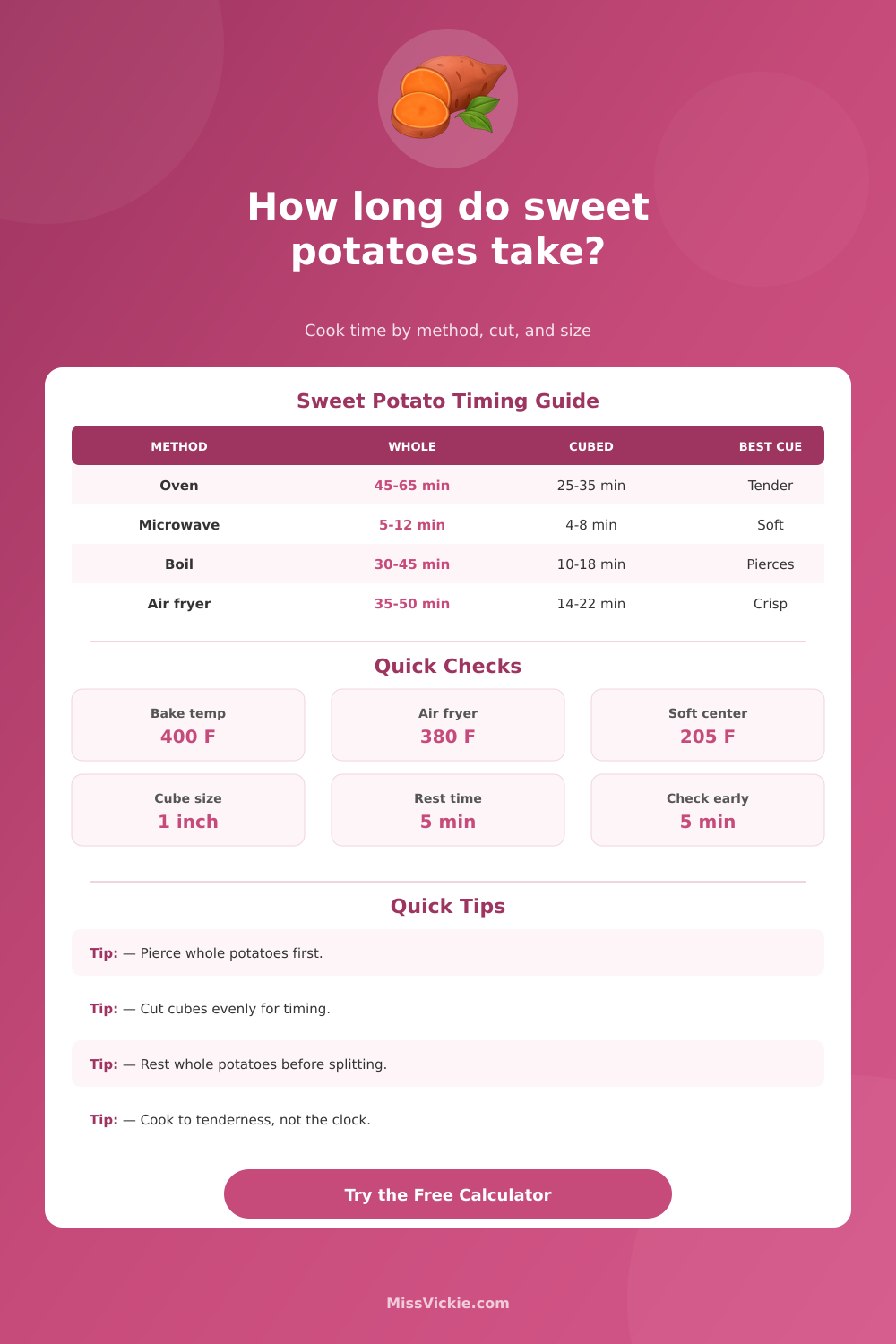
| Method | Best For | Typical Whole Time | Typical Cut Time | Key Adjustment |
|---|---|---|---|---|
| Oven bake or roast | Caramelized whole potatoes, cubes, wedges, meal prep trays | 45 to 65 minutes at 400 F | 22 to 40 minutes depending on thickness | Lower oven temperature and foil both add time. |
| Microwave | Fast single potatoes, soft lunch potatoes, quick steaming | 5 to 12 minutes plus rest | 4 to 8 minutes in a covered dish | More than two whole potatoes usually need rounds and rotation. |
| Boil or simmer | Mash, puree, salads, pies, baby food prep | 30 to 45 minutes for whole roots | 10 to 18 minutes for 1 inch cubes | Small cubes overcook quickly after they turn tender. |
| Air fryer | Crisp cubes, wedges, smaller whole potatoes, fast sides | 35 to 50 minutes at 380 F | 14 to 24 minutes for cubes or wedges | Crowding the basket can add 20% or more. |
The calculator estimates practical kitchen timing, then tells you when to begin checking. Actual doneness still depends on potato shape, appliance behavior, and tenderness.
🔪 Size And Cut Reference
| Prep Style | Measurement To Enter | Heat Path | Common Use | Timing Note |
|---|---|---|---|---|
| Whole, pierced | Average weight per potato | Heat travels to the center from all sides | Baked potatoes, stuffed potatoes, microwave sides | Large thick centers need the biggest buffer. |
| Halved lengthwise | Weight plus cut thickness | Cut face speeds heat transfer | Roasted halves, loaded halves, sheet-pan meals | Place cut-side down for caramelization. |
| Wedges or thick fries | Thickest wedge width | Edges brown before the core softens | Oven fries, air fryer wedges, BBQ sides | Shake or flip so the points do not scorch. |
| Cubes | Largest cube edge | Even small pieces cook from many sides | Mash, hash, curry, salad, roasted cubes | Uneven cubes make the timer less reliable. |
| Rounds or slices | Slice thickness | Short heat path with broad surface area | Gratins, snacks, roasting, air fryer coins | Thin slices can go from firm to soft fast. |
🌡 Doneness And Start Temperature Table
| Setting | Calculator Effect | Best Cue | Finish Range | Kitchen Use |
|---|---|---|---|---|
| Firm-tender | Shortens the estimate | Knife meets slight resistance | 185 F to 195 F center | Salads, dice, reheating later |
| Tender side dish | Uses the normal estimate | Fork pierces cleanly | 198 F to 205 F center | Everyday sides and bowls |
| Creamy baked center | Adds a modest buffer | Skin gives and center feels soft | 205 F to 212 F center | Whole baked potatoes |
| Very soft mash | Adds extra softening time | Pieces crush easily | 208 F to 214 F center | Mash, puree, pie filling |
| Cold start | Adds time before starch softens | Check the thickest piece | Depends on doneness target | Fridge-cold leftovers or washed roots |
🍲 Wrap, Skin, And Batch Reference
| Choice | What It Does | Best Method | Time Direction | Texture Result |
|---|---|---|---|---|
| Bare skin, pierced | Lets steam escape and surface dry | Oven or air fryer whole | Baseline | Dryer skin, sweeter edges |
| Foil wrapped | Holds moisture close to the skin | Oven whole potatoes | Usually adds time | Soft skin, less caramelized |
| Covered bowl or pot | Traps steam around pieces | Microwave or boiling | Can speed early heat | Moist, soft texture |
| Peeled pieces | Removes skin insulation | Boil, roast, mash prep | Slightly shorter | Softer edges, less structure |
| Crowded batch | Reduces airflow or water movement | Any large batch | Adds time | More steaming, less browning |
⚔ Method Comparison Grid
Slow, steady heat gives caramelized edges and a fluffy whole-potato center.
Great for one or two potatoes, but needs resting time and rotation for even cooking.
Reliable for cubes and puree prep because water transfers heat quickly and evenly.
Excellent for cubes and wedges when the basket is not packed too tightly.
💡 Sweet Potato Timing Tips
If you’ve baked a sweet potato that looks perfect on the outside but is still rock-hard in the middle, this has probabley happened to you before. And if it has, then so has every experienced cook who bake sweet potatoes. Usually, it has nothing to do with your instincts about cooking time or even oven temperature. It has everything to do with misreading starch. Sweet potatoes is dense. They hold their own moisture and don’t heat up quite like thin-skinned Russet spuds. A little finesse, and some extra time, will help soften the interior while keeping the rest of potato moist.
Now that we’ve entered the details of your unique variables into the calculator above, the work stops here (that’s what computers is for). No need to guess at imprecise recipes anymore. Root veggies aren’t interchangeable, although most home cooks assume they are. A big Japanese yam doesn’t behave like a smallish purple-skinned one, or even an average-size orange-fleshed sweet potato. By requesting information about cut type and weight, the calculator take those small details into account.
How to Cook Sweet Potatoes Perfectly
If you are roasting whole tubers, the heat has to travel from the skin to the core. That matters much more then other factors when deciding how long to cook them. Pierce them first so steam can vent during cooking. Otherwise things could get unevenly soft, or burst under pressure.
But once the potatoes is sliced, it’s game on. Slicing them up creates much more surface area. This means they’ll absorbs heat far more quickly. Roast them at half the time of an uncut whole potato. But be careful. These guys won’t take long to get from tender to mushy! Watch carefully and know that you shouldn’t cut them unevenly, otherwise, some pieces will burn while others stays raw. Precision in timing isn’t as important than consistency in cutting.
We tend to think microwaves are all about shortcuts, but they don’t need to be bad for food. When used right, a microwave’s best feature is its ability to heat up water molecules within the potato. This generates steam within the potato. That’s how it ends up cooking from inside-out. But there’s one feature it doesn’t have: It can’t brown anything like an oven or air fryer could. For something like a speedy lunchtime spud, stick with microwave by itself. Or use it to soften the middle, then put it in a hot pan or an air fryer to make the outside crunchy. Think of this as a halfway house between good flavor and speedy, no need to wait 45 mins while a cold potato heats through.
More so than most people think, it’s about starting temperature. If you pull those potatoes out of fridge, they’re going to begin at roughly thirty-eight degrees Fahrenheit. You’ll need to bridge a far greater temperature difference to bring them up to a tender two hundred five degrees. Starting them off cold will add a large amount of time to your cooking process. Not simply because “you added more minutes on the timer,” but because that initial coldness impedes ability of starch granules to gelatinize correctly. A rushed effort here leads to gritty instead of creamy.
Other things like crowding and batch size destroys timing. When a pan or basket gets too full in an oven or even an air fryer, it holds onto some of the steam. And moisture inhibits browning. Want crispy edges? Make friends with space. Hot air can flow all around each item when they is in a single layer. Otherwise, crowded pans essentially boil the food in its own juices. It’s a true physical limit (airflow resistance), which is why the tool accounts for it as a load factor.
The last thing many people do, however, is rest. Baked potatoes are best left to sit for a few minutes when taken out of the heat. Leftover heat will distribute itself and continue to cook potato gently on the inside so that, even if the center was cooked enough, it won’t feel underdone. Better texture comes with patience instead of overcooking out of panic.
When it comes to cooking sweet potatoes, there’s no set schedule. Rather, just knowing how heat will be absorbed is key. If roasting as a side, keep an eye out for when they’re tender; same goes if mashing after boiling. A knife is your best friend; not necessarily the stopwatch. You should of used the calculator earlier.