Corn On The Cob Cooking Time Calculator
Estimate corn on the cob timing for fresh, chilled, or frozen ears by cooking method, ear count, ear size, water or steam style, grill or air fryer heat, sweetness, altitude, and holding plan.
🌽 Corn cooking presets
Pick a real corn scenario, then adjust the ears, method, heat, altitude, and holding plan for your kitchen or cookout.
⚖ Corn timing inputs
Corn timing result
Enter your corn setup to calculate the cooking window.
Timing breakdown
Cooking plan
Step cues
📏 Ear size and yield guide
🍝 Method timing reference table
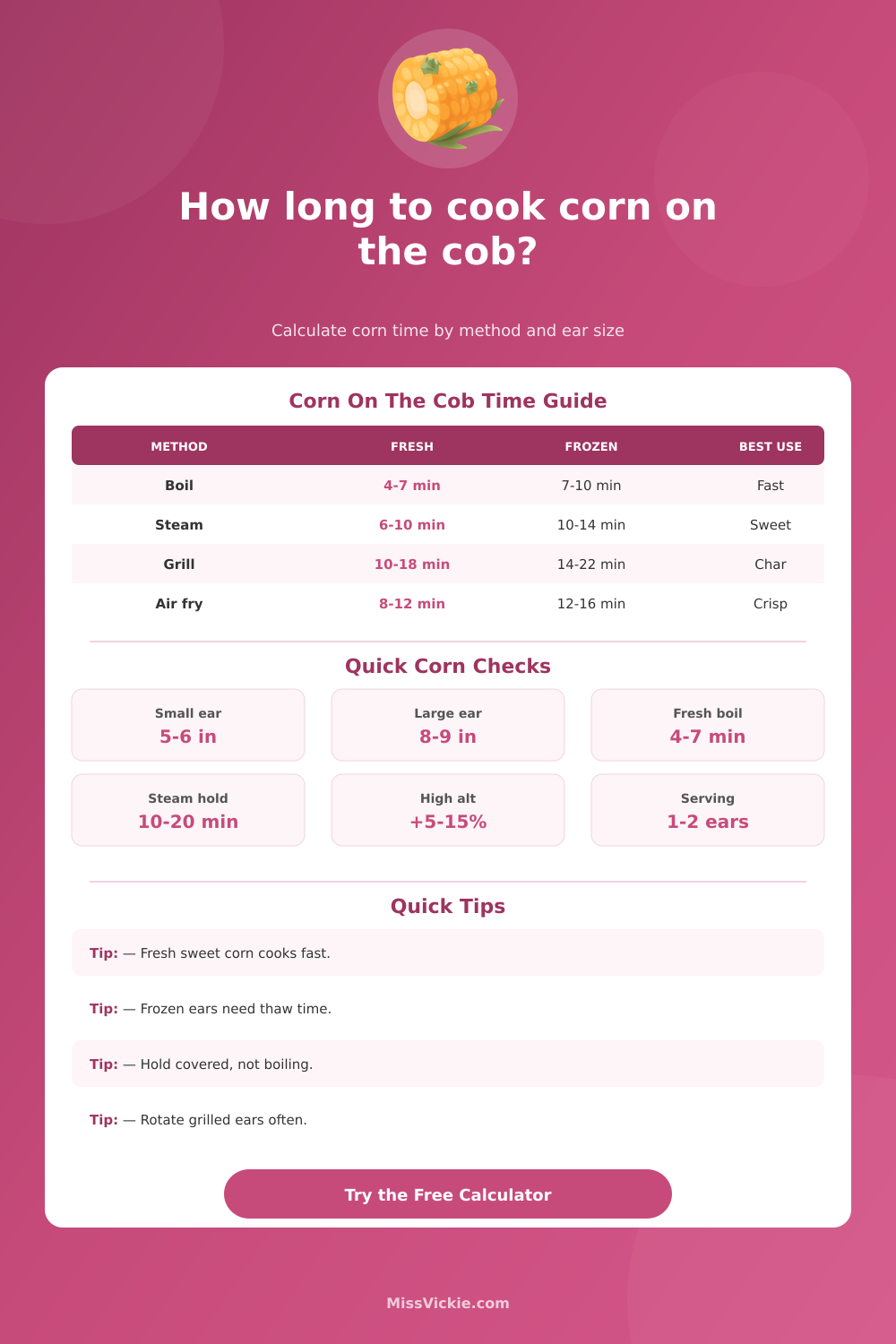
| Method | Fresh Standard Ear | Frozen Whole Ear | Best Texture | Kitchen Note |
|---|---|---|---|---|
| Boiling water | 4 to 7 minutes | 7 to 10 minutes | Tender and juicy | Start timing after water returns to a boil. |
| Steamer basket | 6 to 10 minutes | 10 to 14 minutes | Sweet, less diluted | Keep a tight lid so steam stays strong. |
| Grill in husk or foil | 12 to 18 minutes | 16 to 22 minutes | Moist with light smoke | Rotate every 4 to 5 minutes. |
| Grill shucked | 8 to 12 minutes | 12 to 16 minutes | Charred and crisp | Brush lightly with oil and rotate often. |
| Air fryer | 8 to 12 minutes | 12 to 16 minutes | Roasty edges | Use a single layer and shake or rotate once. |
| Microwave covered | 3 to 6 minutes | 6 to 9 minutes | Quick small batch | Rest covered for 2 minutes before unwrapping. |
📊 Ear size, kernels, and servings table
| Ear Size | Typical Length | Cook Time Effect | Kernel Yield | Serving Planning |
|---|---|---|---|---|
| Mini or half-ear | 3 to 4.5 in / 8 to 11 cm | Subtract 15 to 25% | 1/4 to 1/3 cup | 2 halves per adult side serving. |
| Small ear | 5 to 6 in / 13 to 15 cm | Subtract 5 to 10% | 1/3 to 1/2 cup | Good for kids or mixed side dishes. |
| Standard ear | 7 to 8 in / 18 to 20 cm | Baseline | 1/2 to 3/4 cup | Plan 1 ear per side serving. |
| Large ear | 8 to 9 in / 20 to 23 cm | Add 8 to 16% | 3/4 to 1 cup | Plan 1 to 1 1/2 ears for hearty eaters. |
| Very plump ear | Over 2 in / 5 cm diameter | Add 10 to 20% | About 1 cup | Check center kernels before holding. |
⛰ Altitude and water behavior table
| Altitude | Approx. Boil Point | Boil or Steam Effect | Time Adjustment | Best Practice |
|---|---|---|---|---|
| 0 to 2,000 ft / 0 to 610 m | 212 to 208°F / 100 to 98°C | Baseline water heat | No change | Boil, steam, grill, or air fry normally. |
| 2,000 to 4,000 ft / 610 to 1,220 m | 208 to 204°F / 98 to 96°C | Water cooks slightly cooler | Add 2 to 5% | Keep the lid on for steaming. |
| 4,000 to 6,000 ft / 1,220 to 1,830 m | 204 to 201°F / 96 to 94°C | Steam and boil slow down | Add 5 to 9% | Use a rolling boil or strong steam. |
| 6,000 to 10,000 ft / 1,830 to 3,050 m | 201 to 194°F / 94 to 90°C | Water methods need patience | Add 9 to 16% | Favor covered steam or grill for large batches. |
🍲 Holding and batch planning table
| Holding Method | Useful Window | Texture Effect | Calculator Adjustment | Best Use |
|---|---|---|---|---|
| Serve immediately | 0 to 5 minutes | Bright, crisp, hottest | No pullback | Small dinners and air fryer batches. |
| Covered pot | 10 to 20 minutes | Softens gently | Pull 2 to 5% early | Boiled or steamed ears for family meals. |
| Butter bath | 15 to 30 minutes | Moist and seasoned | Pull 4 to 8% early | Picnic service and potluck trays. |
| Towel-lined cooler | 30 to 60 minutes | Very soft if overcooked first | Pull 8 to 12% early | Large BBQs where timing is staggered. |
| Cook ahead and reheat | Same day | Needs gentle reheating | Short active cook first | Meal prep, parties, and limited stove space. |
🧪 Corn method comparison grid
Best for several fresh ears when the pot is large enough for quick boil recovery.
Kernels stay above the water, so delicate sweet corn keeps more flavor.
Use husk or foil for moisture, or shucked ears for faster browning.
Works best with two to four ears in a single layer and one rotation.
💡 Corn cooking tips
Corn sweetness, harvest age, ear thickness, and appliance airflow vary. Use the first-check time, then adjust by tenderness and the way the kernels release steam.
It is the panicking kind. The kind where you’re realizing your guests will be here in twenty minutes and your corn isn’t even cooked yet. You plop it into some boiling water, and let the bubbles rage. You wait for the moment when those kernels go from pale white to bright yellow. The thing is, no one ever explains to you what that moment look like, until it’s too late, and it’s already overcooked.
How hard can perfecting corn-on-the-cob be? Pretty hard, as it turns out. There’s more to it than heat, it’s all about biology and timing, too. And the window between mushy and crisp-tender is smaller then most people expect.
How to Cook Perfect Corn
You can plug all this into the calculator up top, which do the math for you. No guesswork as to whether your ears are small or large enough to need extra time. You’re a more knowledgeable home cook if you understand what goes where in there, even if you aren’t looking at computer screen.
Corn is fresh, full of sugars that haven’t converted to starch; hence it’s so fast to cook. Sweet corn bought first thing in the morning, cooked by noontime, means it’s as sugary as it’ll ever get. In fact, you only want a brief cooking period. Boiled corn should generally take between four and seven minutes. The longer it waits to cook after being picked, the more the sugars will turns to starch, altering everything about its texture. This is why the calculator wants to know maturity and sweetness level. An ear picked early in the day will require less heat penetration than an old, late-season ear that has spent some time in a truck bed.
One common error: People assume they can only boil their corn. Boiling, however, will make it mushy. It’s best steamed; less of that precious sweet flavor are lost when the kernels aren’t sitting in water. Soaking those kernels in hot water also causes some of the flavor to be taken from corn and put into the water. Steaming it traps all of that deliciousness within the kernels themselves. By accounting for that, the tool adjusts its starting point based off your selected cooking technique.
Grilling presents another trade-off entirely. While the exterior gets that nice charring and firmness, there’s a danger that the inside will dry out before it even starts to brown. To avoid burnt-on-corn disasters, brush your shucked-on-the-grill ears with oil, and then constantly turn them as they cook, since they will stick if left in one place too long. How much time should you allow for turning? That’s what the calculator allows you to calculate.
Another thing that confuses home cooks who go from sea level to mountainous heights: altitude affects boiling points. Because atmospheric pressure decreases, water also boils at a lower temperature. So what appears to be a rolling boil isn’t necessarily so hot. At altitudes over four thousand feet, for instance, your boiling water may never get past two hundred and zero degrees Fahrenheit, rather than the normal two hundred and twelve. That’s a significant difference, one that slows heat transfer considerably.
Here you need to either use a method that captures heat better (like a steamed dish under cover) or simply give it more time. The page spells it all out in the reference table, which tells you precisely how many additional minutes to cook things based on your altitude. It is a minor adjustment, but it makes all the difference between firm kernels and those that feel chalky in the middle.
The most overlooked variable may be holding time. Unless you’re a caterer with an army of sous chefs, no one will expect to eat all at once. When you leave corn in boiling water, it’s still cooking. It also quickly becomes limp. Here is the solution. Pull it a little underdone and hold it (covered) off the heat. Then let the remaining heat do the rest, without cooking kernels into mush. Even better, hold them in a warm bath of butter. This adds more flavor without destroying the texture. The calculator uses this holding plan in its final recommendation: How long should you start removing ears if you have a large batch to handle? How does one think about the logistics of serving, beyond the chemistry of cooking?
But ultimately, corn is an exercise in respect: Respect the ingredient by not overdoing it. When you bite into the kernels, there should be just a little resistance left, plump, yes, but also hot, really hot. That bright flavor you shelled out good money for will be ruined if it’s cooked past done. Set your benchmark with the timer, then rely on your sense of taste for the last call. With a few quick pokes from the fork, you shouldn’t have any trouble sliding it in. There should be plenty of clear juice.
If you’re still unsure after following the timeline, keep in mind that it’s better to take it out a moment too soon rather than a moment too late. An extra minute or two wouldn’t of hurt, but you can’t un-cook mushy corn. Do the math, then let your taste buds do the talking.
Let the season speak for itself.