Egg Steaming Time Calculator
Estimate egg steaming time from egg size, rack load, starting temperature, steam intensity, altitude, target doneness, ice bath plan, pot type, and lid fit.
🍲 Egg Steaming Presets
Choose a common steaming setup, then adjust the egg size, batch size, steam strength, altitude, and chilling method for your kitchen.
⚖ Egg and Steamer Details
Your Egg Steaming Plan
Steam timing will appear here after calculation.
Timing Adjustments
Batch Notes
⏱ Quick Timing Markers
🥚 Baseline Steaming Times
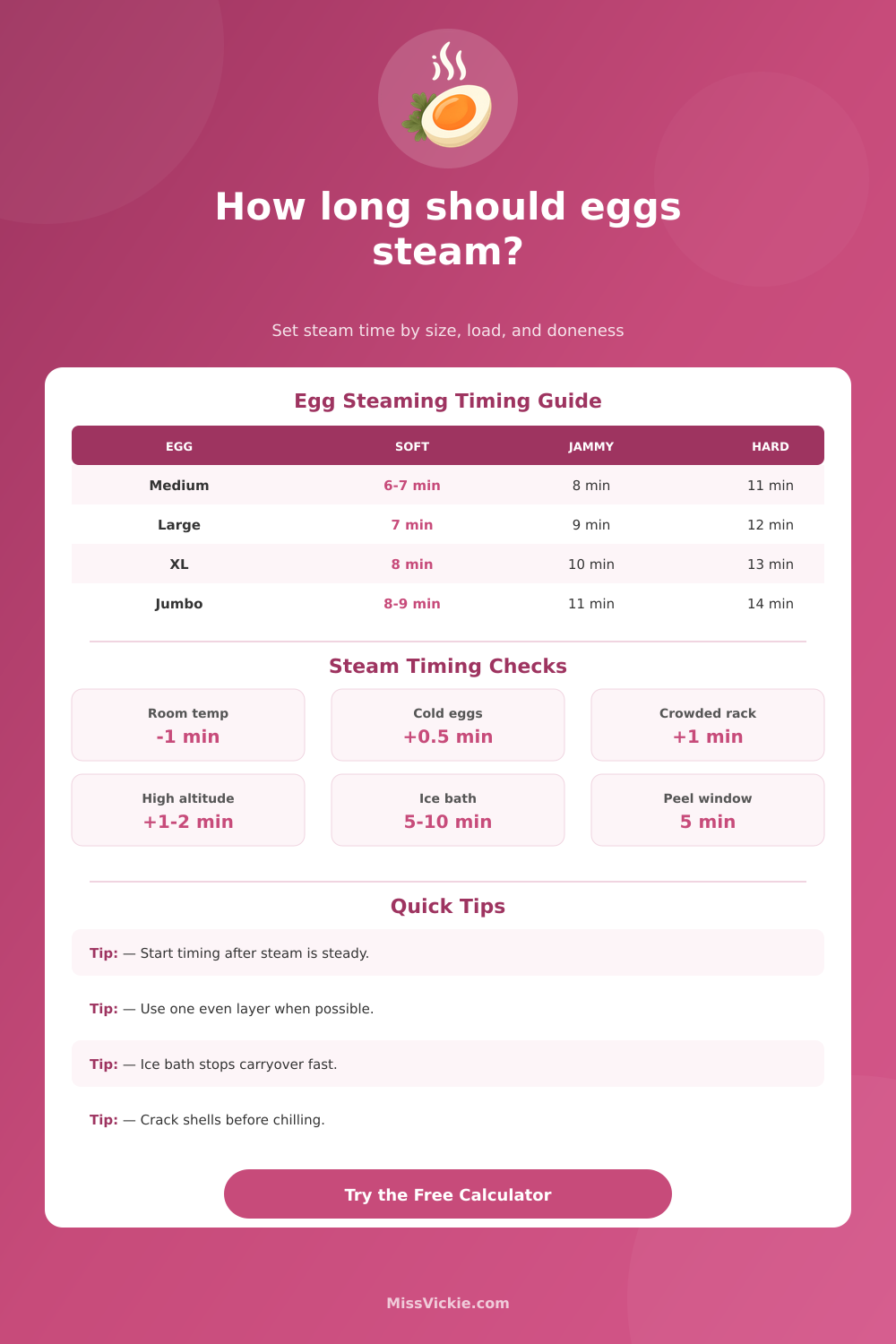
| Egg Size | Soft Yolk | Jammy Yolk | Creamy Firm | Hard-Cooked | Best Use |
|---|---|---|---|---|---|
| Small | 5.5 to 6.5 min | 7 to 8 min | 8.5 to 9.5 min | 10 to 11 min | Snacks, toast, lunch boxes |
| Medium | 6 to 7 min | 7.5 to 8.5 min | 9 to 10 min | 10.5 to 11.5 min | Breakfast plates and salads |
| Large | 6.5 to 7.5 min | 8 to 9.5 min | 10 to 11 min | 11.5 to 12.5 min | Most home recipes |
| Extra-large | 7.5 to 8.5 min | 9 to 10.5 min | 10.5 to 12 min | 12.5 to 13.5 min | Meal prep and slicing |
| Jumbo | 8 to 9 min | 10 to 11.5 min | 12 to 13 min | 13.5 to 14.5 min | Deviled eggs and egg salad |
| Duck | 9 to 10.5 min | 11 to 12.5 min | 13 to 14.5 min | 15 to 16.5 min | Rich yolk recipes |
Baseline assumes refrigerator-cold eggs, one full rack, a tight lid, steady steam, sea level, and an immediate ice bath.
📊 Timing Adjustment Table
| Factor | Lower Time | Add Time | Why It Changes | Kitchen Check |
|---|---|---|---|---|
| Room-temperature eggs | 0.5 to 1 min | None | The center starts warmer. | Use eggs held briefly at room temperature. |
| Very cold eggs | None | 0.5 to 1 min | The center must climb farther. | Watch for shell cracking in hard steam. |
| Crowded rack | None | 0.5 to 1.5 min | Steam circulation slows between eggs. | Rotate tiers only if your setup allows it safely. |
| Gentle or intermittent steam | None | 0.8 to 2 min | The shell sees a lower effective heat. | Keep water simmering below the rack. |
| High altitude | None | 0.5 to 3 min | Steam temperature drops as altitude rises. | Use the same pot each time for consistency. |
| No ice bath | 0.5 to 1 min | None | Carryover continues after steaming. | Serve quickly for soft or jammy yolks. |
🧊 Ice Bath and Peeling Guide
| Cooling Method | Recommended Time | Texture Effect | Peeling Effect | Best For |
|---|---|---|---|---|
| No bath | 0 to 2 min rest | More carryover, softer shell handling | Harder to peel cleanly | Warm soft eggs served immediately |
| Cool water | 3 to 5 min | Slows carryover gently | Moderate peel release | Warm hard eggs for quick lunch |
| Ice bath | 5 to 8 min | Stops yolk at target texture | Best everyday peeling | Jammy, hard, and meal prep eggs |
| Long ice bath | 10 to 15 min | Fully chilled center | Best for batch peeling later | Deviled eggs, salads, storage |
🍳 Preset Reference Table
| Preset | Eggs | Target | Setup | Typical Result |
|---|---|---|---|---|
| Soft breakfast eggs | 4 large | Soft | Loose rack, steady steam | Set white with spoonable yolk |
| Jammy ramen eggs | 6 large | Jammy | Full rack, ice bath | Custardy orange center |
| Dozen hard eggs | 12 large | Hard | Full rack, tight lid | Sliceable yolk without gray ring |
| Jumbo deviled eggs | 12 jumbo | Firm | Crowded rack, long chill | Firm yolk for filling |
| High-altitude dozen | 12 XL | Hard | Steady steam, tight lid | Extra time offsets cooler steam |
⇄ Egg Cooking Method Comparison
Steam shocks shells evenly and usually releases membranes better than a cold-water boil.
Boiling is simple, but water volume, pot recovery, and rolling bubbles can vary more.
Pressure methods can handle big batches, but timing changes sharply by appliance model.
Oven eggs suit sheet pans, though shells may spot and timing is less precise for jammy yolks.
💡 Steaming Tips
Eggs are an ingredient, not just something you toss into a pan: think of them as something to be thermally engineered. If you know how heat transfer, you can cook yolks so they hold up but don’t get chalky. The trick is steaming instead of boiling, which mean there is no contact with boiling water. This minimizes cracks and yields more even texture all the way around. A small difference in process make for a more reliable result.
Once you choose your variables, the calculator does math for you (above). When you don’t use the tool, understanding why each input matter makes you a better cook. The biggest factor is egg size. Mass determines how long it will take heat to penetrate to center. If you have more volume (i.e., jumbo vs. Small), it’s going to take longer for the heat to travel to middle and set the proteins.
The Science of Cooking Perfect Eggs
Where the eggs are sourced also come into play. Eggs taken straight from fridge require more time than room-temperature ones. And that difference increase if you’re pulling them straight from a freezer-cold shelf. On the one hand, starting with cold eggs protects the yolk from prematurely setting as it warms; on the other, it means waiting patienty at the beginning of steaming.
Another factor that wreaks havoc if neglected is load density. You can’t pile eggs sky-high or cram them to tightly on any given shelf and expect the steam to properly circulate around each eggshell. When the shells is bunched up together, they create insulation pockets, which the calculator handles by adding time to those crowded loads.
Similarly, altitude does its work… But in the opposite way. Because it’s thinner air at higher altitudes, water boils and steam condenses at a temperature below two hundred twelve degrees Fahrenheit. This means additional minutes will be needed to reach the same degree of protein denaturation as if you were at sea level. It’s not your stove that’s weak; its the atmosphere fighting back.
Doneness targets are subjective, but there is chemical reactions taking place in those egg proteins. Albumin thickens at a slightly different temp than the yolk, so it’s critical to hit that runny-white sweet spot. Go a half-minute beyond that margin and what was a silken white transform into something like a latex glove. If your hard-cooked eggs will be eaten in salad form, you’ll want the yolks completely cooked but not with that chalky-green halo caused by overcooking reaction between the egg’s sulfur and iron. Those benchmarks are graphed out neatly in chart on the opposite page.
This chart plots small changes in cooking times against specific levels of doneness, so you can choose whether a custard-like dip or sliceable solidity best suits your purpose.
An ice bath is mandatory to get control. Once your eggs is off the heat, they will continue to cook, cooking until their centers cool. Plunging them immediately into cold water halts this and locks in texture you achieved at the final second of steaming. (It’ll even contract just slightly, inside the shell, aiding easy peeling.) If you don’t do that, the membrane adheres itself to the inner surface of the shell and what’s supposed to be a quick job becomes an exercise in frustration. You should of used it.
At first, steaming may feel slower than dumping the eggs in some boiling water. But there is a precision that comes from steaming which you don’t get as much with boiling: no variable water level (which throws off timing) and no violent tumbling of the eggs around in pan (which cracks the shell). Controlling the tightness of the lid and the intensity of the steam creates an even heating environment for a steady cooking experience. This visualization tool allows you to understand the tradeoffs, seeing if gentle steam requires more minutes on the clock, or whether a loose-fitting lid adds time.
There’s nothing guess-y about perfect eggs. They’re about careful control of time, mass and heat.