Egg Boiling Time Calculator
Dial in soft, jammy, medium, hard, or extra-firm eggs by adjusting egg size, starting temperature, water volume, altitude, batch size, shell age, and ice-bath timing.
🥚 Boiling Presets
Choose a real kitchen scenario, then fine-tune the inputs. Each preset changes doneness, batch size, starting temperature, water amount, altitude, and cooling style.
⚖ Egg Boiling Inputs
Your Egg Timer Plan
The timer combines doneness, size, start temperature, water mass, altitude, pot crowding, method, and carryover cooling.
Timing Breakdown
Step Schedule
📌 Quick Egg Boiling Numbers
📋 Reference Tables
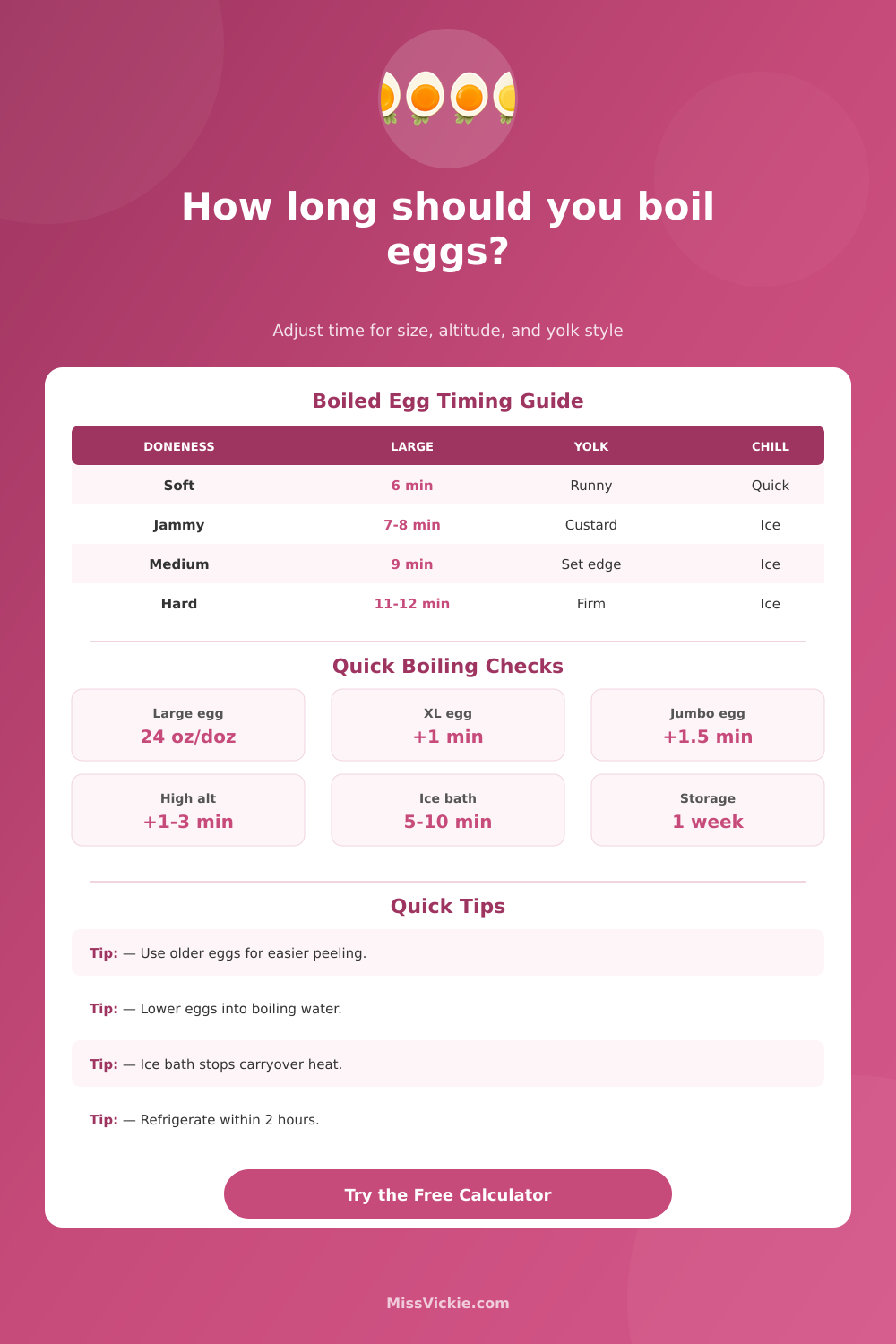
| Doneness Target | Hot-Start Time, Large Egg | Yolk Texture | Best Uses |
|---|---|---|---|
| Soft-boiled | 5.5 to 6.5 minutes | Liquid center, just-set white | Toast soldiers, breakfast bowls, immediate serving |
| Jammy | 7 to 8 minutes | Thick, glossy yolk with custardy center | Ramen, grain bowls, marinated eggs |
| Medium | 8.5 to 9.5 minutes | Mostly set yolk with a softer middle | Salads, lunch plates, snack boxes |
| Hard-cooked | 10.5 to 12 minutes | Firm yolk, still moist if chilled fast | Deviled eggs, egg salad, chopped toppings |
| Extra-firm | 12 to 13.5 minutes | Fully firm yolk for clean slicing | Picnic trays, garnish slices, make-ahead platters |
| U.S. Egg Size | Minimum Dozen Weight | Approx. Each | Timing Adjustment |
|---|---|---|---|
| Medium | 21 oz / 595 g per dozen | 1.75 oz / 50 g | Subtract about 30 to 45 seconds |
| Large | 24 oz / 680 g per dozen | 2 oz / 57 g | Use the baseline time |
| Extra-large | 27 oz / 765 g per dozen | 2.25 oz / 64 g | Add about 45 to 75 seconds |
| Jumbo | 30 oz / 850 g per dozen | 2.5 oz / 71 g | Add about 1 to 1.5 minutes |
| Altitude | Approx. Water Boiling Point | Egg Timing Effect | Practical Adjustment |
|---|---|---|---|
| Sea level | 212 F / 100 C | Baseline boiling heat | No altitude change |
| 2,000 ft / 610 m | About 208 F / 98 C | Slightly slower yolk heating | Add about 30 to 60 seconds |
| 5,000 ft / 1,524 m | About 203 F / 95 C | Noticeably cooler boil | Add about 1.5 to 2.5 minutes |
| 7,500 ft / 2,286 m | About 198 F / 92 C | Hard eggs need patience | Add about 2.5 to 4 minutes |
| Food Safety Point | Reference Number | Why It Matters | Kitchen Action |
|---|---|---|---|
| Firm-yolk safety target | 160 F for 2 minutes or 165 F final | Soft yolks may not reach the same kill step | Use hard-cooked eggs for high-risk diners |
| Room-temperature limit | 2 hours, or 1 hour above 90 F | Warm cooked eggs enter the danger zone | Serve promptly or refrigerate |
| Hard-cooked storage | Use within 1 week | Cooked shells are more perishable than raw eggs | Chill, label, and keep refrigerated |
| Ice-bath cooling | 5 to 10 minutes | Stops carryover and keeps yolks bright | Move eggs straight from pot to ice water |
Timing varies by stove, pan, egg shape, and true water temperature. For the most exact repeatable result, test one egg from the same carton before boiling a party batch.
🔍 Method Comparison Grid
Boil water first, lower eggs in, then time from entry. Best for soft and jammy yolks.
Eggs heat with the water. Good for hard-cooked eggs, but heat-up time varies by pot.
Steam rebounds quickly after adding eggs and often gives tidy peeling with an ice bath.
Large batches cool the water and crack more easily. Use more water or split batches.
💡 Egg Boiling Tips
To prevent a green halo on hard-boiled yolks, you just need to consider certain physical variables. Factors like physics of your specific stove, size of your eggs, and altitude in your home is what throw off most basic timers. The egg calculator takes these things into account so you don’t have to guess. You won’t have to deal with a chalky texture or metallic taste from overcooking. This happens when you follow standard cooking times that don’t work in your own kitchen.
Another important variable is the initial egg temperature. Cold eggs in refrigerator will take longer than room-temperature eggs because they has more energy stored in them as mass that needs to be heated. You’ll also cool down your water when you plop those fridge-cold eggs into boiling water. The more eggs you add, or if you use a smaller pot, the more the water cools and it takes longer to reboil. Because we aren’t heating just the eggs but the whole system, we have to factor in the inertia of thermal dynamics based off our timer.
Variables That Change Egg Cooking Time
Water also boils differently with elevation: Higher altitudes has lower boiling temperatures. For example, at an elevation of five thousand feet, water reaches its boiling point around two hundred three degrees, not two hundred twelve, which alters the rate of heat transfer and how proteins clumps. To compensate for this, the timer is extended by calculator so that the yolk can set correctly even though the water isn’t as hot as it would of be if the egg were boiled on level ground. The risk of having undercooked yolks (a common occurrence when altitude isn’t factored into timing) are thus avoided.
How easy they are to peel is related to their age. Eggs that are very fresh (the inner membrane adheres closely to the shell) can be difficult to peel. The older the egg, the easier it is. As time passes, the pores allow carbon dioxide to escape from within the egg, raising its pH and causing the membrane to separate from the shell. One-week-old or slightly older eggs is typically easier to peel. This age factor gives you a realistic expectation for how well the shell will separate from egg white. Very fresh eggs are not typicaly easy to peel. You can chill them first in an ice water bath, but you may end up leaving some of the white stuck to the shell.
This would mean that when you’re ready for soft boiled, you need an ice bath. When you take your egg out of boiling water, there’s still a lot of carryover heat that will continue to cook the yolk. If you leave eggs on the counter to cool down they’ll get harder and harder over time. The ice water cools off their centers and puts a stop to that almost instantly. It also shuts down any further reaction between iron and sulfur compounds, preventing the green ring. Letting the eggs chill in cold water for at least five minutes will bring center of the egg down to a safe temperature.
Food safety recommendations change depending on who will eat those eggs. To immediately kill any present salmonella bacteria, an egg’s interior needs to gets up to a certain temperature. Pregnant people, older adults, and young children should only eats fully hard cooked eggs; they shouldn’t consume eggs with softer, more runny yolks. With this tool, you can think about that risk of exposing someone to salmonella, but still choose how you like your yolk.
Egg boiling is not an intuitive skill; it’s a matter of controlling variables to make the process predictable. Altitude, starting temperature, and how you cool them all matter. When you account for these, the process becomes repeatable. Guesswork goes out the window, and you’ll be able to consistently boil your eggs exactly as desired, no more luxurios green ring.