Rice Per Person for Gumbo Calculator
Calculate dry rice, cooked rice, and gumbo bowl portions for seafood gumbo, chicken and sausage gumbo, thick roux batches, buffet service, leftovers, rice style, and hot holding time.
🍚 Gumbo rice presets
Choose the gumbo situation that looks closest, then adjust guest count, rice style, gumbo thickness, serving role, bowl size, leftovers, and hot holding.
📝 Gumbo rice inputs
Your gumbo rice plan
Rice totals will appear here after calculation.
Portion math
Yield math
Cooking notes for this batch
- Keep rice and gumbo separate until serving so the rice does not soak up the roux.
📌 Fast gumbo rice rules
🥣 Serving size table
| Gumbo serving situation | Cooked rice per person | Dry rice per person | Best use |
|---|---|---|---|
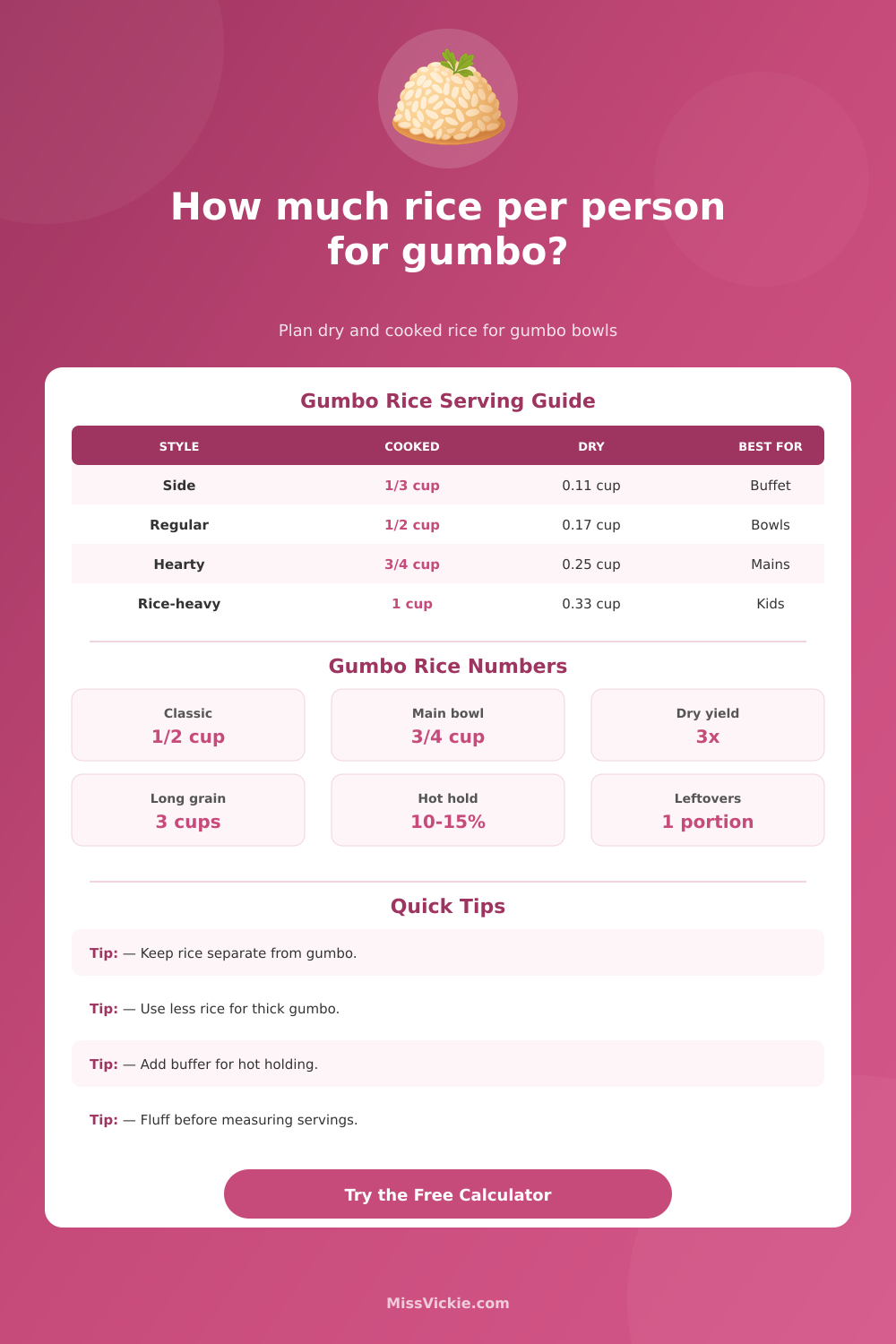
| Tasting cups or appetizer gumbo | 1/4 to 1/3 cup | 1 1/2 to 2 tablespoons | Small cups, sample bowls, or buffet starters. |
| Side serving with many dishes | 1/3 cup | About 0.11 cup dry | Potlucks, holiday spreads, and gumbo served beside other mains. |
| Classic gumbo bowl | 1/2 cup | About 0.17 cup dry | A standard bowl where gumbo is the main dish but not rice-heavy. |
| Hearty main meal bowl | 2/3 to 3/4 cup | About 1/4 cup dry | Dinner bowls for hungry guests or thinner gumbo. |
| Rice-heavy family bowl | 3/4 to 1 cup | 1/4 to 1/3 cup dry | Kids, mild gumbo, or families who like a thicker rice base. |
| Meal prep container | 1/2 to 3/4 cup | 0.17 to 0.25 cup dry | Separate containers that will be chilled and reheated. |
🌾 Rice yield and water reference
| Rice style | Cooked yield from 1 cup dry | Dry cup weight | Water starting point | Gumbo note |
|---|---|---|---|---|
| Long-grain white rice | About 3 cups cooked | 185 g / 6.5 oz | 1 1/2 cups water | Classic fluffy choice for most gumbo bowls. |
| Jasmine rice | About 2.9 cups cooked | 180 g / 6.3 oz | 1 1/4 to 1 1/2 cups water | Aromatic and soft; avoid overholding. |
| Parboiled or converted rice | About 3.2 cups cooked | 190 g / 6.7 oz | 2 cups water | Excellent for buffets because grains stay separate. |
| Basmati rice | About 3.1 cups cooked | 180 g / 6.3 oz | 1 1/2 cups water | Light grains; good when gumbo is rich and dark. |
| Medium-grain white rice | About 2.7 cups cooked | 190 g / 6.7 oz | 1 1/3 to 1 1/2 cups water | Softer and stickier, so portion slightly lighter. |
| Long-grain brown rice | About 3 cups cooked | 195 g / 6.9 oz | 2 to 2 1/4 cups water | Nutty, sturdy, and best cooked well ahead. |
| Instant rice | About 2 cups cooked | 95 g / 3.4 oz | Equal water by volume | Fast backup, but it can turn soft under gumbo. |
Rice brands, age, rinsing, pot shape, and lid fit change water needs. The calculator estimates planning quantities, then rounds dry rice to practical kitchen measures.
🍲 Common group quantities
| Group size | Classic bowls | Main meal bowls | Buffet side cups | Rice-heavy bowls |
|---|---|---|---|---|
| 4 people | 2 cups cooked / 2/3 cup dry | 3 cups cooked / 1 cup dry | 1 1/3 cups cooked / 1/2 cup dry | 4 cups cooked / 1 1/3 cups dry |
| 8 people | 4 cups cooked / 1 1/3 cups dry | 6 cups cooked / 2 cups dry | 2 2/3 cups cooked / 1 cup dry | 8 cups cooked / 2 2/3 cups dry |
| 12 people | 6 cups cooked / 2 cups dry | 9 cups cooked / 3 cups dry | 4 cups cooked / 1 1/3 cups dry | 12 cups cooked / 4 cups dry |
| 25 people | 12 1/2 cups cooked / 4 1/4 cups dry | 18 3/4 cups cooked / 6 1/4 cups dry | 8 1/3 cups cooked / 2 3/4 cups dry | 25 cups cooked / 8 1/3 cups dry |
| 50 people | 25 cups cooked / 8 1/3 cups dry | 37 1/2 cups cooked / 12 1/2 cups dry | 16 2/3 cups cooked / 5 2/3 cups dry | 50 cups cooked / 16 2/3 cups dry |
⚖ Gumbo thickness adjustment table
| Gumbo texture | Rice factor | Bowl effect | Portion note |
|---|---|---|---|
| Brothy seafood gumbo | 1.08x | Rice helps fill the bowl | Use a clear half-cup mound so broth can surround it. |
| Classic spoonable gumbo | 1.00x | Balanced gumbo and rice | Best starting point for chicken, sausage, seafood, or mixed gumbo. |
| Thick dark roux gumbo | 0.92x | Less rice keeps flavor concentrated | Use smaller rice mounds for rich, dark batches. |
| Okra or file-thickened gumbo | 0.86x | Gumbo already has body | Too much rice can make the bowl feel pasty. |
| Thin gumbo that needs body | 1.15x | Rice carries the serving | Useful for mild family gumbo or stretching a large pot. |
📊 Serving style comparison
Cook rice separately and place it in each bowl before ladling gumbo around it. This keeps leftovers from swelling.
Good for mixed appetites because guests can add more rice without thinning the gumbo pot.
Parboiled rice, a covered warmer, and a 10% to 15% buffer help keep scoops neat during service.
Rice absorbs broth quickly and can make gumbo thick, dull, and uneven before everyone is served.
🌡 Holding and leftover reference
| Holding plan | Calculator buffer | Texture risk | Best practice |
|---|---|---|---|
| Serve fresh within 20 minutes | 0% | Low | Fluff once, portion, and serve while gumbo is hot. |
| Hold warm 20 to 45 minutes | 3% | Moderate | Keep covered and fluff before the first scoop. |
| Hold warm 45 to 90 minutes | 7% | Moderate to high | Use a rice cooker warm setting and avoid pressing down. |
| Steam table or service line | 12% | High | Parboiled rice holds best; rotate smaller pans if possible. |
| Cook, chill, and reheat later | 8% | Drying risk | Cool quickly, reheat covered, and keep gumbo separate. |
💡 Practical gumbo rice tips
There’s a certain type of panic that comes from having a pot of gumbo on the stove and not knowing whether or not you’ve got enough rice cooked. With a rice scoop and a ladle in each hand, you hover above the stovetop, wondering how many people sits at your table and whether they’ll be leaving empty-stomached or eating cold leftovers for the next three days.
More often than not, however, the roux isn’t the issue. What we’re dealing with is science of sauce to starch, or more specifically, the math of gumbo. Unlike soup, which is generally lighter and more delicate, gumbo is a thick, heavy stew. And this is no side dish; it’s not filler here. Rice, when done right, is foundation of the bowl. Too much of it, and you’ve got flavorless heaps of grain begging for some much-needed gravy to fall upon them. Not enough, and you’ve got a pile of glop drowning your otherwise well-seasoned meal.
How to Know How Much Rice to Cook
So that’s where the calculator comes in. Above is one I made that does the grunt work for you, taking guest number and leftover goals as input, and spitting out the dry rice measurement. But it’s the “why” behind the numbers that will save you from a bad dinner.
Why would the gumbo thickness matter? It helps us understand how much of the solid ingredients (the solids) versus the liquid (broth) we’re dealing with. A brothy fish stew have fewer solids and more liquid. You want the grain to give the bowl substance. On the flip side, a thick dark roux gumbo packed with chunky meats is going to be denser, filling you up quicker. You don’t want a brick in your gut, so the calculator lowers the amount of rice for thicker stews. It usually cuts it by an eighth or quarter cup per person. But for over a dozen people, that adds up to another whole bowl of wasted dry rice.
What kind of rice? Most home cooks don’t know this, but type does matter. That’s why long-grain white rice is the standard. Why do we use it? It yields three cups of cooked rice for every one cup of dry rice. It also doesn’t turn into mushy glue if you have to go back and fluff it.
Yes, some rices may smell better (jasmine or basmati) and yes, they will soften up after they’ve sat in the warm liquid a while, but they also has a different ratio of yield. Parboiled rice (the type used for buffets where food sits in warm liquid in a chafing dish for a while) is designed to handle that amount of time. As rice sits there cooling down even just a little bit, it packs tighter together. A 1/2-cup scoop of fresh-cooked rice isn’t the same as a 1/2-cup scoop of rice that’s been cooling under a lid. The calculator adds a percentage to the overall amount to take this settling factor into account so that you’re never left short in the last few minutes before serving.
There’s also the quiet factor of bowl size. A deep dish entrée bowl will hold more volume than a small tasting cup. By default, the tool treats these two types of dishes as equal. But perhaps you serve gumbo out of big ceramic bowls that might as well be soup tureens? You’ll have to make up for dead air, which people do consciously or not. The calculator allows for this adjustment to make sure you’re serving enough for your dinnerware.
How about appetite? Is this a group of ravenous construction workers, or are we dealing with light lunchers? The tool includes presets for appetite so that you can adjust accordingly. If you have kids, expect them to grab more rice than adults, since the complex spices in the stew won’t be as appealing compared to the familiar comfort of starch. On the other hand, maybe the gumbo’s so rich nobody will even touch it. That’s where the “appetite mix” input comes into play: You can shift the average up/down depending off who’s actually eating it.
Gumbo is one of those dishes where leftovers are not considered a bug but rather a feature. Leftover gumbo actualy tastes even better the next day. Make sure to make a little extra rice. That way, when you’re eating your second batch, you’ll already have another full meal ready… No need to start cooking more rice from scratch.
Keep the gumbo and rice separate in the refrigerator. If you mix too soon, the rice gets mushy and absorbs all the flavor. This will ruin the texture of both. Reheat by spooning on some freshly hot rice into a bowl, then ladle some gumbo over top. It is just as good as the first night, if not better.
At the end of the day, gumbo cooking comes down to confidence. You’ll be pulling dishes out of the kitchen with bowls in hand. You will know exactly how many servings of gumbo you have and nobody’s going home hungry. Of course the numbers assist, but the key lies in the rhythm of serving. Once you’ve fluffed your rice, scoop it nicely. Ladle generously. Separate the starch until the very last second. Do all these things correctly, and your only concern will be whether you saved any for lunch.