Green Salad Per Person Calculator
Plan salad greens by guest count, side or main serving, lettuce type, toppings, dressing style, appetite, trim loss, waste buffer, and the bowl volume needed for clean tossing.
🥗 Salad presets
Choose a real serving situation, then fine-tune the number of guests, greens, toppings, dressing, buffer, and bowl capacity.
⚖ Salad inputs
Your green salad plan
Amounts update when you calculate.
Portion breakdown
Shopping and serving detail
Serving notes
- Calculate to see salad-specific guidance.
🧺 Quick serving grid
📋 Serving size reference
| Serving use | Edible greens per person | Loose volume per person | Dressing starting point |
|---|---|---|---|
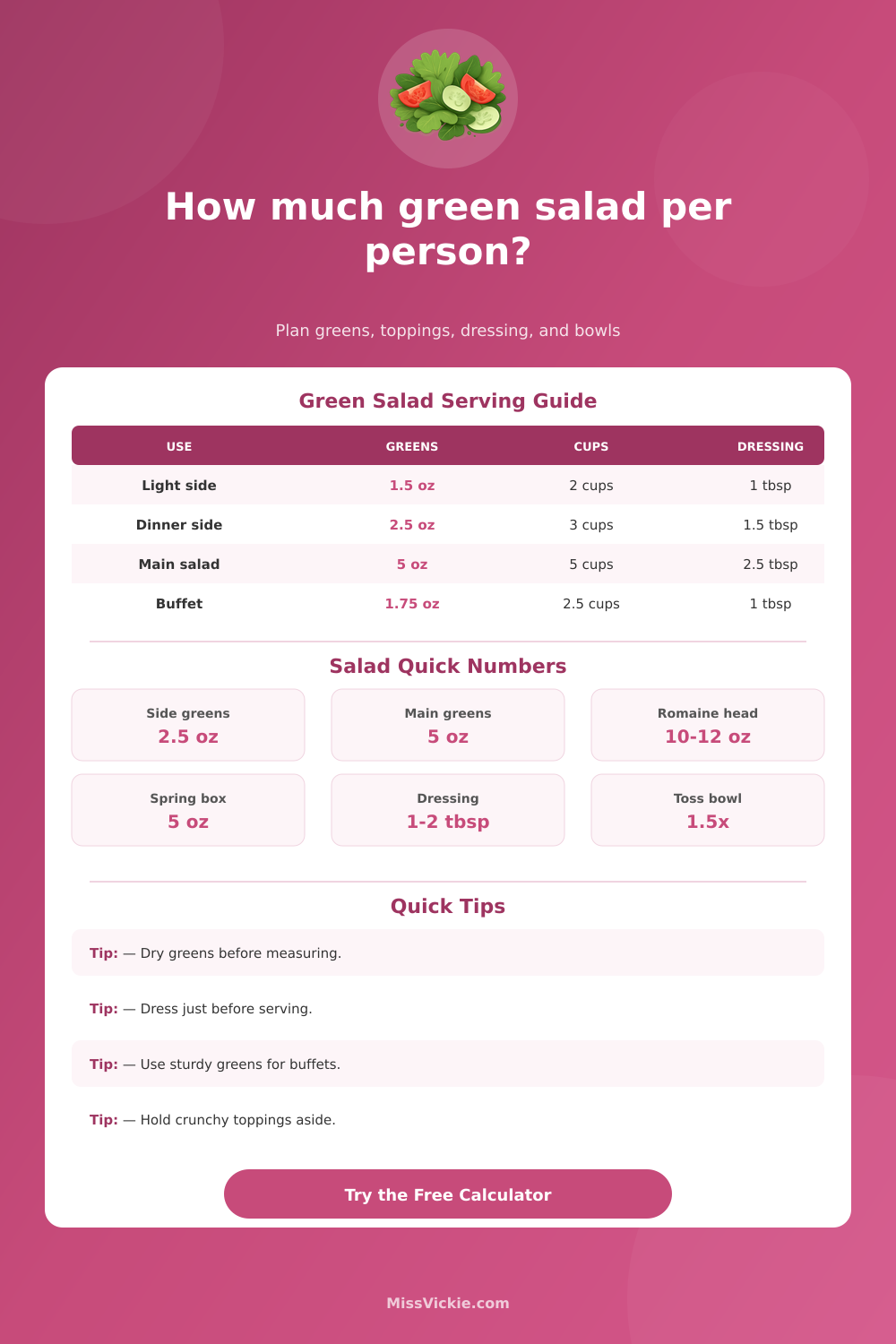
| Light side with several dishes | 1.5 oz / 43 g | About 2 loose cups | 1 tbsp / 15 ml |
| Dinner side salad | 2.5 oz / 71 g | About 3 loose cups | 1.5 tbsp / 22 ml |
| Hearty side salad | 3.25 oz / 92 g | About 4 loose cups | 2 tbsp / 30 ml |
| Main-dish salad base | 5 oz / 142 g | About 5 to 6 loose cups | 2.5 tbsp / 37 ml |
| Buffet side portion | 1.75 oz / 50 g | About 2.5 loose cups | 1 tbsp / 15 ml |
| Kids side salad | 1.25 oz / 35 g | About 1.5 loose cups | 0.75 tbsp / 11 ml |
Leafy greens vary a lot by cut and packing. The calculator uses weight as the anchor, then estimates loose volume for serving bowls.
🥬 Greens yield and conversion table
| Green | Approx cup weight | Typical package or head yield | Best salad use |
|---|---|---|---|
| Romaine hearts, chopped | 1 cup is about 47 g | 10 to 12 oz usable per large head | Caesar, chopped, dinner sides |
| Spring mix or baby lettuce | 1 cup is about 30 g | 5 oz clamshell is 5 oz edible | Tender side salads |
| Baby spinach | 1 cup is about 30 g | 5 oz bag is 5 oz edible | Main salads and meal prep |
| Iceberg, shredded or chopped | 1 cup is about 72 g | 18 to 22 oz usable per head | Wedges, tacos, crisp sides |
| Kale, stemmed and chopped | 1 cup is about 67 g | 6 to 8 oz usable per bunch | Make-ahead salad bowls |
| Arugula | 1 cup is about 20 g | 5 oz clamshell is 5 oz edible | Peppery side salads |
| Butter lettuce leaves | 1 cup is about 36 g | 6 to 8 oz usable per head | Soft dinner salads |
| Cabbage or slaw greens | 1 cup is about 70 g | 1 medium head gives 28 to 32 oz | Buffets, BBQ, dressed ahead |
🥣 Dressing and topping reference
| Choice | Typical amount | Weight or volume effect | Planner note |
|---|---|---|---|
| Bare greens | 0 oz toppings per person | No extra bowl space | Best when salad is only a palate cleanser |
| Light vegetables | 0.6 oz toppings per person | Adds about 0.25 cup volume | Cucumber, herbs, scallions, radish |
| Classic mixed toppings | 1.2 oz toppings per person | Adds about 0.45 cup volume | Tomato, carrot, cucumber, onion |
| Loaded toppings | 2.2 oz toppings per person | Adds about 0.7 cup volume | Cheese, nuts, croutons, olives |
| Main salad toppings | 4 oz toppings per person | Adds about 1 cup volume | Protein, grains, beans, avocado |
| Classic vinaigrette | 1.5 tbsp per side salad | About 0.75 fl oz per person | Toss half first, then adjust |
| Creamy dressing | 1.25 tbsp per side salad | Coats more heavily than vinaigrette | Serve extra on the side |
| Dressing on side | 1.75 tbsp available per person | Less waste in the bowl | Useful for buffets and picky eaters |
👥 Group size comparison
About 1 small romaine head plus toppings and 3/8 cup dressing.
Use a large bowl and keep dressing separate until serving.
Sturdy greens hold longer than spring mix on a buffet.
Plan protein toppings separately if portions must be exact.
📚 Bowl volume guide
| Bowl size | Comfortable tossed salad | Best group size | What to watch |
|---|---|---|---|
| 3 qt / 2.8 L | Up to 2 qt salad | 2 to 4 side portions | Dress in batches if toppings are bulky |
| 5 qt / 4.7 L | Up to 3.3 qt salad | 4 to 8 side portions | Good home dinner bowl |
| 8 qt / 7.6 L | Up to 5.3 qt salad | 8 to 14 side portions | Works for BBQ side salads |
| 12 qt / 11.4 L | Up to 8 qt salad | 15 to 24 side portions | Use tongs from the bottom |
| 20 qt / 18.9 L | Up to 13 qt salad | 25 to 40 side portions | Split tender greens into two bowls |
💡 Salad planning tips
For feeding a large group with salad greens, it’s all about physics, not intuition. We’re trying to cram soft lettuce leaves into a box that doesn’t bend. We need to plan for the fact that some people won’t touch salad while others will needs heavy drizzling. But how do you know? Cups don’t count: Spinach weighs very little compared to romaine, even if they look the same in a bag. Most home cooks measure by volume before shopping but that is an inaccurate measurement. Weight is the true answer because weight account for how dense each variety is. Plan in grams (or ounces) and you’re calculating real yield, not estimation.
After entering how many people you’re cooking for and what you’re serving (side? Is it an appetizer? Once you enter what you are serving, such as a side, appetizer, or main, the calculator above do all that math for you. There is no need to wing your conversions. Different items require different portion sizes depending on the meal. For example, ribs paired with a salad will call for less greens then ribs eaten as a main dish. About an ounce and a half per person is enough for a light side; a generous main dish require five ounces or more.
How to Plan Your Salad Perfectly
Why does this matter? Appetite varies based off what else you eat. For example, if there’s cornbread and mashed potatoes sitting in front of someone, they won’t require a heaping mound of vegetable to be satisfied. The tool automatically adjusts these baseline numbers, and use multipliers to account for appetite level (so you don’t overdo it on lettuce or run out too soon).
The volume realy multiplies with toppings. Grains and nuts, croutons and cheese: these all add weight, but more importantly, they displace air in your bowl. A reasonable pile of salad on a cutting board spills over the edge of a mixing bowl once you add dressing because there is no more room for extra volume. To ensure even coating, you want some headspace, to spin the leaves without squashing them. Choose a mixing bowl that holds at least one and a half times the volume you expect from weight of your salad ingredients.
Tossing those greens around in an already-full container will crush any tender baby lettuces long before they make it onto a plate. Sturdier greens like kale can stand up to close quarters; tender baby lettuces needs space to turn while you toss.
Another error: There’s such thing as overdressing. One would think that there can’t be; I mean, who’d pour more vinaigrette on fifteen pounds of lettuce until it turns to mush? But they do: Most of us severely underdress our salads. (The reference table say to use one tablespoon for a lightly dressed side and almost three for a main meal’s worth.) It feels like a lot if you’re used to drizzling from a bottle. However, tossing it in a big bowl is different than eating off a plate. Every leaf should be coated, not just the top ones.
Dressing your salad too soon mean wilted greens that give up their own moisture and create a puddle in the bottom of the bowl that messes with texture. For larger groups, the single most critical ingredient is the waste buffer. Uneven scooping increase waste. Removing any damaged leaves or trimmings further decreases the usable portion. A ten to fifteen percent buffer provides enough edible product after shrinkage. And it accounts for seconds: Guests don’t often request “more salad,” but won’t balk at finishing a healthy pile of what appears to be gone. That added layer should of plans for stress-free hosting vs. Happy bellies.
The physics of greens is key to successful salad planning: It’s impossible to anticipate exactly how much dressing everyone will want; you can’t push air out of a leaf. Pay attention to the details. Weigh your ingredients correctly and allow some space in the bowl for them to move around. This eliminates variables that add stress. Aim to make sure there are no gaps between salad items so nothing gets disturbed until they’re on the plates. Once you’ve got the bowl fitting the salad and the volume matching the weight, it all just falls into place.