Salmon Fillet Cooking Time Foil Calculator
Estimate foil packet salmon time for oven or grill cooking using fillet thickness, portion size, packet room, vegetables, sauce moisture, steam density, doneness, and rest.
🐟 Foil Packet Salmon Presets
Choose a real packet style, then fine-tune the fillet, foil seal, vegetables, sauce, heat, steam, and doneness target.
⚖ Packet Details
Your Foil Packet Salmon Plan
A closed-packet timing estimate will appear here.
Timing Breakdown
Packet Setup
📌 Foil Packet Quick Specs
🌡 Internal Temperature and Doneness Reference
| Doneness Setting | Pull From Heat | After Covered Rest | Texture Cue |
|---|---|---|---|
| Medium, moist center | 120-124 F | 125-130 F | Glossy center, flakes with gentle pressure |
| Medium-well, flakes easily | 128-132 F | 133-138 F | Opaque edges, slightly moist center |
| Food-safe fish target | 140-142 F | 145 F | Opaque and separates easily with a fork |
| Well done, firm flakes | 146-150 F | 150-155 F | Firm flakes and fully opaque throughout |
FoodSafety.gov and USDA list 145 F for fish. Lower pull temperatures are culinary doneness targets and should be chosen only when appropriate for the diner.
⏲ Foil Packet Time by Thickness
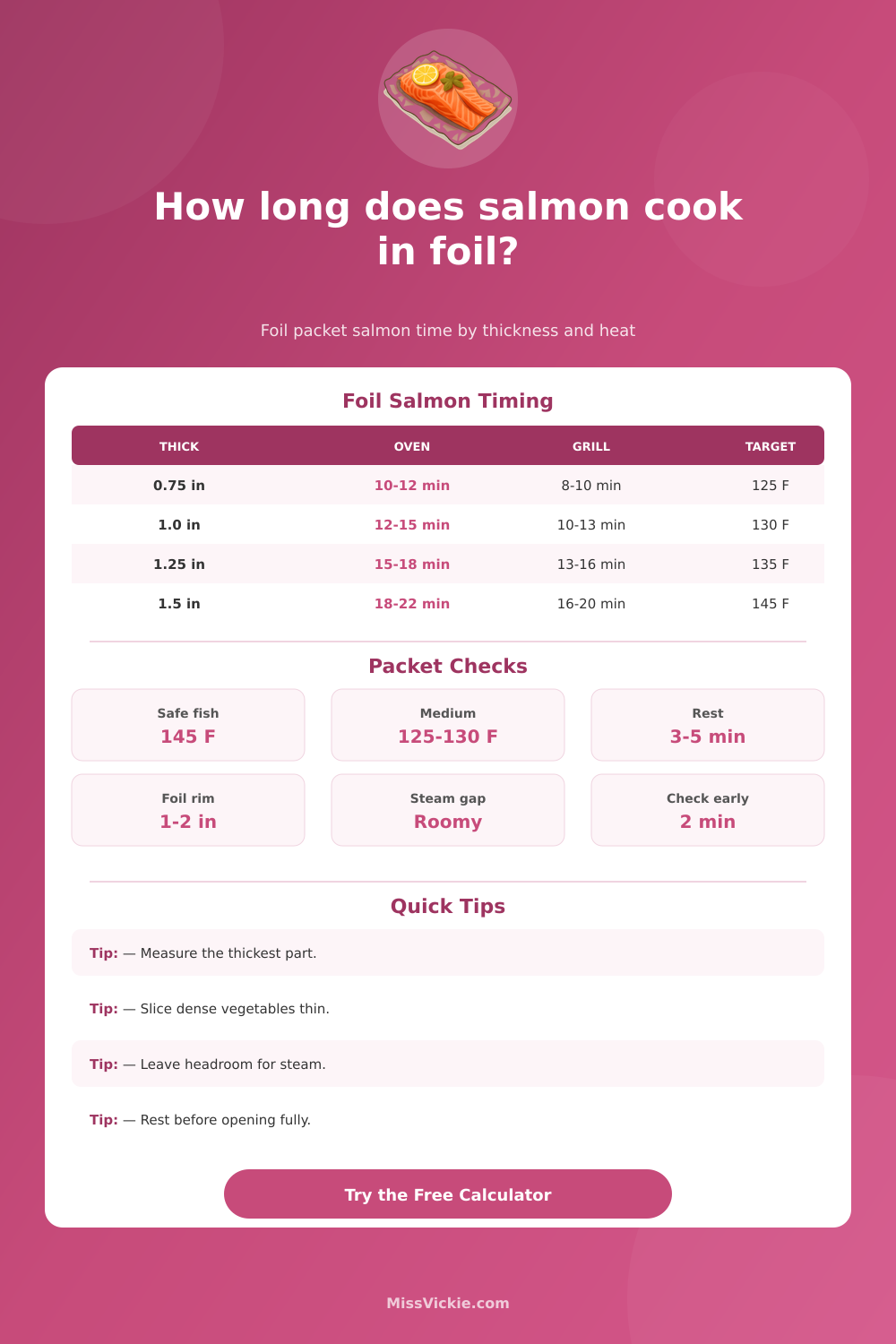
| Fillet Thickness | 400 F Oven Packet | 425 F Oven Packet | Covered Grill Packet |
|---|---|---|---|
| 0.75 inch / 1.9 cm | 10-12 min | 8-10 min | 8-10 min |
| 1.0 inch / 2.5 cm | 12-15 min | 10-13 min | 10-13 min |
| 1.25 inch / 3.2 cm | 15-18 min | 13-16 min | 13-16 min |
| 1.5 inch / 3.8 cm | 18-22 min | 16-19 min | 16-20 min |
| Whole side, 1.25 inch center | 19-24 min | 17-21 min | 18-23 min indirect |
🥬 Vegetable, Sauce, and Steam Adjustments
| Packet Add-In | Best Cut Size | Time Effect | Steam Effect |
|---|---|---|---|
| Asparagus, zucchini, bell pepper | Thin spears or 1/4 inch slices | Add 0-1 min | Moist but not crowded |
| Green beans, onions, cherry tomatoes | Halved or thin strips | Add 1-2 min | Moderate steam |
| Potatoes, carrots, broccoli stems | Very thin slices or pre-cooked | Add 3-5 min | Can slow the packet center |
| Frozen vegetables | Small pieces, not blocks | Add 4-6 min | Heavy steam and extra water |
| Citrus, wine, broth, butter | 1-2 tablespoons per packet | Add 0 min | Improves steam transfer |
📏 Packet Size Reference
| Packet Type | Foil Footprint | Best For | Timing Note |
|---|---|---|---|
| Individual fillet packet | 12 x 16 in | 5-8 oz portions | Most even timing |
| Vegetable dinner packet | 14 x 18 in | Fillet plus thin vegetables | Leave a steam dome |
| Whole side packet | 18 x 24 in or larger | 1.5-3 lb salmon side | Check center and tail separately |
| Foil tray with tight cover | Pan plus sealed top | Meal prep or many portions | Add time for crowded pans |
🔍 Foil Packet Method Comparison
Best all-purpose range for 1 to 1.25 inch fillets in sealed packets.
Faster packets with better aromatic lift, but glazes can darken at the edges.
Direct heat is quick; indirect heat is steadier for whole sides and thick cuts.
Convenient for meal prep, though crowded trays need a center temperature check.
💡 Foil Salmon Timing Tips
Until salmon isn’t. A second ago, you’re all set to serve up flaky fish for a tender meal. Now, you’re picking rubber from foil because you burned it in the oven or turned the heat on too high. Timing is everything. But there’s only that bit of space between perfection and failure.
That’s what creates stress and why I have a calculator for removing guesswork. Don’t worry, you don’t have to be a trained chef to nail it. All you have to know is how much time each type of fillet take to cook while tucked within its aluminum tomb, and how it transfers heat.
How to Cook Salmon in Foil Perfectly
Thickness is the single most important measurement you’ll make. And weight are a liar when it comes to determining cook time. You can have a five-ounce hunk of fish in the middle that’s thick as a tree and a six-ounce piece out of the tail that’s paper thin. Because heat moves from the outside in, thickness wins the calculator. So if you only base your timing on weight, you’re going to almost certainly wind up with a cold center and overcooked exterior.
Before you squeeze some lemon and add any butter, measure the thickest spot. Use that measurement as your baseline. Adjust everything else around physical reality.
It turns out there’s more to wrapping salmon in foil than meets the eye. First, you’re not exactly “roasting” the fish. It’s being cooked in its own juices, plus any vegetables or sauces you’ve included, via gentle steaming. To achieve this, the packet should of have some breathing room. A bit of extra space let steam move freely to cook everything gradually. But if you make the package too tight, the flesh will press up against the scorching-hot metal; it won’t cook evenly.
And even worse: If you cram lots of veggies (like carrots or potatoes) into same confined space, their heat-sucking nature will slow things down a lot. This is where the tool comes in. It factors all of this into its calculations and adjusts to match depending on who else has set up shop in the real-estate lottery. You don’t have to remember any of those tweaks. Tell it about how you filled out your packet, and let the calculator do the math.
The surprising factor here is how much the sauce matters to the timing and the final texture. If you only have a little bit of oil or maybe even a simple dry rub, then the cooking take place pretty fast. If you use something like a creamy sauce, a teriyaki glaze, or a cup of lemon juice, you are adding a lot of water. That water need time to get hot before it starts heating the fish.
In other words, it’s not bad; in fact, having all that creaminess will keep the salmon tender. But it also means starting the clock later than what you thought. Love a good glaze? You’ll want to either reduce the temperature of the oven a smidge or give it more time to compensate for all that thermal mass. It’s spelled out in clear detail across different sauces in the reference table on the page.
Don’t neglect the rest. You know what they say about carryover cooking: once you take your food out of the oven, leave it wrapped in foil and bring it with you. Trapping leftover heat inside a packet is an efficient way to do this. Even with the oven/burner/grill turned off and the lid closed, the internal temperature will creep upward by a few degrees more. Allowing it to rest for a few (3-5) minutes ensures that final ascent occurs slowly and doesn’t force all that moisture out of your salmon. When you remove the foil, you’ll find exactly the right doneness in the middle. Not two minutes earlier.
But there are other variables: Windy grills and high altitudes adds a problem. At altitude, for example, or if you’re cooking outside where drafts will rob heat from beneath the lid of your grill, then your effective temperature won’t be what the dial says it is. That’s why those factors is built into the final window on the calculator, to prevent you from undercooking due to changes in the weather.
And there are no exact recipes for cooking salmon in foil. It’s more a matter of understanding how thickness, steam volume, and resting time work together. When you get this, you don’t worry as much about the clock; you begin to trust the process. In fact, the fish itself eventually tells you when it’s ready, usually by giving up subtly to something you can feel (if you’re paying attention) that shifts the texture. At that point, it’s just a matter of letting it rest.