Brine Shrimp Salt Per Liter Calculator
Mix brine shrimp hatching water by liters, target salinity, specific gravity, salt type, temperature, egg density, aeration, hatch time, baking soda buffer, and water-change reserve.
⚗ Hatching Presets
Choose a practical hatch plan, then fine-tune the liters, ppt or specific gravity, egg loading, aeration, and reserve water. This tool is for brine shrimp hatch water, not kitchen brining.
🧂 Hatch Water Inputs
Your Hatch Water Mix
Adjust the inputs to calculate salt, buffer, eggs, and reserve water.
Mix Breakdown
Hatch Management
📊 Quick Salinity Targets
⚖ PPT to Specific Gravity Reference
| Use Case | Target PPT | Estimated SG | Salt per Liter | Notes |
|---|---|---|---|---|
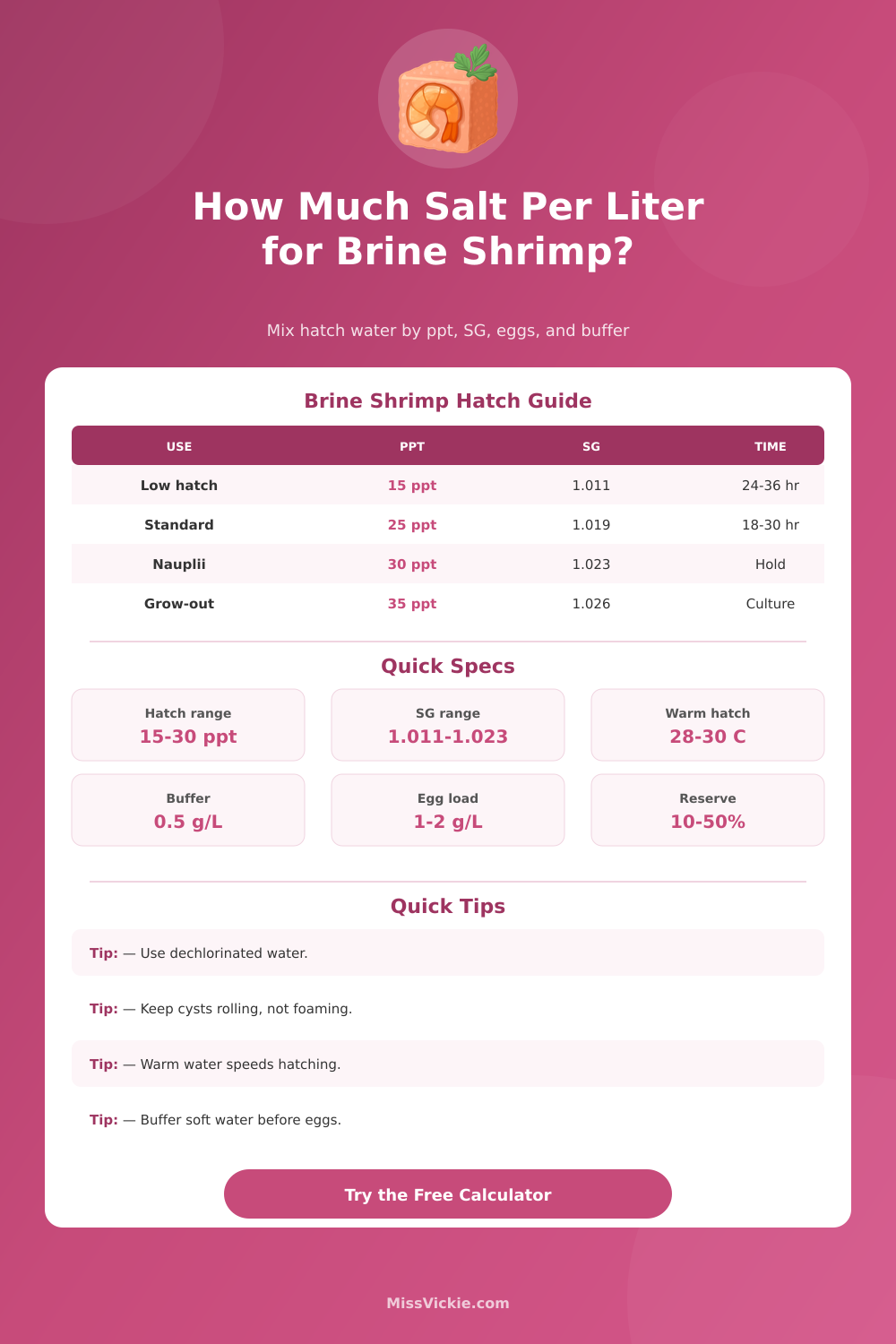
| Low-salinity hatching | 15 ppt | 1.011 | 15 g/L | Can speed hydration, but match your egg brand and water. |
| Balanced home hatch | 25 ppt | 1.019 | 25 g/L | Common all-purpose target for 24 hour bottle hatches. |
| Nauplii holding water | 30 ppt | 1.023 | 30 g/L | Useful when nauplii will sit briefly before feeding. |
| Grow-out culture | 35 ppt | 1.026 | 35 g/L | Closer to marine water for longer culture and feeding. |
Specific gravity is an estimate for hobby mixing. For precise work, calibrate a refractometer or hydrometer and temperature-correct the reading.
🌡 Temperature, Eggs, and Aeration Guide
| Parameter | Conservative | Standard | Intensive | Watch For |
|---|---|---|---|---|
| Temperature | 24-26 C | 28-30 C | 30-31 C | Cool water delays hatch; hot water can crash oxygen. |
| Egg load | 0.5-1 g/L | 1-2 g/L | 2-4 g/L | Dense cysts require stronger rolling aeration. |
| Hatch hours | 30-36 hr | 18-30 hr | 18-24 hr | Older nauplii use yolk reserves after hatching. |
| Baking soda | 0.15-0.25 g/L | 0.5 g/L | 0.75 g/L | Use more only when source water is soft or acidic. |
🧪 Mix Planning Checks
| Brine Shrimp Stage | Salinity and SG | Egg Density | Aeration Target | Buffer and Hatch Hours |
|---|---|---|---|---|
| Low-salt hatch | 15-20 ppt, SG 1.011-1.015 | 0.5-1 g/L | Gentle to rolling lift | 0.25 g/L buffer; often 24-36 hr. |
| Daily nauplii hatch | 24-28 ppt, SG 1.018-1.021 | 1-2 g/L | Rolling cone with no dead spots | 0.5 g/L buffer; usually 18-30 hr at 28-30 C. |
| Nauplii holding water | 28-32 ppt, SG 1.021-1.024 | Harvested nauplii only | Light movement after rinsing | 0.15-0.5 g/L buffer; hold briefly before feeding. |
| Grow-out culture | 32-35 ppt, SG 1.024-1.026 | 0.25-0.75 g/L starter cysts | Steady oxygen without foam | Marine mix or light buffer; culture beyond hatch hours. |
Chlorine or chloramine can cut hatch results before salinity matters.
Brine shrimp hatch best in alkaline water, so soft water often needs buffer.
Mix extra water at the same salinity for rinsing or grow-out changes.
Feed soon after hatch for rich yolk sacs and fewer empty shells.
💡 Practical Hatching Tips
The disadvantage is that your fish don’t eat what’s offered because it doesn’t look appealing. Nauplii brine shrimp are a great product offering high value for marine tanks but only if hatched propery. To do that, you have to duplicate the same conditions as they would encounter in the wild. Simply adding salt isn’t enough; there’s more to it. You need to match certain parameters. The calculator output the correct measurements (grams/liter) to hatch brine shrimp properly every time. There is no guessing. It takes your instinct and converts it into information.
Initially most people begin with tap water which contains chlorine. Chlorine will kill cysts faster than low salinity ever could. Low salinity isn’t as harmful immediately either. Once the water are ready, decide on your target density for hatching. With those numbers, it can calculate your culture requirements, whether for a long-term culture or a single day feed. Knowing this will help you troubleshoot problems with your hatch.
How to Hatch Brine Shrimp Correctly
Specifically, salinity can be measured in parts per thousand or specific gravity, which is just two ways of describing weight. Twenty-five parts per thousand is normal for a hatch. That is just enough salinity to allow hydration without causing an osmotic stress on the cysts. If there isn’t enough salinity the eggs won’t be able to pull water into them well and hatching rate decreases. Too much salt and the cysts don’t wake up at all. You can see on the reference table how slight shifts in target density changes your salt requirements.
The hatch time greatly depends on temperature. Metabolism depends on temperature. As water warms, so does metabolic rate. This accelerates hatching, making things more active sooner, but it lowers oxygen content as well. Oxygenation requires aeration. That’s where a good aerator comes into play. You want enough water rolling to suspend the eggs while keeping them off the surface without any excessive foam. Too much foam will waste energy and hold the cysts in bubbles. Hatches are usually set for 18-30 hours. Exceeding this time risks using up the yolk sacs before feeding time, which leave the nauplii nutritionally deficient. The calculator provides an estimate based off desired hatch hours.
Prevent failure due to a drop in pH with buffering. When cysts respire, pH drops and acid inhibits hatch. Buffer pH with baking soda to maintain alk and promote development. How much? That depends on how hard your water is. Harder water needs less buffering; softer water need more. Seems small but will screw up a batch if forgotten.
Having some premixed water is good insurance. You can use it as needed to replace evaporated water, for rinses, and to avoid shocking the nauplii with non-buffered water. With hatchling brine shrimp there are multiple variable to manage together: temperature, water, air, pH, etc. It appears complicated, but it all boils down to separating inputs (things you do) from outputs (what happens).
With this approach, the calculator generates a starting list of what is needed (mix sheet). It considers the amount of water, salinity, salt type, reserve amounts, and more. From there, it’s simple maintenance. Time the water flow, measure your inputs, wait a bit, then scoop and repeat. Successful hatching is less about voodoo, and more about diligent measuring. When you get the variables right, your fish will show results.