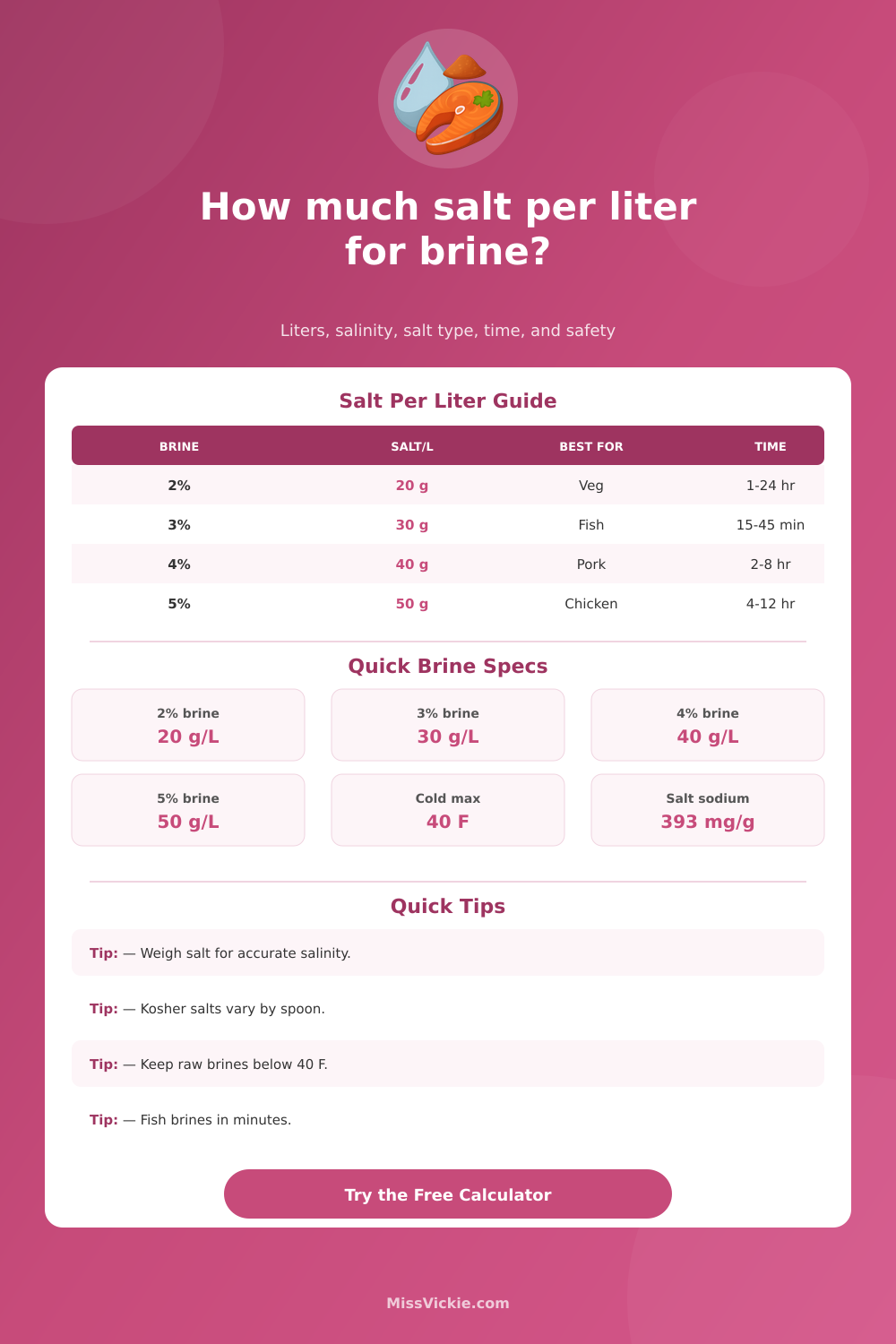
Liter-first brine salinity math
Salt Per Liter of Water for Brine Calculator
Calculate brine salt by liters and target salinity, then translate the weight into spoons or cups for your salt type. Add food type, brine time, displacement, chilled water, sugar, aromatics, and temperature checks for a practical kitchen plan.
Each preset loads a liter-based brine with food type, target salinity, salt density, displacement, chilled water split, sugar or aromatics, and a time window.
Brine summary
Salt, time, and temperature status will appear here.
Calculation Breakdown
| Salt type | Approx g per tsp | 50 g per liter equals | Best brine use |
|---|---|---|---|
| Fine table salt | 6.0 g | 8.3 tsp / 2.8 tbsp | Works by weight; dense by spoon |
| Pickling salt | 6.0 g | 8.3 tsp / 2.8 tbsp | Clear brines and quick pickles |
| Fine sea salt | 5.7 g | 8.8 tsp / 2.9 tbsp | General-purpose kitchen brines |
| Morton kosher salt | 4.8 g | 10.4 tsp / 3.5 tbsp | Meat brines when brand is known |
| Coarse sea salt | 4.5 g | 11.1 tsp / 3.7 tbsp | Dissolve fully before chilling |
| Diamond Crystal kosher | 2.8 g | 17.9 tsp / 6.0 tbsp | Large, light crystals by volume |
| Food type | Typical salinity | Usual time | Cold target |
|---|---|---|---|
| Chicken pieces | 4.5% to 6% | 4 to 12 hours | 0°C to 4°C / 32°F to 40°F |
| Whole chicken | 5% to 6% | 8 to 16 hours | 0°C to 4°C / 32°F to 40°F |
| Pork chops or loin | 3.5% to 5% | 2 to 10 hours | 0°C to 4°C / 32°F to 40°F |
| Fish and seafood | 2.5% to 4% | 15 to 60 minutes | 0°C to 3°C / 32°F to 38°F |
| Vegetables and quick pickles | 2% to 5% | 1 to 24 hours | Cold unless fermenting |
| Firm tofu | 2.5% to 4% | 1 to 8 hours | 0°C to 4°C / 32°F to 40°F |
Use when you already know how many liters of brine you want to mix.
Starts with the container fill volume, then subtracts displacement from the food.
Calculates salt from water plus food weight for a gentler, capped salinity.
Shows hot dissolve water and cold reserve so the brine can chill quickly.
| Volume | Liters | Water weight | Salt at 5% |
|---|---|---|---|
| 1 liter | 1.00 L | 1000 g | 50 g salt |
| 1 US quart | 0.95 L | 946 g | 47 g salt |
| 2 liters | 2.00 L | 2000 g | 100 g salt |
| 1 US gallon | 3.79 L | 3785 g | 189 g salt |
| 8 liters | 8.00 L | 8000 g | 400 g salt |
Volume is imprecise: A spoon measures your seasonings by volume. It doesn’t take into account density. Flaky kosher salt has air pockets between each crystal, while fine table salt clump together and fits snugly inside a teaspoon. That’s why you sometimes end up with a batch that’s perfect, but other times it’s too salty or even turns out rubbery.
Weight-based measurements fix that issue: Instead of guesstimating, you weigh the real mass of sodium chloride in the mixture. After plugging in your preferred salinity level and water volume, the calculator on the site will do the rest. Not all salts is created equal, so it’ll calculate amount of salt in grams, which is the only consistent measurement that works regardless of brand you use. For instance, when making a five-percent brine solution for your chicken, you need fifty grams of salt per liter of water. Depending on what salt you use, the calculator will adjust to ensure you’re getting the right amount. Even though Morton’s looks like Morton’s, Diamond Crystal’s crystals is slightly lighter. This is no small detail, as it is easy to more than double or halve the amount of salt you think you’ve used by using the incorrect conversion factor.
Why You Should Weigh Your Salt
The other variable that trips people up is displacement. A heavy chunk of pork roast displace water as it sits in your container. If you then fill up the container to capacity with water and drop the pork on top, water will spill out and throw off your salt-water ratio surrounding the pork. To compensate, the calculator lets you account for the amount of space that will be taken up by the food itself. Estimate its size and mark where it would sit in the brine. Then, subtract that amount from your fill line. This ensures the final concentration level around the protein reflect what you calculated rather than a weaker-than-expected guess.
This is a small mechanical detail, but it is important if you want a specific texture. The combination of time and temperature regulate how deeply the salt permeates the meat. Osmosis causes higher salinity solutions to pull more moisture from the meat (and replace it with seasoned water). Leave your fish in the brine for eight hours and you’ll have cured ham rather than moist fillets. You need only minutes to cure fish, usually less than half an hour. The safe window is shown in the reference tables, so you can quickly see the necessary times. Delicate protein needs immediate attention; dense cuts like pork loins can withstand several hours of soaking without turning into mush.
You want the brine to be cold, preferably around freezing, because colder temperatures slows bacteria growth but still allow the salt to affect the meat’s muscle fibers. Adding sugar and other aromatic ingredients makes things more complex without altering the underlying chemistry of preservation. Sugar balances things out (and so can bay leaves, peppercorns, etc.), but that’s secondary to the overall salt concentration. If you’re looking for something along the lines off the sweet-savory combination found in barbecue marinades, you can add a percentage of sugar; the tool will figure everything else out from there.
And it separates out the water portion into hot and cold, because dissolving salt in ice cold water is hard work (takes time). The idea is to get most of the salt dissolved using hot water, and then cool down the final solution with ice or some chilled water so you don’t warm up the brine before it comes into contact with the food.
You won’t know exactly how much salt goes into your body just from knowing how much brine you used. Salt does not absorbs at a steady rate. Some gets deep inside, while others stays on top. Some gets washed away during preparation and cooking. That’s why I provide an estimate of how much salt will go into your body based off average absorption rates across various foods. It’s an approximate number that lets you decide if your meal is within your daily sodium goals or not. It will help you make educated decisions, but don’t pretend it’s a nutrition label.
Control. Brining comes down to control. If all you do is toss a few spoonfuls into some water, you’ll either end up with salted jerky or a batch of preserved artifacts instead of tender meat or seasoned fish. By replacing these imprecise volumetric measurements with more precise weight-based ones, you eliminate guesswork from your brine. And when you’re ready to make your favorite recipe again, you’ll be able to make it exact since you have complete knowledge of the exact amount of salt per liter of water.
Next time you grab that shaker, remember: Grams not Spoons.