Flour Per Cup of Liquid for Gravy Calculator
Calculate tablespoons of flour for stock, broth, or pan drippings after reduction, with roux versus slurry guidance, fat balance, saltiness notes, serving yield, lump-risk checks, and make-ahead reheating adjustments.
🥣 Gravy presets
Choose a real gravy situation, then fine-tune liquid, thickness, fat, simmer reduction, saltiness, serving size, lump risk, and reheating plan.
⚖ Gravy inputs
Your gravy flour amount
The calculator sizes flour from final liquid volume, then adjusts for method, reheating, and practical whisking.
Batch math
Serving and seasoning
Cooking plan
📌 Flour and fat quick guide
📘 Gravy thickness reference
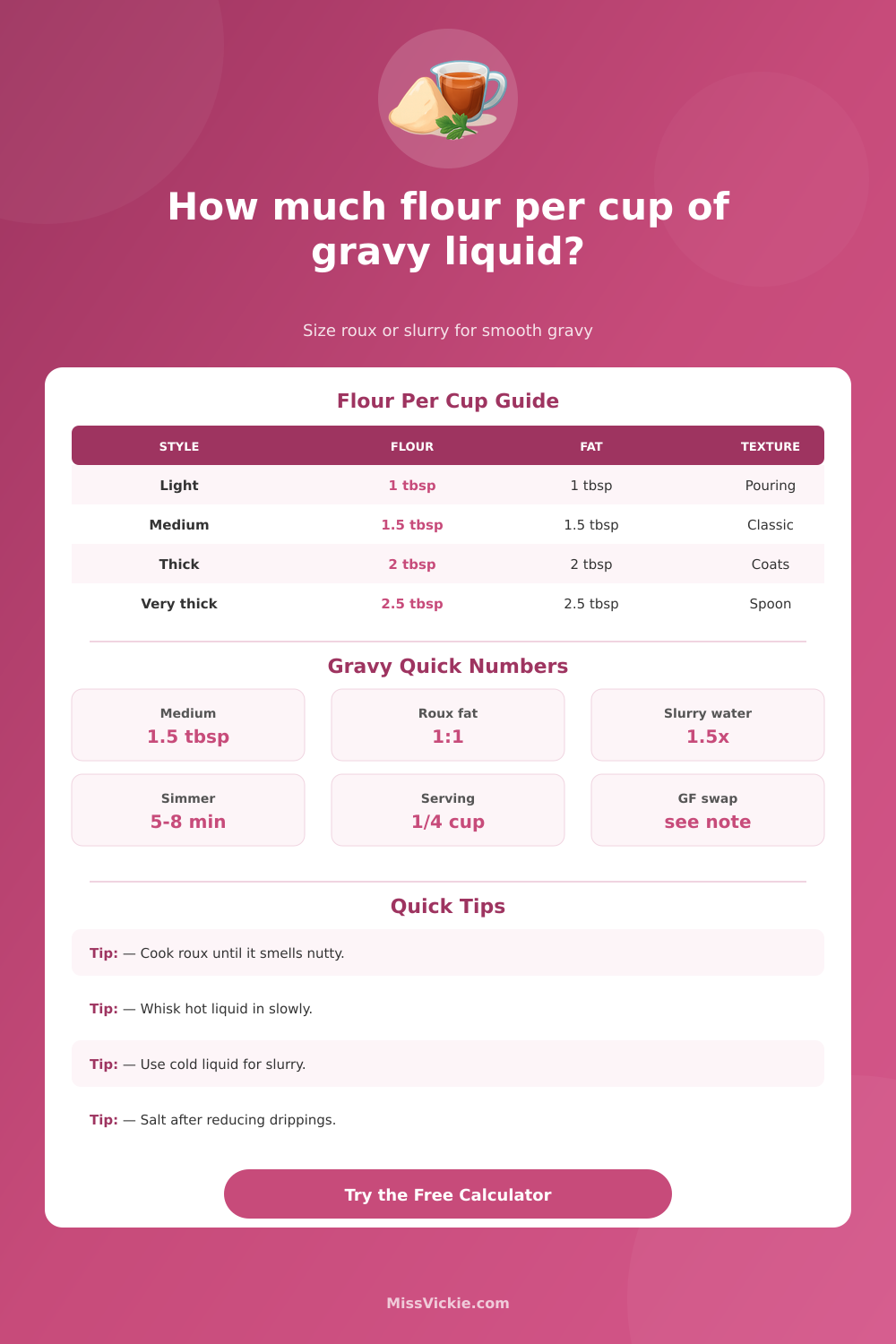
| Target texture | Flour per final cup | Equal roux fat | Best method | Use it for |
|---|---|---|---|---|
| Light pouring gravy | 1 tablespoon | 1 tablespoon | Roux or light slurry | Roast chicken, ladling over rice, delicate pan sauces |
| Medium classic gravy | 1 1/2 tablespoons | 1 1/2 tablespoons | Cooked roux | Turkey dinner, mashed potatoes, everyday stock gravy |
| Coats the spoon | 1 3/4 tablespoons | 1 3/4 tablespoons | Pan roux | Roast beef, concentrated drippings, holiday gravy boats |
| Thick mashed potato gravy | 2 tablespoons | 2 tablespoons | Roux with steady whisking | Open-faced sandwiches, biscuits, hearty plates |
| Very thick buffet gravy | 2 1/2 tablespoons | 2 1/2 tablespoons | Roux, then thin as held | Steam-table holding, make-ahead service, heavy ladling |
Measure flour lightly spooned and leveled. A tablespoon of all-purpose flour is about 7 to 8 grams, depending on brand and packing.
🥄 Roux, slurry, and make-ahead reference
| Choice | How to add flour | Liquid temperature | Lump control | Calculator adjustment |
|---|---|---|---|---|
| Cooked roux | Cook flour in equal fat until foamy | Whisk in warm or hot stock gradually | Best all-around control | Baseline flour rate |
| Pan roux | Use de-fatted drippings plus butter as needed | Add stock slowly while scraping browned bits | Watch salty drippings | Slightly firmer set |
| Cold flour slurry | Whisk flour with cold liquid first | Add slurry into simmering gravy slowly | Strain if rushed | Small flour increase |
| Butter paste | Knead soft butter and flour together | Whisk small pieces into hot gravy | Good rescue method | Slightly lower flour rate |
| Make-ahead gravy | Use a little less flour at first | Reheat gently and thin with stock | Whisk often as it loosens | Reduces flour slightly |
🥗 Serving yield table
| Finished gravy | Light servings | Standard servings | Generous servings | Flour for medium gravy |
|---|---|---|---|---|
| 2 cups | 8 at 2 fl oz | 6 at 2.5 fl oz | 5 at 3 fl oz | 3 tablespoons |
| 3 cups | 12 at 2 fl oz | 9 at 2.5 fl oz | 8 at 3 fl oz | 4 1/2 tablespoons |
| 4 cups | 16 at 2 fl oz | 12 at 2.5 fl oz | 10 at 3 fl oz | 6 tablespoons |
| 6 cups | 24 at 2 fl oz | 19 at 2.5 fl oz | 16 at 3 fl oz | 9 tablespoons |
| 8 cups | 32 at 2 fl oz | 25 at 2.5 fl oz | 21 at 3 fl oz | 12 tablespoons |
🌾 Gluten-free and starch notes
Use close to the wheat-flour amount by volume. Whisk very well and simmer a few minutes so the texture is not dusty.
Use slightly less than wheat flour for a glossy, clingy gravy. It works well for reheating and freezing.
Use a blend without strong gums when possible. Start one spoon light, simmer, then adjust if the gravy stays thin.
Cornstarch usually needs about half as much by volume and is added as a cold slurry near the end. This tool stays focused on flour gravy.
💡 Practical gravy notes
Remember the gravy that runs down your mashed potatoes like water off glass? Or is it the excess thickener stirred into something that shouldn’t be a paste but fits nicely into a brick mold? It is not a question of skill. Rather, its the heat outpacing the math. Run the numbers through the calculator above; they’ll do the work for you. But knowing why they matter prevent you from having to scramble to make sense off things when the timer goes off.
And this brings us to our variable: final volume versus starting volume. You may start your pan with four cups of stock. By the time you’re ready to serve, you’ve simmered it down to reduce flavors. You have also lost some to evaporation, so now you has less liquid to work with. This changes things. What looks like just right, say, a tablespoon of flour, in a thin broth turn out too much when you’ve cooked the liquid down. Measure the starch, yes, but take into account the reduction beforehand. It’s a subtle thing, but the difference between gravy that clings to the spoon and no gravy at all on the plate.
How to Make Good Gravy
The other silent partner in this equation is fat. Whether you’re making a roux, simply a combination of cooked flour and fat, or something else requiring flour or starches, the ratio is more important than what brand of butter you happen to use. You’ll see; the calculator will ask how much usable fat you’ve got, because it needs to know whether there’s enough to properly coat all those starch granules. Raw flour, uncooked, taste dusty and raw. Flour cooked in fat have a nutty smell, and thickens reliably. Lean pan drippings? Maybe a knob of butter is necessary just to make the roux work. Lacking enough fat to suspend the flour, you gets lumps. It’s physics, not bad luck.
There’s also how you’re making your method: With a roux, the proteins in the flour change slightly as they get heated, resulting in deeper flavors and a smoother consistency. However, when in a pinch (or when faced with a broken sauce), all you’ve got time for may be a cold slurry. By combining flour with cold water first, then whisking into hot liquid, you’ll avoid immediate clumping. For this reason, the tool change to match. A slurry isn’t quite like a roux. It will thicken more quickly, but it won’t hold its thickness as well if you want to keep gravy warm for an hour. Pick your timing, and go from there.
The biggest misstep for most home cooks is salt. When there’s a lot of salt on your pan drippings (you did brine your roast/turkey, right?), and even more as you reduce the liquid down, well…that salt just gets more salty. Seasoning heavily early on could make the finished sauce undrinkable. The calculator warns you about timing and take saltiness into account. Don’t taste until after reduction; don’t taste beforehand. You can’t take away salt; only add more. That is exactly why you should of waited.
Then there’s the element of re-heating: When food gets cold, starches keeps on soaking up water. What tasted like a silky-rich gravy when hot becomes gluey-thick right off the fridge. No worries. If you’re making the gravy ahead, the calculator adjust its flour suggestion accordingly. So just add some warm broth when reheating, should it need thinning. There’s no rescuing a gluey sauce. Go light in the beginning; then work your way up.
And lastly, take account of its audience. Different gluten-free ingredients (such as cornstarch or rice flour) has their own rules. For example: You can use half as much cornstarch by volume instead of wheat flour, but don’t boil it too vigorously or it’ll break down. When substituting flours, think of the traditional guidelines as a cap, not a requirement. Use a little at first, whisk continuously, and bring it up to a low boil. After all this time in, go on faith; your eyes will see when enough is enough.
But precision isn’t everything when it comes to good gravy. Timing, flavor, and thickness all needs to be balanced so that the sauce lands right on your tongue. Numbers lead you to the finish line; it’s your taste buds that tell you whether or not you made it over the bar successfully. You want the first ladle to stick to the food, without drowning it or drying it out. Find that middle ground and let the rest fall into place naturaly.