Lemon Juice Per Quart of Tomato Juice Calculator
Calculate jar-by-jar bottled lemon juice for tomato juice canning, plus citric acid alternatives, pints versus quarts, yield estimates, 1/2-inch headspace, optional salt, and altitude process notes.
🍅 Tomato Juice Presets
Choose a common batch, then adjust jar size, juice stage, acid choice, altitude, and margin. This calculator is for tomato juice jars, not a loose volume of chopped tomatoes.
⚖ Juice, Jar, and Acid Inputs
Tomato juice acid plan
Add bottled lemon juice or citric acid to every jar before filling with hot tomato juice.
Acid and Jar Breakdown
Process and Safety Notes
🧪 Acidification Reference
📋 Jar-by-Jar Acid Table
| Jar Size | Bottled Lemon Juice | Citric Acid | 5% Vinegar | Optional Salt |
|---|---|---|---|---|
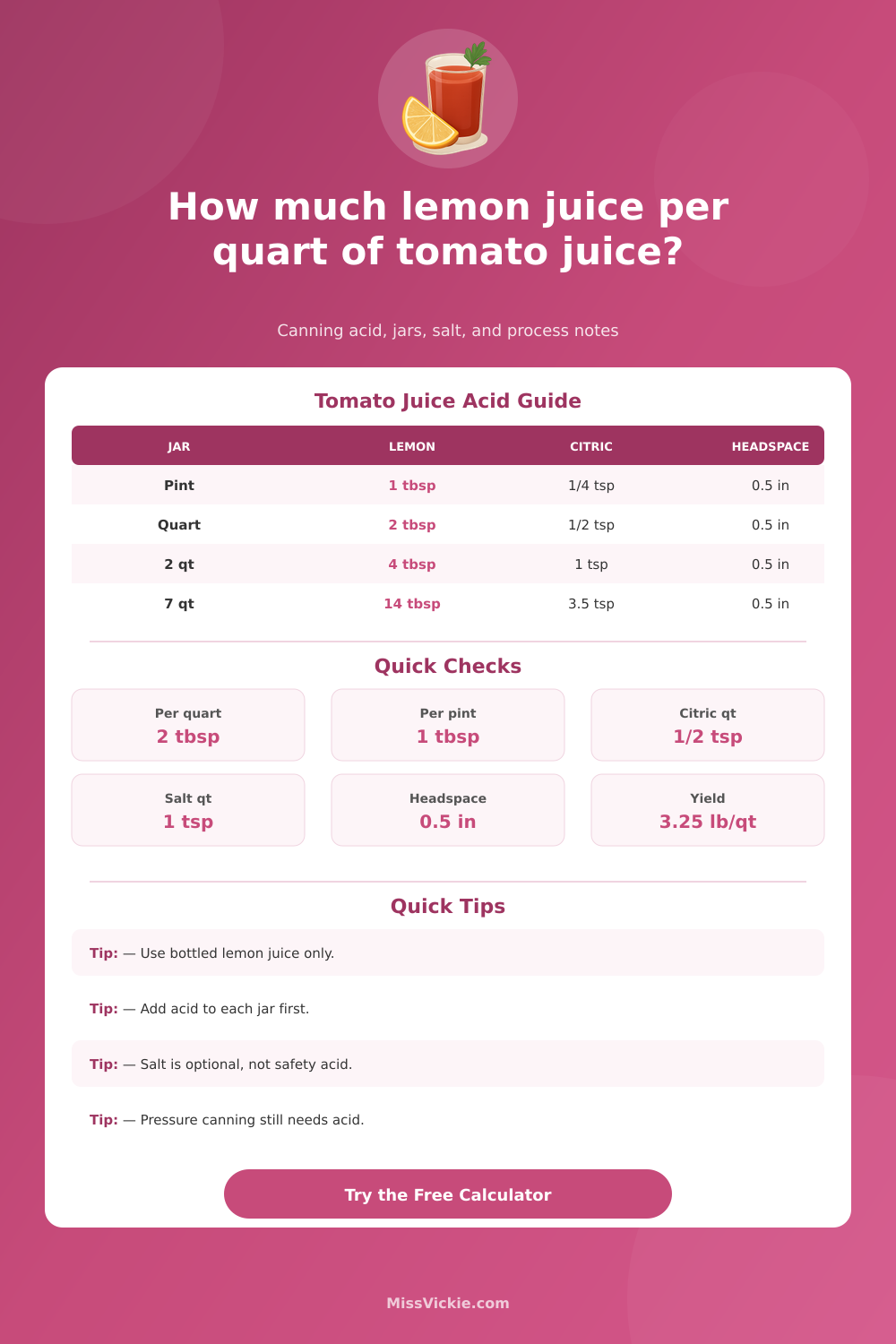
| Pint jar tomato juice | 1 tablespoon | 1/4 teaspoon | 2 tablespoons | 1/2 teaspoon, if desired |
| Quart jar tomato juice | 2 tablespoons | 1/2 teaspoon | 4 tablespoons | 1 teaspoon, if desired |
| Two quart jars | 4 tablespoons | 1 teaspoon | 8 tablespoons | 2 teaspoons, if desired |
| Seven quart canner load | 14 tablespoons | 3 1/2 teaspoons | 28 tablespoons | 7 teaspoons, if desired |
| Nine pint canner load | 9 tablespoons | 2 1/4 teaspoons | 18 tablespoons | 4 1/2 teaspoons, if desired |
Reference basis: National Center for Home Food Preservation tomato guidance for whole, crushed, or juiced tomatoes and the tomato juice procedure adapted from USDA Complete Guide to Home Canning.
🌡 Tomato Juice Yield and Process Table
| Item | Working Number | How It Is Used | Canning Note |
|---|---|---|---|
| Tomato juice yield | About 3.25 lb tomatoes per quart | Estimates juice from raw tomato weight | Actual yield changes with tomato variety, ripeness, and how hard the pulp is pressed. |
| Quart canner load | About 23 lb tomatoes for 7 quarts | Checks a common full load | Acid is still measured into each quart jar, not into the kettle. |
| Pint canner load | About 14 lb tomatoes for 9 pints | Checks a common pint load | Each pint gets 1 tablespoon bottled lemon juice. |
| Boiling-water process | Pints 35 to 50 min, quarts 40 to 55 min | Depends on altitude | Use the time for your altitude and jar size. |
| Pressure canning | 15 or 20 min options | Depends on gauge type and altitude | Pressure processing options still require added acid. |
🧾 Tomato Juice Pack and Jar Yield Reference
| Juice Pack Type | Typical Jar Yield | Bottled Lemon Juice | Citric Acid | Headspace and Salt |
|---|---|---|---|---|
| One pint of hot tomato juice | 1 pint jar | 1 tablespoon in jar | 1/4 teaspoon in jar | 1/2 inch headspace; 1/2 teaspoon salt optional |
| One quart of hot tomato juice | 1 quart jar | 2 tablespoons in jar | 1/2 teaspoon in jar | 1/2 inch headspace; 1 teaspoon salt optional |
| About 14 lb raw tomatoes | About 9 pints | 9 tablespoons total | 2 1/4 teaspoons total | Add acid before filling each pint jar |
| About 23 lb raw tomatoes | About 7 quarts | 14 tablespoons total | 3 1/2 teaspoons total | Add acid before filling each quart jar |
| Thicker cooked-down juice | Fewer jars than raw yield | Measure by final filled jars | Measure by final filled jars | Do not reduce acid for thicker juice |
⏱ Altitude and Process Notes for Tomato Juice
| Process Choice | Altitude Band | Pint Time or Pressure | Quart Time or Pressure | Acid Note |
|---|---|---|---|---|
| Boiling-water canner | 0 to 1,000 ft | 35 minutes | 40 minutes | Use full lemon or citric acid dose |
| Boiling-water canner | 1,001 to 3,000 ft | 40 minutes | 45 minutes | Altitude changes time, not acid amount |
| Boiling-water canner | 3,001 to 6,000 ft | 45 minutes | 50 minutes | Keep 1/2 inch headspace |
| Boiling-water canner | Above 6,000 ft | 50 minutes | 55 minutes | Add acid directly to every jar |
| Pressure canner option | Adjust for gauge type | 15 or 20 minute options | 15 or 20 minute options | Pressure processing still needs acid |
💡 Safety Notes
The first time I used a boiling water bath to fill a jar, it made me feel good: There’s all this steam, and all this glass going clank, and I’m thinking, I got this! And then when the jars cool, that feeling often shatters as I realize I might of made a mistake with the acidification. Except maybe I don’t. Maybe I screwed up the acidification thing.
Or maybe tomato juice isn’t the same as crushed sauce or whole tomatoes even though they’re close relatives. Maybe it’s runnier; maybe it’s cloudier. Maybe it’s more prone to changes in pH that goes unnoticed.
How to Keep Tomato Juice Safe When Canning
If it’s measured correctly, lemon juice-per-quart, then we’re safe here, because the science of it is what matters, not the guesswork. For low-acid food (tomatoes, etc.), reduce the pH so it’s no more than 4.6. Higher pH levels are hospitable to bacteria including *Clostridium botulinum*. These organisms forms toxins that can absorbs by heat alone. Bringing the pH below danger zone causes these pathogens to die.
The standard rule for tomato juice is two tablespoons of bottled lemon juice per quart jar. Because the acidity of fresh lemons can change depending on the year’s crop, bottled lemon juice is always standardized at 5 percent acidity to provide consistent results. Because fresh lemons can range in there own acidity level depending on the year’s crop, bottled lemon juice is always standardized at 5 percent acidity, which provides consistant results.
Once you have your batch size and number of jars entered in this tool, it do the math for you. You no longer has to multiply numbers while balancing a pot of bubbling-hot liquid.
If you hate it when tomatoes taste like citrus (or if you want to try canning with citric acid rather than lemon juice), no problem: You’re not alone, and some home canners prefers this approach. Citric acid does exactly what lemon juice does, lower the pH… But doesn’t add much flavor. That makes for a purer tomato experience.
Getting it right requires accuracy. Half a teaspoon of citric acid has the punch of two tablespoons of bottled lemon juice. It’s easy to underestimate how strong pure powder is compared to diluted liquid. If you measure incorrectly, your tomatoes will either be slightly too high in pH, meaning they didn’t drop as low as you needed or slightly too low. A pH that is too low will make the juice sour.
Another issue regarding sealing has to do with headspace. Leave a half-inch or so headspace above the tops of jars; this will allow things to expand while you process them. As they cool, the jars have time to create a vacuum and seal. If there isn’t enough liquid in the jar (underfilled) it won’t seal properly. Too much liquid (overfill) will boil over and not seal either. It wastes space and risks a color change.
The tool keeps track of how many jars you have filled vs. Your overall yield so you know when you are filling enough.
Safety: You can add salt (optional) but that won’t kill any bacteria or alter pH. Salt is only added for improved flavor. A tsp. Per quart of tomato juice will give a more pronounced flavor. Per quart of water will give a more pronounced flavor. If you enjoy slightly less salty pickle flavor, simply omit. The safe part is handled by the acid. The tasty part is enhanced with salt.
Adjust the processing time, but do not change the acid level. Processing times adjusts based off altitude. Why? Boiling point is lower. Where? At higher altitudes. How? Water boils at a lower temperature. What’s the impact? That slower cooking time requires longer processing. Adjust your timing accordingly. But don’t change the acid level. Those adjustments are listed in the table below by elevation bands.
Following the process is what it’s all about with canning tomato juice. The science will protect your pantry months down the road. If you follow proven rates, there is no reason not to enjoy the taste of homegrown without worry. A mere two tablespoons per quart seems negligible, but this step affects every batch you’ll make that day. Take the time to measure correctly. Put it into the jar first. Allow the heat to work.