
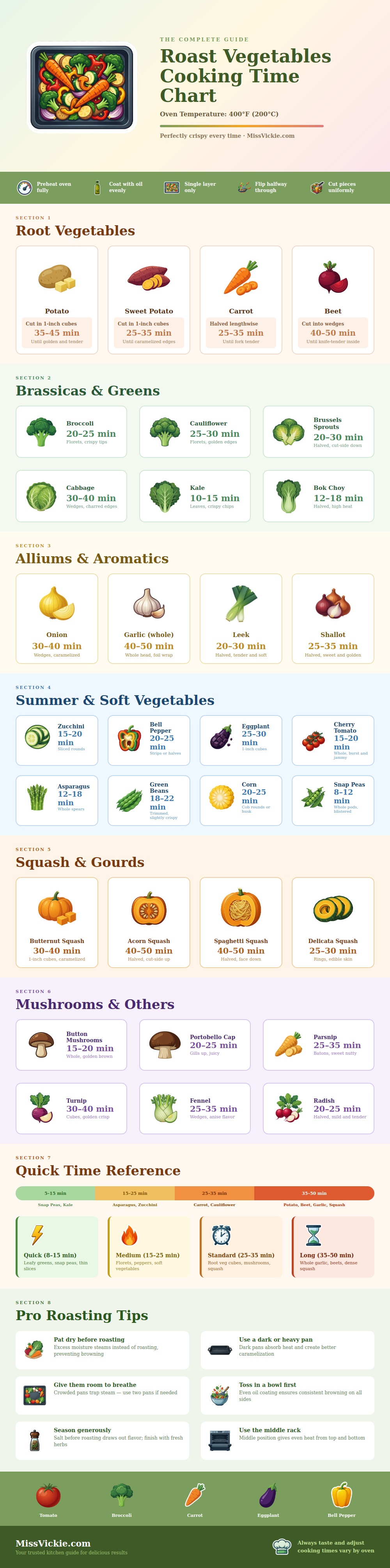
When vegetables roast, they can turn from crisp-to-the-bite delights into steamed mush, and it’s all about timing. How do you know when each one has had just enough? There is no magic formula, but there is a helpful reference: Familiarize yourself with the relative density of your ingredients and learn what length of time is reasonable to expect them to soften based off the hot oven.
This chart (above) group vegetables according to their type, and that tell us something that could get lost in the details of any given vegetable’s description. For example, beets, potatoes, and other root veggie are denser than most. These thick-skinned, starchy things takes awhile to succumb to heat, so pay attention when cooking them. Pull a beet prematurely, and you’ll still have a chunky piece of something unpleasant. Put delicate summer squash or tender greens in for the same amount of time as those stubborn roots, and you’ll find charred disappointment rather then dinner on your plate.
Tips for Perfect Roasted Vegetables
Here’s the real secret: It’s all about moisture control. Moisture doesn’t cause browning; lack of moisture does. Why? Because when vegetables is crowded onto one baking sheet, their combined steam gets trapped between them. The steam cooks the tops but never allow for a crisp texture. That’s where the spacing comes in: Space each piece out by itself on the baking sheet. You may need to use two pans. Steam results from crowding. Crowding results in disappointment.
Keep in mind the textural contrasts, too. The same goes for any other summer veggie, such as asparagus or zucchini. These contain plenty of water and fiber and will cook up very quickly. They’ll wilt right away. In the case of these veggies, you want slightly tender but still bright, not mushy. Compare this to something like an onion or garlic, an allium that wants time to sweeten. A whole head of garlic in its paper will roast slowly in nearly fifty minutes; again, it feels like a long time until you see that you’re realy just slow-cooking it down to a kind of spreadable paste. Patience is a virtue, and a recipe ingredient.
The seasoning is more important than folks think. Before the heat even turns on, salt pulls water out onto the surface of the vegetable. If you’re going for something crispy, this might sound counterproductive, but it’s actualy beneficial. A dry surface will help it brown better once it meets the hot pan. Toss it all together in a bowl with the oil first. This way each and every face of each cube will get coated. The ones that don’t cook evenly are the ones that didn’t get tossed in the oil, and that is no good.
Then there’s temperature consistency. You’d be surprised how important preheating completely is. Placing veggies on a cold pan puts them in a warm-up phase. Before long, they’ll begin to sweat instead of roast. The moment of even heat is what initiates the Maillard reaction and creates your gorgeous golden brown edges. Place on the center rack for evenly distributed air flow. Darker pans will absorbs heat quicker and lead to more effective caramelization than their shinier counterparts. It is a tiny difference in your kitchen but a big change in result.
And lastly, believe your eyeballs rather than the timer. Every oven is different; what the dial indicates internally may not match up to reality at all. That’s where the guide comes in as a reliable baseline. But ultimately, trust what you see. Is it changing color? Have the individual components shrunk a bit? Can you taste-test a piece (without burning yourself)? If so, it is fork tender, right? Are the edges starting to pull away from the middle? Then you’re there.
There are no hard and fast rules when it comes to roasting vegetables; it’s more about observing what happens as the heat change them from raw to something deeper and better. Time your meal based off the guideline, then rely on your senses for the rest. Dinner will thank you for paying attention.