
The story follows someone who is following a recipe requiring three fresh cloves of garlic, but all they has in the house is a shaker of powdered granules. Time to run out to the market. Or wing it? Guess wrong, and ruin dinner!
Garlic, to most home chefs, seems like just one ingredient, you can substitute one form for another, right? Wrong. Not all types of garlic is equal. Fresh minced versus dried powdered does not only alter texture, it changes the intensity, timing and even the chemistry. Knowing how those ingredients change help prevent the all-too-common errors of under- or over-seasoning an otherwise-perfect dish.
How to Use Different Kinds of Garlic
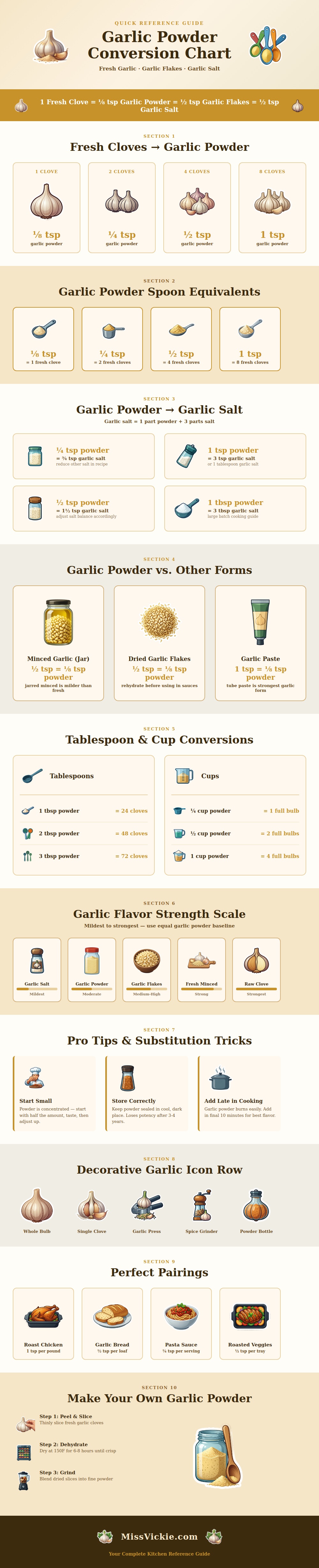
As for how little or how much, that’s broken out in the visual guide above, which spares you from having to memorize the ratio on-the-fly. You can see that about an eighth of a teaspoon of powder is equivalent to one fresh clove. It is a drop in the bucket. It is nothing at all, yet it has the flavor-punch of a clove. As you dry it, it strip away its water content and concentrates its garlic oil. If you need to scale-up, know that eight cloves are a full-teaspoon; four are half a teaspoon. Keeping these benchmarks in mind will help you avoid adding too much powder to a sauce and ruining it with a metallic, overpowering taste.
The flavor strength scale (a column on the chart) helps; fresh is key. When we’re talking about raw, whole cloves of garlic, chopped or crushed. The garlic enzymes is intact and ready for action. Powdered garlic, however, has had time to mellow: The volatile compounds have been dried and ground into powdery form, making for a mellower, richer but subtler back-note instead of an up-front punch in the face. No wonder the stuff performs so well in stews, soups, dry rubs and the like, where you desire more of the flavor throughout without it stealing the show. On the other hand, fresh garlic rocks it when you crave that instant smack of oniony goodness, for instance, in a raw dressing or finishing oil. Half the battle is knowing what do the job best.
The addition of salt complicates substitutions, particularly if you’re using garlic salt. The infographic explains that you typically use three parts salt to one part powder. This means if the recipe calls for plain old garlic powder but all you have is the salt variety, you’ll need to account for that extra sodium in the recipe. Three-quarters of a teaspoon of garlic salt for every quarter teaspoon of powder, but remember to subtract that amount from any other added salt in the dish. Otherwise, what should of been a well-balanced marinara will turn into an undrinkable brine. A simple mistake leads to disastrous results.
And then there are other things; like texture, which plays a bigger role than you might assume. The dried stuff is between powder and fresh. It is not quite as strong because it loses potency over time. However, it is more intact because the flakes maintains their form better. They can be added to dishes with their shape still recognizable, which is nice. But they won’t dissolve very easily. For a silky sauce, stick to the powder or grind the fresh cloves super-fine, since they’ll dissolve into nothingness otherwise.
Minced garlic from jars has less kick than fresh because it’s typically diluted by watery packing liquid or oil. Use at least double the amount called for if you are using jarred garlic instead of fresh, assuming your recipe calls for equal amounts. You’ll typicaly have to double the amount on the label of jarred garlic to get the same flavor as one fresh clove.
The trick most cooks don’t know: timing. There’s nothing between a powder and heat except dryness, which burns. If you toss some in with your onions at the start of sautéing, it will turn bitter in just minutes. For maximum aromatic effect, add powders and other dried spices in the last ten minutes of cooking time. Fresh herbs (especially whole, as in roasted garlic cloves) can withstand more abuse than fresh garlic, but even minced fresh garlic cooked too long will lose its nuance.
Homemade powder is simple to create, and better than buying in bulk. Just slice some fresh cloves very thin, dry them until they’re crisp, then grind them down to a fine powder. Because it’s fresh and hasn’t been sitting on a shelf for years losing its strength, it has a brighter taste compared to the stuff at the store. To stabilize the oils, keep this homemade stash in a cool, dark place. Make it, or buy it, but either way you’ll always know exactly what you’re getting (and you won’t ever have to sacrifice convenience to get the taste that you want). I am repeating this point.