
Here’s the scene: There are three cloves of garlic called for in your recipe, and you’re standing in your kitchen staring at the garlic jar. It’s a promise of ease right there, unopened on the counter, but its label doesn’t speak your language. Instead of speaking your language, it tell you grams or ounces. Who cares about those? That pot of onions isn’t going to wait for you to do the math. You’ve gotta get something out of that jar, quick. What a time to panic!
But here’s the thing: We’ve all been there. Every home cook has faced divide between what we can grab from the fridge and cupboard and what we find sitting in our pantries. And there’s no reason to worry because it doesn’t require turning into a mathematician. All you have to do is have a foolproof ratio. When you lay this stuff all out, the conversion logic are shockingly straightforward.
How to Use Different Types of Garlic
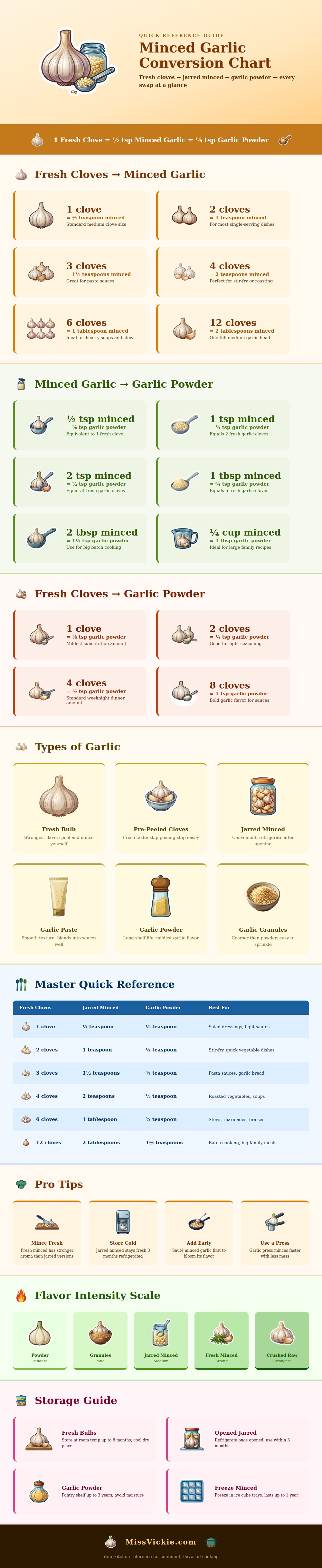
About one-half teaspoon of jarred, minced garlic equals one standard medium-sized clove of fresh garlic. Why? Most of us grab the jar when we’re in a rush on weeknights. Cooks write down recipes as though we all mince our own garlic. Knowing how to make that substitution lets you do it confidentely. You can trust that the recipe won’t come out wrong, or at least, not terribly wrong, just because of how you prepared something.
Fresh garlic is indisputably the gold standard for flavor intensity. The strong oils is released immediately when you break a raw clove open; you inhale their sharpness, which no jarred or dried version can match. But hot and fast as that bite is, it doesn’t last long: Garlic’s sharpness fades rapidly upon exposure to heat. Sautéed in a pan over high heat, add the garlic too soon and it burns before it begins to sweeten. Add it too late, and you retain the zing but lose the depth it would contribute to your sauce. That’s why most folks do it wrong: They fail to recognize that garlic isn’t a one-note ingredient, but a factor with different flavors at different stages.
Convenience aside, there are drawbacks to using pre-minced jarred garlic. Since it is stored in oil (or sometimes just water) to stay fresh, it will be a bit diluted compared to when you mince your own fresh cloves. To make up for that dilution, I broke out the math: Here’s roughly how many times more garlic than usual you might have to use: If you’re leaning into garlic, as in a hearty marinade or stew, you’ll probably want to go on the high side of these amounts. The jarred garlic is also smoother. Less chewy and textural than the real thing, and really shines in recipes where you don’t want raw pieces of garlic showing up, such as an emulsified sauce. It blends right in and doesn’t add any unappreciated crunch.
But then there’s the layer of garlic powder. It is not just an easy stand-in; it is an entirely different flavor. Without the moisture that transmits those sharp garlic bite flavors, dried garlic leaves only a dirtier, mellower undercurrent. And as the graphic shows, much less will get you what you want: A whole clove of garlic is equivalent to one eighth of a teaspoon of powder. Novice cooks sometimes make the mistake of doubling or tripling this measure, instinctively. But all they’ve done is transform their food from a delicious addition of depth to a face-melting mess of chalky bitterness.
To keep all of them fresh, storage is critical: In fact, the fresher the bulb, the better. Left whole, they will keep for months in a dry, dark, cool location. After peeling the outer skin, however, time begins to tick quickly. When exposed to oxygen, enzymes in garlic begin to break down its flavor (within hours). Minced garlic freezes nicely in ice cube trays so that all of its strength stays locked in until needed, when you can simply plop a square straight into whatever’s on the stovetop. If buying jarred items, remember: Once opened, they must be kept refrigerated for safety and to avoid spoiling. Otherwise you risk not only wasting your cash but ruining the dish with off-flavors.
Adaptation trumps strict following. Understanding these conversions helps you to cook according to what’s available in your cupboard and not compromise the dish. Use the shaker, the jar, or the bulb, you’ll be able to choose wisely and respect the nature of each ingredient. The next time a recipe calls for an ingredient you’re out of, just recall: Simple ratios connect the dots. Kitchen confusion turns into confidence. You will still taste the garlic, no matter how it ends up on your plate.