
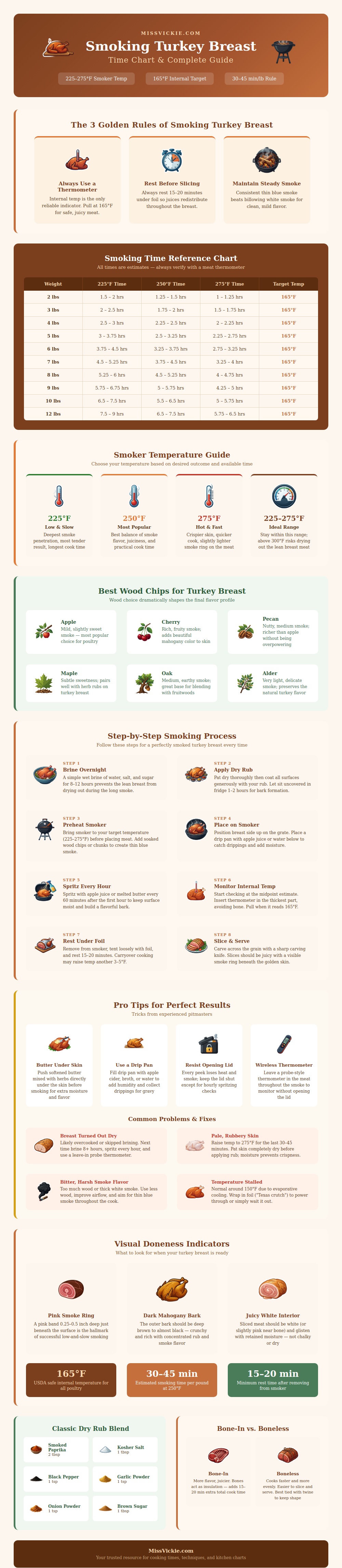
Smoking turkey breast is no easy task: There’s no bone or fat from a full bird to give it flavor, but there are also hours inside the smoker where that flavor must be developed. Mess up the chemistry of heat and time and moisture within the lean meat of the poultry, and your guests will ends up with a plate of dry, chalky meat. Get it right, however, and you’ll have a tender center of the meal.
So what about weight? That’s where many newbies get hung up. They’re staring down a five-pound breast, trying to figure out exactly how many minutes it take for every pound. Instead, there are clear windows here based off the temperature of your smoker (see chart above). The low and slow method, cooking at 225 degrees Fahrenheit for example, achieves deeper flavor penetration because the smoke sticks longer to the proteins on the surface. If you’re cranking the heat, say 275 degrees, you’ll shave off an hour or so, but you also run the risk of losing some of that tender texture that smoked meat demand. Convenience versus quality… Pick your poison; you decide what fits your schedule. But know this: if you’re after juicy results, don’t go higher then 300 degrees.
How to Smoke Turkey Breast
According to the chart, 165 degrees Fahrenheit is the sweet spot for doneness. But that’s only half the story for a lean cut like turkey, since temperature control are the hardest part of smoking it. Once you take the bird off the grill, the carryover heat takes over and the internal temp will rise another three or five degrees while resting. If you let a 165-degree turkey cool before slicing, the breast will be well done… So pull it early. Trust the thermometer more than your nose. The biggest mistake most folks make is trusting the color of skin instead of the reading from the probe inserted into the thickest part of meat.
The timer isn’t the only thing to consider: you also need to pay attention to wood type. Mesquite or hickory can be far too aggressive for something as delicate as turkey breast. For this application, fruitwoods (e.g., cherry, apple) is preferred. They’re more gentle (sweet, but not too sweet), and won’t overwhelm whatever else you pair with them. You’ll want thin, blue smoke; not thick, white clouds… So make sure your airflow isn’t too tight when using those heavier-tasting woods, so they don’t impart bitterness to the meat. Thin smoke smells clean, infuses flavor without spoiling it, while thicker smoke indicates incomplete combustion, depositing acrid compounds on the food instead of letting the smoke’s flavors come through. It is subtle, but it makes a world of differance in the finished product.
Before you even crank up the grill, preparation is everything. To keep your turkey breast juicy even after hours of exposure to the heat, a basic brine made with just water, salt and sugar will draw moisture into the meat via osmosis as well as change the way the muscle fibers retains water by soaking overnight. While some pitmasters don’t bother with this step at all, they’re battling the natural properties of lean protein, without the help of brine, the moisture dries out faster then the smoke penetrates. Another tip: Pat the skin down with paper towels until dry, then leave it exposed in the refrigerator for a few hours prior to smoking. Moist skin becomes rubbery, but dry skin creates a crispy bark no matter how hot you gets the grill.
It’s not up for debate: There is no rest. If you take the turkey off the smoker, all that juicy goodness runs down into the middle of meat and collects there. If you start slicing immediately, those juices run back out onto your cutting board and leave you with dry meat on the plate. Twenty minutes is all it takes, the muscle fiber loosens up and redistributes the moisture inside the cut. In my opinion, that’s what makes for tender meat. I know it feels endless to make your company wait around, but there should of simply been no alternative.
Smoking doesn’t have to be an active process. It is about letting nature take its course, or in this case, using physics. Set the temp, toss in some wood, shut the lid and let it go. Don’t open the door too much (check the probe), just trust the process. The result will be a glistening mahogany shell over a juicy, succulent center that makes every extra minute you spend waiting comfortabley worth your while.