
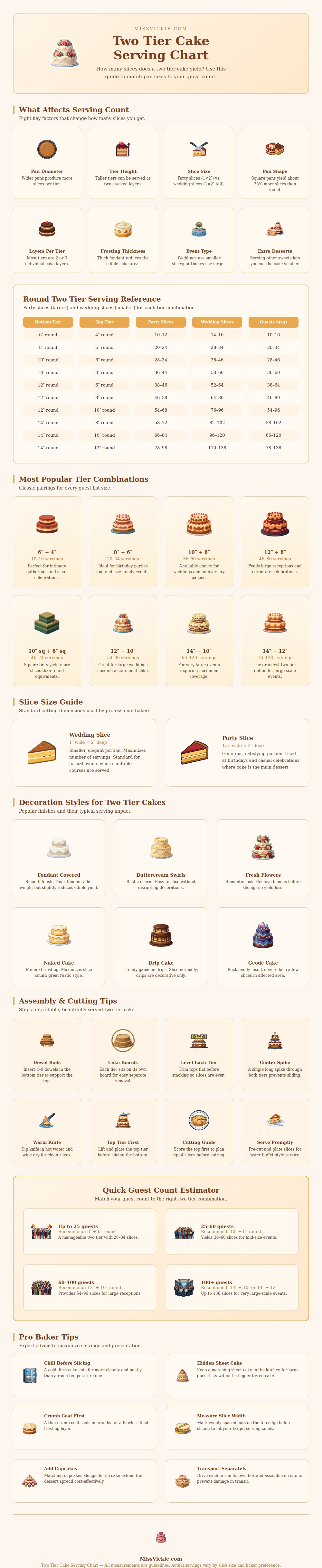
Two-tier cakes are sexy, but they’re a bit tricky, as far as serving goes: You have to account for how many people each tier will serve. Knowing how much each tier serves will help take the guesswork out.
There’s no denying that something tall looks good, but then there is also issue of geometry (and frosting). To avoid guesswork, this chart converts pan sizes into numbers of guests. It also differentiates between wedding slices and party slice. Many forget this distinction until it’s too late, and then suddenly there’s not enough cake!
How to Serve Two-Tier Cakes Easily
A party slice is larger, roughly one and a half inches across. Since cake is just the final dessert, party guests tend to eat more of it (hence the wider slice). Wedding guests, however, have already enjoyed a full meal, so they don’t need quite as much cake. So, a wedding slice are smaller (generally an inch in diameter).
This variation in width has a dramatic effect on yield. While the same cake, for example, ten-inch bottom/eight-inch top, would feed thirty-six people at a birthday gathering, it would easily provide enough for twice that number at an elegant dinner party. Simply changing size of your slice increases overall yield by almost two times.
Also take into account what’s on the inside. The amount of sponge per slice matter with a complicated cake, so think about thick layers of fondant reducing the eating surface. Heavy buttercream (or fondant) squashes sponge further inwards. More space for sponge in each bite come with a drip style or a naked cake. And this isn’t only about looks, but volume too.
You should also consider that using square pans gives you approximately twenty-five percent more slices because there is no wasted corner space. If your occasion has a preference for clean lines, and you’re looking to stretch the purse-strings, making the switch from round to square without needing to bake an additional layer are a smart decision.
And that cuts to structural integrity. If tower is crooked, your cuts will be too. Cutting into a wobbly pile isn’t going to result in triangular pieces. Dowel supports and a center spike keeps everything straight, allowing the knife to pass through smoothly.
When you start cutting, don’t do it when cake is warm, chill it first. A firm cake won’t slump on the serving dish; it’ll stand up to the plate. This seems like one more step to take, but it would of saved you having to reconstruct pieces at the buffet table.
Then there’s the pro tip of hiding the sheet cake. For big events this can be a great strategy. You show off your lovely two-tierred masterpiece for tradition and photos. You formally slice up a couple of pieces. The rest of the crowd enjoys it from a similarly decorated sheet cake hidden away in the kitchen or elsewhere. It allows you to have your visual dream come true on your cake while avoiding having to create some giant monster of a thing that risks falling over from its own weight.
To prevent damage, transport the tiers individually. To avoid shifting, drive all the tiers separately to the location and then assemble them there. Once you’re at the event space, be sure to level out each tier as well. If top is domed, cut it down to make it flat. Have a spirit level handy? A little bit of a tilt will mess up your slicing angle later on.
Lightly score the top first with your knife, then cut deeper. It helps guide your hand and makes sure everyone recieve roughly the same amount no matter how far they are from the middle.
At the end of the day, a two-tiered cake is all about math… Specifically, the mathematics of aesthetics. You want it to look tall in the picture, but you also need enough across to feed the crowd. Knowing which pan shapes will accommodate which slice sizes take the guesswork out of the equation.
And at long last, that first slice can be made without dread; but with confidence. After all, no party’s complete until everyone has their fair share of dessert.