
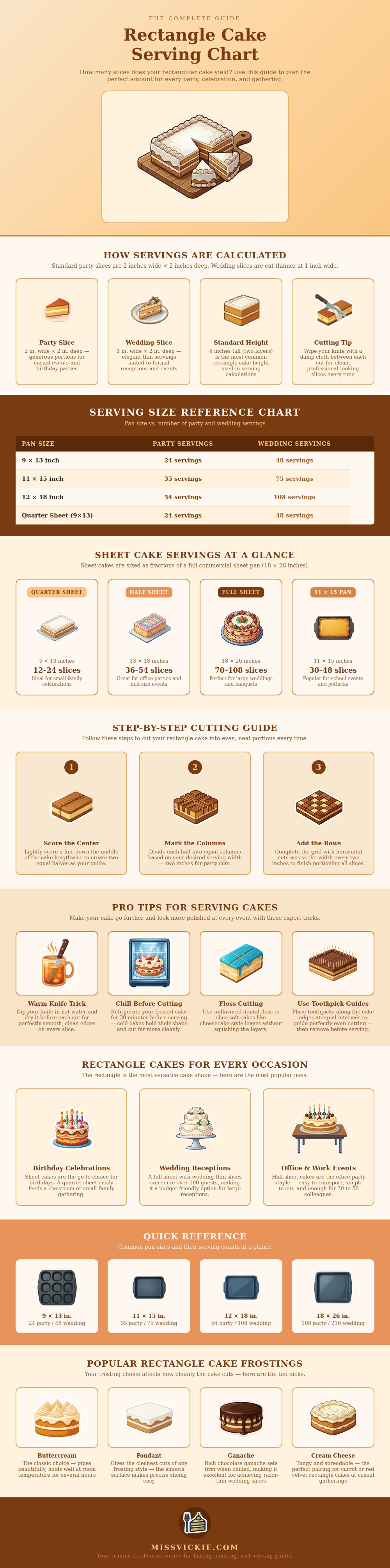
While this isn’t always true (a rectangular cake can be smaller than anticipated), this stress come from not knowing exactly what size serving you’re getting. Will we run out? Did I order too much? Should I just look around the table, count imaginary slices and stare at the board? Most people believe that a cake serve however many heads sit at the table, regardless of slice thickness. Unfortunately, it’s not like that and it causes us to run out.
Let’s talk about serving sizes. As chart above shows, understanding this will help you order correctly based off the event and the number of people you’re feeding. When serving slices as part of a more informal setting like a birthday party, seek out larger, 2 inch x 2 inch slice. You’ll get bigger bites, big enough to savor while drinking some coffee. However, you will get only half as many bites different than an equivalent sized cake sliced into thin one inch strips. Those thinner strips would works better at a sit-down, formal reception where a complete meal is already served.
How to Cut Cake Slices Correctly
It’s geometry, not magic. But knowing the difference mean you won’t buy too much for a small group or skimp on portions for a big crowd. A quarter sheet, really just another name for a 9 x 13-inch pan, are the workhorse of both small-office-parties and home baking. At about 24 hearty party servings per cake, it’s big enough to serve plenty, but not enough to blow your budget when buying several mini-cakes to feed a crowd. For slightly bigger events where budget constraints don’t allow for buying multiple cakes, upgrading to an eleven by fifteen inch sheet give you a substantial cushion, with approximately thirty-five good servings. These sizes scale up and down easy, as shown in this example from the guide:
Ordering the correct size cake is equally significant to cutting it correctly, and using a blunt knife will ruin all your efforts by forcing you to saw back and forth which damages the fine crumb structure of sponge. The ideal solution? Prepare ahead slightly by putting the cake into the fridge for roughly half an hour. This lets the frosting firm up, which help hold the layers together and makes clean cuts possible. Then, use a damp cloth to wipe your blade or run it under hot water after each and every cut. It sounds silly but this prevents any leftover crumbs or sticky batter from sticking to your knife, resulting in beautifully sharp slices every time.
While most cakes can handles being sliced just before serving, they will hold up better (and look nicer) depending on what type of frosting you choose. Buttercream is the go-to here for good reason. It’s forgiving in case you has to slice a bit last minute. It stays firm enough at room temp for hours while still piping beautifuly. It also keep the cake intact when served. If you want the cleanest cut of all, fondant will provide it, since the smooth exterior forms a hard shell so it doesn’t crumble as much.
But if you’re working with something a little more soft than that, such as cream cheese frosting (which also happens to pair perfect with carrot cake), make sure to take extra care with your knife skills. That tangy taste is so worth it, you’ll just have to work harder to maintain tidy slices.
While it might not be completely accurate, having an idea of how big each of your slice is allows you to manage expectations. If you’re feeding 20 kids in a classroom OR 50 execs in a boardroom, at least you know what to expect. Then there’s no frantic searching for extra goodies once the cake is gone halfway through. Just cut, serve, and watch them stuff their faces with peace of mind that you didn’t did the math wrong. It’s all about planning so you can ENJOY the party rather than wrangling the dessert table.