
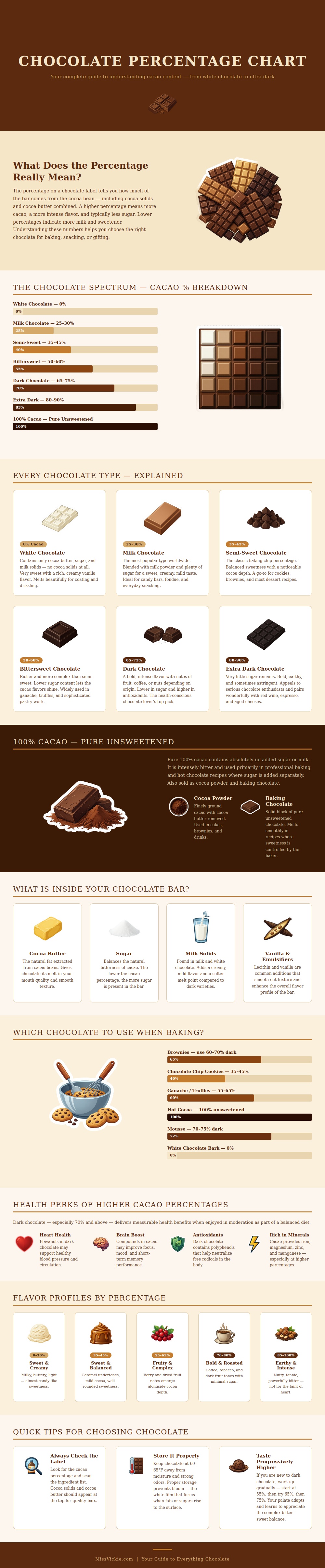
Imagine that you’re in bakery. You see two bars of chocolate on display. One bar is a deep brown; another is pale with a hint of creaminess. Unless you look at their packaging, your brain will assume they’re entirely different things. But the percent on the package reveals what’s encased within its wrapper.
And it’s not just a marketing ploy: That number shapes the chocolate itself. It tells you how much cocoa butter and cocoa solids versus how much sugar or milk powder are inside. Once you understand this measurement, you start to store, snack, and even bake differntly.
What the Percentage on Chocolate Means
But most of us assume dark chocolate is just bitter milk chocolate with less sugar, so it’s helpful to be able to visualize the spectrum on a chart like the one above: zero percent white chocolate (left) to a 100 percent pure cacao bar (right). Most of us don’t realize that the transition from 30 to 70 isn’t linear. Flavor-wise, it’s a curve. Small shifts in percentages yields big shifts in flavor and texture.
A lower number means a product designed for immediate satisfaction, such as a chocolate using sweeteners and dairy to mask the naturaly bitter qualities of the bean. Moving into the fifties to sixties are a transition from sweet comfort food to something a little more characterful.
Let’s get back to cookie making. If you flip through any of your favorite cookbooks, they usually recommends semisweet chips. Replace that with more of a bar at a higher percentage and the flavor deepens but there is no increase in sweetness. It’s completely different. Chocolate contain cocoa butter, which holds the dough together; cocoa solids (and other ingredients) contribute depth of flavor and color. Milk chocolate used for brownies could be to soft. A dessert becomes something closer to a candy bar. Choose a chocolate that fits needs of your recipe.
Everyone talks about how good dark chocolate is for health reasons. And that’s valid… But only if it’s made with high cacao levels. The cocoa solids contains antioxidants and minerals; the milk powder and sugar do not. Eighty-five percent chocolate has more nutrition in a single small square than does half a pound of twenty-five percent milk chocolate. Moderation still applies.
You do not need to eat an entire bar to get the benefits. Neither does forcing yourself to tolerate such extreme bitterness all at one time. Don’t begin at the top of the chart if you’re new to the darker side of things; often that’s where regrets originate. Gradually work your way up in increments of a couple of weeks. Start with a sixty percenter and allow your palate to acclimate to less sweetness. You should of started slow. As the sugar recedes, you’ll begin to notice other flavors like nuts and fruit. Your brain won’t crave those sugar hits anymore.
Proper storage can also aid the transition. Store the chocolate in a cool place, free from strong smells and heat. This keep it smooth and prevents it from turning waxy-white due to fat separation.
So how do you pick your chocolate? It’s all about intent. Do you need it to stick well and be sweet? (cover fruit) Do you want something complex and less sweet? A truffle is a cozy treat for one. The number is a guide. It isn’t written in stone. Once you know how much the ingredients cost, it is just about taste. Pick which bar you like.
Next time you reach for a chocolate bar, read the package. You might discover you’ve been missing out because you’re only sticking to the middle.