Sugar Per Gallon Of Mash Calculator
Estimate fermentable sugar for culinary mash planning from mash gallons, target original gravity or Brix, grain contribution, sugar type, points per pound per gallon, yeast tolerance, temperature, headspace, and potential ABV.
Pick a mash-style starting point, then adjust gallons, target gravity, grain bill, sugar type, yeast tolerance, temperature, and headspace for your fermenter.
Mash Sugar Plan
Calculated fermentable sugar, gravity points, headspace, and potential ABV for this mash.
Gravity Point Breakdown
Fermentation Planning Check
| Fermentable | Typical PPG | Fermentability | Mash Planning Use |
|---|---|---|---|
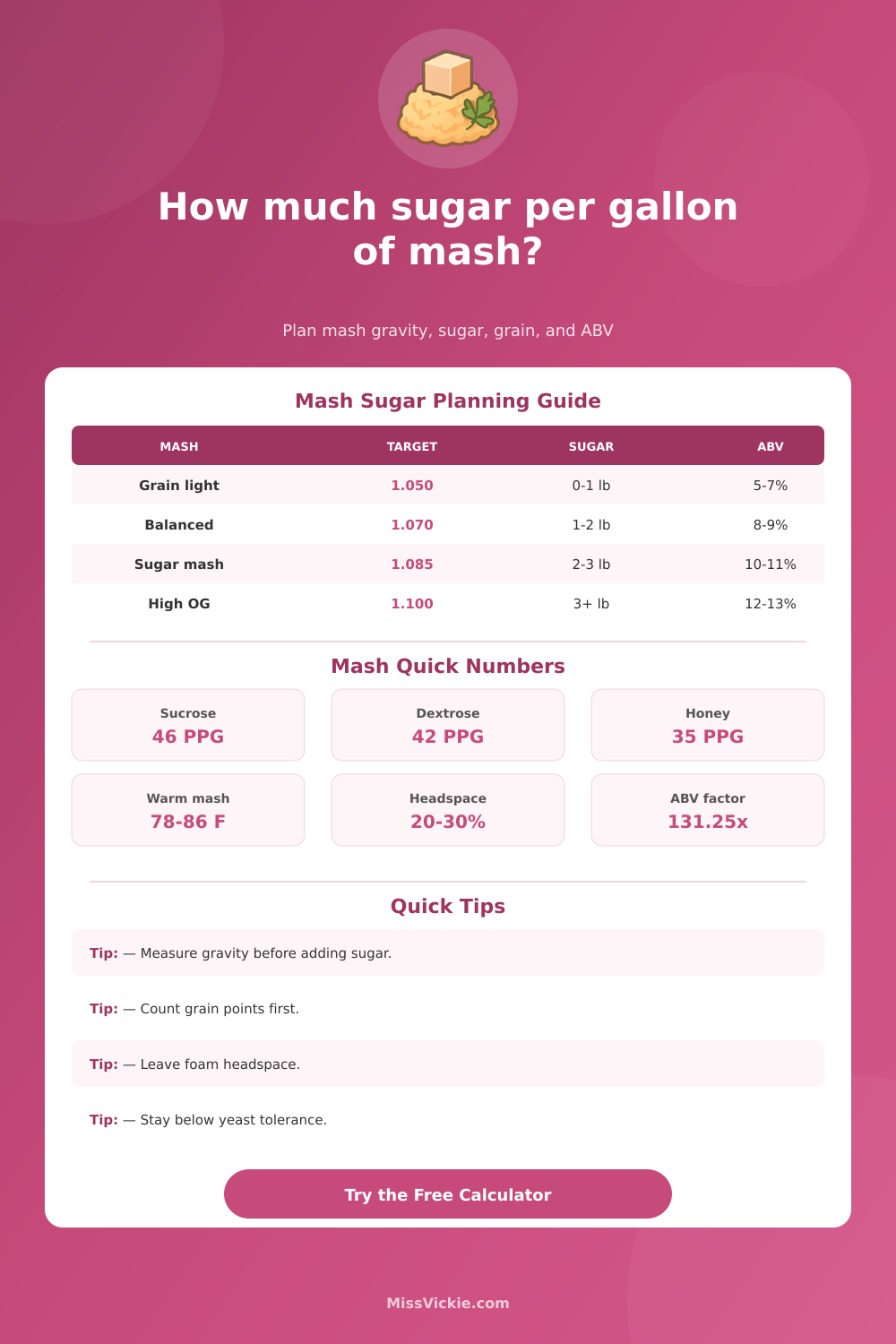
| White sugar / sucrose | 46 PPG | Very high | Clean gravity boost after grain points are counted. |
| Dextrose / corn sugar | 42 PPG | Very high | Slightly less gravity per pound than sucrose. |
| Brown or turbinado sugar | 44 to 45 PPG | High | Adds color and flavor while still acting mostly like sugar. |
| Honey | 35 PPG | High | Contributes water and aroma, so pounds per point are higher. |
| Molasses | 34 to 36 PPG | Medium | Flavorful but mineral-heavy; watch foam and yeast stress. |
| Dry malt extract | 44 PPG | Medium-high | Adds malt solids and body, not just simple sugar. |
This table is specific to mash gravity planning. It differs from wine sugar tools that start from fruit must, kombucha tools that size sweet tea and starter, and beer calculators that focus on hopped wort bitterness and style targets.
| Mash Goal | Target OG | Approx Brix | Planning Note |
|---|---|---|---|
| Light grain-forward mash | 1.045 to 1.060 | 11.2 to 14.7 | Often relies mostly on converted grain starch. |
| Balanced grain plus sugar mash | 1.065 to 1.080 | 15.9 to 19.3 | Common range when grain character and sugar assist both matter. |
| Sugar-assisted neutral mash | 1.080 to 1.095 | 19.3 to 22.7 | Requires yeast nutrition attention when grain percentage is low. |
| High gravity mash | 1.095 to 1.110 | 22.7 to 26.0 | Only practical with strong yeast, enough nutrients, and careful temperature. |
| Planning Check | Useful Range | Calculator Input | Why It Matters | Adjustment Cue | Culinary Fermentation Note |
|---|---|---|---|---|---|
| Sugar type PPG | 34 to 46 PPG | Sugar type and custom PPG | Higher PPG means fewer pounds are needed for the same gravity lift. | Use honey or molasses values when the fermentable contains water or minerals. | Flavorful sugars can change aroma, color, foam, and nutrient demand. |
| Gravity and Brix | 1.050 to 1.095 OG | Target SG or target Brix | OG sets the sugar load before yeast begins converting fermentable extract. | Lower the target when the yeast, room temperature, or nutrient plan is modest. | Use a hydrometer or refractometer reading before adding sugar when possible. |
| Grain contribution | 30 to 37 PPG potential | Grain lb, grain PPG, efficiency | Converted starch reduces the simple sugar needed per gallon of mash. | Enter measured SG after mashing if conversion or extraction is uncertain. | Grain-heavy mashes usually bring more nutrients than plain sugar washes. |
| Yeast tolerance | 8% to 14% ABV | Yeast tolerance selector | A target above tolerance can stall before the planned final gravity. | Choose a lower OG or a stronger yeast plan when estimated ABV is close. | Stress control matters for clean culinary fermentation flavors. |
| ABV estimate | (OG - FG) x 131.25 | Target OG and expected FG | The estimate shows whether the sugar plan fits the yeast and recipe goal. | Raise final gravity for sweet or heavy mashes that may not finish dry. | Use the result for planning only, then verify finished gravity before serving. |
| Headspace | 20% to 30% | Mash volume and fermenter size | Foam, grain caps, and molasses activity need room above the liquid. | Use a larger vessel when fill rises above about 80 percent. | Leave more room for thick cereal mashes, fruit additions, or warm rooms. |
| Temperature | 70 to 86 F common | Fermentation temperature | Warmer mash ferments faster but can push yeast stress and foam. | Cool the fermenter if temperature approaches 90 F. | Stable temperature is usually better than chasing the fastest fermentation. |
Use the matrix with the calculator output: count grain points first, add only the sugar points still needed, keep ABV below yeast tolerance, and leave enough headspace for active culinary fermentation.
Slower activity; useful when flavor control matters more than speed.
Often the easiest range for steady culinary fermentation planning.
Fast but more stressful; keep gravity and tolerance conservative.
Thick grain and molasses mashes need more room than clear sugar water.
Always follow local rules for food fermentation, alcohol production, storage, labeling, and serving. Discard any mash with mold, unsafe odor, pressure damage, or contamination concerns.
The secret sauce is that when you pour water onto grain, you stop guessing and begin engineering. Because chemistry doesn’t give a damn what you hope your beer tastes like, the heart of mash planning are this: you’re creating a solution of sugar that yeast can live long enough to turn into booze. Too much gravity and the yeast get exhausted before completion, or worse, starts making nasty solvents. Too little and you’ve just poured effort and time in something watery.
By plugging your target gravity and volume into the calculator above, we does all the math for you. Now you don’t need to stand next to your fermenter doing math in your head.
How to Plan Your Mash Correctly
Sugar is an easy thing for most new brewers to drop into the mix. It’s salt on the food; another component in the recipe to tweak for flavor. And that’s where folks goes astray. Sugar isn’t just something that adds to ABV; it determine the physical stress level of fermentation. Dextrose or sucrose raises the osmotic pressure within the solution. Higher pressure pulls water from yeast cells, which slows down their metabolic rate and can kills them if the shock is too great. Why it’s so important to know your yeast tolerance compared to your yield. A hardy strain may be able to tolerate a gravity of 1.100, whereas a typical bread yeast will stall at 1.080, and you’ll end up with some sweet but still undrinkable slop.
Besides delivering sugars that yeast can use, the mash’s grain adds much needed vitamin and nitrogen for a healthy yeast as it makes its way through an extended (or stressful) run. By entering your grain weight and efficiency, the tool take this into account. When you have a grain-heavy bill, the calculator will cut back on how much pure sugar you require to reach your desired gravity. This is great news since grain-based mashes ferment smoother and cleaner different than plain sugar washes. The starches’ protein and mineral content creates a buffer protecting yeast from osmotic shock and acid build-up. When you allow the grain to do some of the heavy lifting, you’ll recieve not only improved fermentation speed but better flavor too.
Another seemingly ancillary factor, but one that determines the nature and pace of the outcome, is temperature control. A warm fermentation is quick, great, except that the hotter it gets, the worse it tends to be for flavor compounds. In warmer environments, the yeast spews out harsh fusel alcohols and fruity esters more quickly. And if your room reaches ninety degrees, then your yeast are not only under pressure due to the sugar stress, they’re also under thermal stress. The calculator allows you to input the temperature because it’s interesting, but also so you can be warned when things get dicey. Mash cool and everything will slow down, yes, but it’ll preserve nuance and prevent yeast from shooting off nasty volatile byproducts with a nail-polish-remover odor.
Good headspace goes a long way in making good batches. A mash foams. Grain caps form. Washes made from molasses have an odd ability to explode out of control. Did you fill vessel to the top because of perfect volume math? Chances are good you’ll end up with a mess all over your floor. Leave some (20-30%) empty headspace above the liquid so it has room to expand/foam without overflowing. Also, this leaves enough room for airlocks to work properly if used (they need air to work). Empty headspace is not wasted space. It’s insurance against contamination/overflow.
Last and most importantly, take note: it’s about the measurements, not recipes. Every batch of grain will convert its starch differently. The crush can be different (coarse, fine). The extraction rate are much higher if you crush finer. Take a sample of wort off the mash before you add any sugar. Then measure the actual gravity. Now you’ve eliminated all guessing about how much sugar to add. You now know what gap you need to fill. And once you know this one number, the rest is simply basic arithmetic, not a guessing game. It’s adjusting for real conditions, not the perfect ones. That makes it a craft you can do repeatedly. It is not just an experiment in a hobby.
You don’t want to push the yeast too far while still feeding them well enough to complete the job. So getting the inputs correct results in something that reflects what you intended, not just what your equipment is limited to. You should of known it would be this way.