Medium Soft Boiled Egg Time Calculator
Estimate medium soft boiled egg timing for a yolk that is creamy and mostly set, firmer than jammy ramen eggs but not chalky like hard boiled eggs.
🥚Medium Soft Egg Presets
Pick the closest serving plan, then adjust size, start temperature, boiling or steaming method, altitude, batch count, water volume, ice bath, and peel rest.
⚙Eggs, Pot, And Finish Inputs
Medium soft boiled egg plan
Lower eggs into boiling water or a fully steaming basket, then chill according to the finish target.
Timing Breakdown
Batch And Finish
📊Medium Soft Yolk Reference
Good for smaller eggs when you want a creamy center that is no longer runny.
The main range for medium-set yolks in breakfast bowls, salads, and ramen.
Short chill for warm eating, longer chill for peeling and clean slicing.
Resting after chilling helps the white firm before salad chopping or slicing.
⏲Egg Size And Method Timing Table
| Egg size | Boiling water baseline | Steam basket baseline | Medium soft result |
|---|---|---|---|
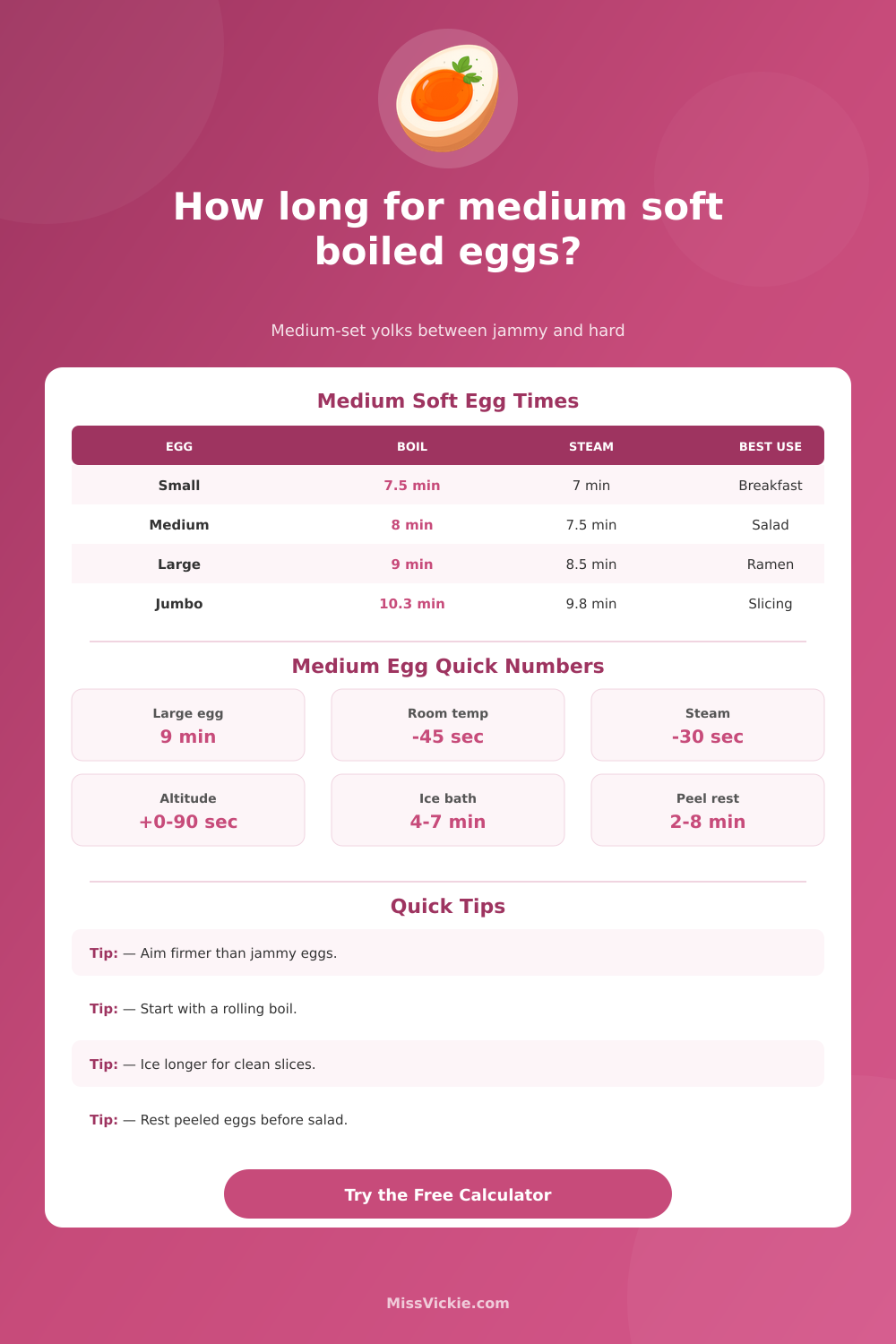
| Small, about 43 g | 7 minutes 30 seconds | 7 minutes | Mostly set yolk, delicate white |
| Medium, about 50 g | 8 minutes | 7 minutes 30 seconds | Creamy center, easy breakfast egg |
| Large, about 57 g | 9 minutes | 8 minutes 30 seconds | Sliceable but still moist in the center |
| Extra large, about 64 g | 9 minutes 35 seconds | 9 minutes 5 seconds | Best for salads and lunch boxes |
| Jumbo, about 71 g | 10 minutes 20 seconds | 9 minutes 50 seconds | Firm medium yolk without hard-boiled dryness |
Boiling-water times assume eggs are lowered into already boiling water. Steam times assume the pot is fully steaming before the timer starts.
🌡Temperature, Altitude, And Water Recovery
| Condition | Adjustment | Why it matters | Kitchen cue |
|---|---|---|---|
| Fridge-cold eggs | Use full timer | The yolk center starts colder and needs more heat | Lower gently to prevent cracking |
| Room-temperature eggs | Subtract about 45 seconds | The yolk warms faster and can drift toward hard | Use an ice bath if slicing |
| Above 3,000 ft | Add 30 to 90 seconds | Boiling water is cooler at altitude | Watch for a slightly softer center |
| Low water or crowded pot | Add 20 to 75 seconds | The boil or steam recovers more slowly | Split the batch for consistent yolks |
🍲Use Case And Finish Table
| Use | Yolk target | Ice bath | Peel or serve note |
|---|---|---|---|
| Breakfast bowl | Creamy center, soft edge | 2 to 4 minutes | Serve warm, peel gently under running water |
| Salad slices | Medium-set and sliceable | 5 to 7 minutes | Rest before slicing so the yolk does not smear |
| Ramen topping | Firmer than jammy ramen eggs | 4 to 5 minutes | Halve with a wet knife for a clean face |
| Snack box | Mostly set but tender | 5 minutes | Peel after a short rest and chill promptly |
| Near-hard egg | Fully set, not chalky | 6 to 7 minutes | Good when hard boiled feels too dry |
🥚Batch Count And Pot Volume Table
| Batch size | Boil water target | Steam setup | Timing note |
|---|---|---|---|
| 1 to 4 eggs | 2 qt / 1.9 L | 1 inch water below basket | Timer usually follows the chart closely |
| 5 to 8 eggs | 3 qt / 2.8 L | Loose single layer | Good everyday medium-soft batch |
| 9 to 12 eggs | 4 qt / 3.8 L | Wide basket, covered tightly | Add time if eggs crowd or stack |
| More than 12 eggs | Split batches | Split baskets or rounds | Consistent yolks beat one overloaded pot |
🧊Medium Soft Compared With Other Egg Styles
Liquid yolk for dipping toast. This calculator intentionally goes firmer.
Sticky center for classic ramen. Medium soft is usually a minute or two longer.
Creamy, mostly set yolk for salads, breakfast plates, ramen, and snack boxes.
Fully firm yolk. Medium soft stops before the yolk becomes dry or chalky.
💡Medium Soft Egg Tips
There’s a fine line between a perfectly boiled egg (the kind with a creamy-yet-formed center) and an egg too soft to eat, or too chalky because it was cooked too long. It’s a fine line and most folks gets tripped up by altitude and coldness. They put all eggs into the same boat no matter if the weather’s chilly or they live at sea level. Two minutes can be the difference between a fully cooked yolk and one that’s runny. People often guess when cooking at home, and they tend to ruin their dinners while still chewing the first bite.
Once you plug in your own variables, the calculator above does all of the math for you. From there it will save you from doing any mental math as the water comes up to temperature. It factors in the initial water temperature and size of eggs. It also considers whether you are going to steam or boil them.
Why Perfectly Boiled Eggs Are Hard to Make
Altitude, something most people don’t really consider, turns out to be more important then you’d imagine. The higher you get the lower the temperature of the water that actualy “boils”. So even if you can see the water churning around like mad, the eggs isn’t cooking any faster. Since you want that gentle simmer, you have to add on some time if you live over three thousand feet above sea level. The tool does that automatically, which is why you are using it.
Temperature is another big factor. Eggs fresh from the refrigerator are cold throughout, and it takes longer for the center to set than it does at room temperature. Because room temp eggs are already halfway there they’ll cook a bit quicker. Letting them warm up on the counter first might save you a minute or two, but consistency trumps speed here.
The other part of the trick isn’t so much when you click “stop” as what you do with those hot egg immediately afterward. Even if you’ve drained out all the water, carryover cooking still has time to go on inside the shell after you stop the timer. Ignore this stage and your medium soft egg will gradually become hard while you wait for the toaster to ding. If you’re looking for clean slices for a salad, then don’t skip the ice bath. The cold water will immediately stop any further cooking action and cause the egg to shrink a little from its shell making for easier peeling.
Older eggs tend to be easier to prepare because the membrane doesn’t stick as tightly to the inner portion of the white; fresh eggs make this task more difficult because their membrane sticks tighter. Knowing that a perfect yolk might go to waste when fighting with a stubborn shell, the calculator prompts you for egg freshness. Before cutting, let the peeled egg rest for several minutes to ensure the protein sets up just enough so that you can slice without much smearing. It is an added step but it makes all the visual difference on the plate.
But there’s one other thing: batch size affects the physics of your pot. When you add a couple of dozen cool eggs into a little bit of water, the temperature drops slowing everything down considerably. To predict how long it will take to boil again once the temperature drops, the tool accounts not just for egg number but for water volume. Crowding the pot? Uneven heat distribution causes some eggs to be done while others remains raw. Steam’s more forgiving here, as the steam temp remains constant despite the falling water level. Also: less water = faster recovery after those cold shells goes in.
All this comes down to controlling how much heat travels across a membrane. How long you cook an egg matters because the sulfur compounds can only react with the yolk’s iron for so long. After that, they turn gray green and everyone starts hating life. By keeping just shy of total coagulation, medium soft prevents this process altogether. You need precision and patience, but the payoff is a tender egg that will make your dish look like it belongs on TV. Whether you’re topping ramen or serving a classic breakfast plate, mastering the texture takes a humble ingredient and makes it special. Once you know what powers the process, the math is simple and the outcome is worth the effort.