Soft Boiled Egg Time From Cold Water Calculator
Estimate soft boiled egg timing when the eggs start in cold water, using water volume, burner power, calculated or observed time-to-boil, egg size, starting temperature, lid fit, altitude, yolk target, ice bath, and carryover.
🥚Cold Water Start Presets
These presets begin with shell-on chicken eggs in cold water. The timer starts when you turn on the burner, not when water is already boiling.
⚙Eggs, Water, Burner, And Finish
Cold-Water Timing Plan
Turn the burner on with eggs already in cold water, then use the calculated first-boil and hold times.
Heat-Up Model
Egg Finish Model
📊Cold-Start Reference Cards
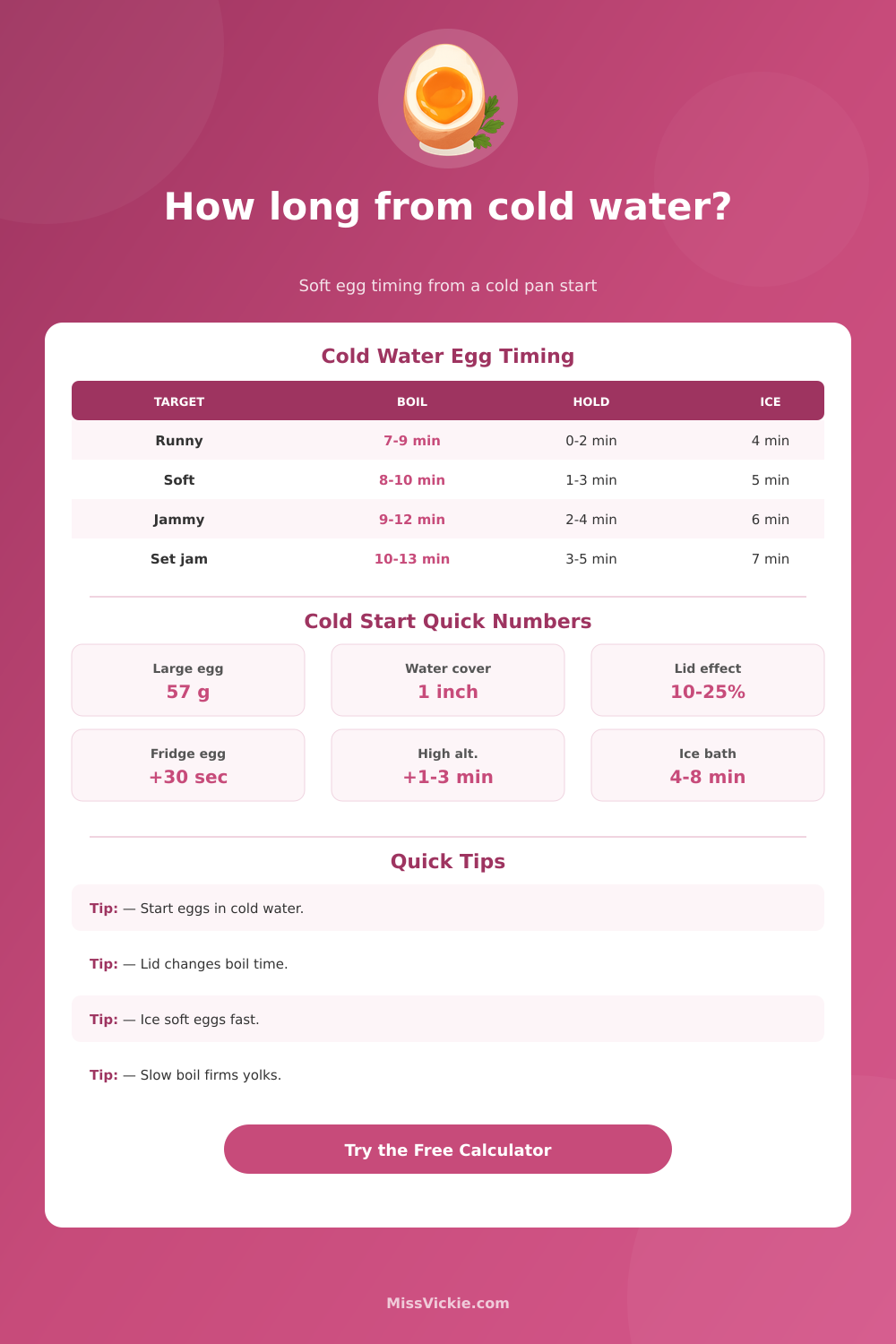
🍳Cold Water Timing Table
| Yolk target | What to watch for | Typical cold-start remove time | Ice bath |
|---|---|---|---|
| Runny center | White set, yolk flows quickly. | Usually first boil plus 0 to 2 minutes, depending on heat-up speed. | 3 to 5 minutes if not serving immediately. |
| Soft boiled | Thick golden yolk with a small loose center. | Usually first boil plus 1 to 3 minutes from a normal covered pan. | 4 to 6 minutes for predictable peeling. |
| Jammy | Spreadable yolk, centered and glossy. | Usually first boil plus 2 to 4 minutes, shorter after a slow boil. | 5 to 7 minutes to stop carryover. |
| Set jammy | Sliceable center with no chalky ring. | Usually first boil plus 3 to 5 minutes, adjusted for altitude. | 6 to 8 minutes before peeling. |
Cold-water timing is sensitive to the speed of the heat-up stage. That is why this calculator estimates or accepts time-to-boil instead of using a fixed boiling-start timer.
🔥Burner, Water, And Lid Effects
| Setup change | Time-to-boil effect | Yolk effect | Adjustment to make |
|---|---|---|---|
| More water | Boil takes longer because more water mass must heat. | Eggs get more gentle ramp cooking before the boil. | Expect a shorter post-boil hold once boiling begins. |
| Less water | Boil arrives quickly, especially in a small pan. | Eggs get less ramp cooking and need more hold time. | Keep eggs covered by at least a shallow layer of water. |
| Tight lid | Heat loss drops and boiling arrives sooner. | Fast boil can leave the center behind the white. | Use the calculated hold rather than removing at first boil. |
| High altitude | Water boils at a lower temperature. | Post-boil cooking is slower and softer. | Add hold time or choose a firmer target. |
⏱Cold-Start Heat-Up Factors
| Cold-start input | Common range | Time-to-boil signal | Soft-yolk effect | Calculator response |
|---|---|---|---|---|
| Water volume | 1.5 to 4 qt for most home batches. | More water stretches the cold ramp before the first steady boil. | Long ramps firm the white and yolk before the hold stage starts. | Enter the actual pan volume so the post-boil hold shortens when the ramp is long. |
| Burner power | 6000 to 14000 BTU/hr, or about 1750 to 4100 W. | Higher output lowers time-to-boil, especially with a covered pan. | Fast boils leave less early heat in the center of the egg. | Use measured time-to-boil when known, or match the burner field to the real setting. |
| Lid use | Open, vented, covered, or tight covered. | A lid can cut heat loss and bring boiling sooner. | Covered fast starts usually need a more honest hold after the boil. | Select the lid style used during heat-up, not the lid used after draining. |
| Altitude | Sea level to high mountain kitchens. | Water boils at a lower temperature as altitude rises. | Eggs cook more slowly once boiling, so soft targets need extra hold time. | The altitude field lowers the boiling point and adds hold time where needed. |
For cold-water starts, time-to-boil is part of the cooking time. A six-minute boil and a twelve-minute boil should not use the same post-boil hold.
🧊Egg Temperature, Ice Bath, And Carryover
| Finish factor | Cold-start detail | What changes | Soft boiled adjustment | Carryover note |
|---|---|---|---|---|
| Egg size | Small eggs heat faster than extra large or jumbo eggs. | Larger yolks lag behind the white during the ramp. | Add time for extra large or jumbo eggs; subtract a little for small eggs. | Large eggs keep more heat after draining, so cool them fully before peeling. |
| Fridge or room temp | Fridge eggs may start near 38 degrees F; room eggs near 68 degrees F. | Colder eggs absorb more early heat and delay the center. | Fridge-cold batches usually need a small timing bump compared with room-temp eggs. | Room-temp eggs can drift firmer quickly if they sit hot after draining. |
| Ice bath strength | Cool rinse, normal ice bath, or strong ice bath. | Better cooling stops yolk setting closer to the remove time. | Use 4 to 6 minutes for soft yolks and 5 to 8 minutes for jammy yolks. | No ice bath leaves enough carryover to push runny eggs toward soft or jammy. |
| Carryover rest | Heat remains in the shell after draining. | The yolk keeps thickening until the egg is cooled or served. | Shorten the hold slightly when serving without ice or when eggs sit in a warm pan. | Drain, cool, and peel on schedule for the most repeatable soft center. |
🥚Egg Size And Nutrition Reference
💡Cold-Water Egg Tips
Boiled egg recipes generally start with “bring water to boil.” That’s great if you are prepared to wait until the kettle clicks off (and start a timer as soon as you do). In real life, though, who knows when you’ll answer the door, pour the coffee, make some toast? The opportunity to time things perfectly vanishes. By starting with cold water, you link the cooking process to the heating one.
The catch is that you are no longer guaranteed to get a result within any particular time frame. Your results will depend on your fridge temperature, your pan, and your stove. Once you plug in your specific setup (which is where the calculator comes in… The one above does the math for you), you can forget about fiddling with altitudes and heat-transfer rates. Thermal mass, like using a light aluminum saucepan versus a heavy-duty, all-stainless-steel stockpot. Matters: The water isn’t going to start cooking the eggs until it’s boiling, but the eggs actualy begin cooking as soon as you turn on the stove. If you don’t take this pre-boil time into consideration, your yolks will be hard…not soft and jammy.
Why You Should Start with Cold Water
Also think about the lid. Home chefs often remove the lid to prevent a boil-over. However, leaving the lid on traps steam and moisture in the pot, which shortens the cooking time considerabley. Is this a tightly closed pot? Is it an open one? That’s a factor the tool takes into account. A fast boil won’t give the yolk enough time to gently warm itself from the inside out, different than a slow boil that allows the proteins to gradually set as the actual cooking phase begins. This means that two different chef following the exact same timer with different lids get eggs with different consistencies: chalky outside/soft inside; runny middle.
A more subtle player in the process, altitude can still derail your game if you don’t take it into account: At higher altitudes, water boils at a lower temperature (though with violent-looking bubbles), making its cooking power less effective. This is where the hold-time adjustment kicks in on the calculator: By accounting for the lowered heat, it increases hold time accordingly. High-altitude egg cooks who blindly adhere to sea-level directions typically ends up undercooking their eggs. It is not because of impatience, but because physics requires longer cooking times at lower temperatures.
Depending on which yolk you are targeting, you’ll know whether or not you need to be forceful with keeping carryover heat under control. When you pull eggs out of the water, there’s still leftover heat locked within the shells, and those eggs will keep cooking. A quick dunk into an ice bath shuts that down instantly, preserving the exact state they were in when you pulled them out. If you don’t do this, your soft boiled egg is going to gradually get firmer as it waits for your partner to finish taking her shower or for you to eat it off of your plate. Based off how far you’re willing to let the egg cook beyond what you intended, the tool will tell you a time for chilling. If there is less margin for error with a runny yolk, use a quicker chill. If there is more margin for error with a set but still gooey jammy yolk, use a longer chill.
There are more variables: Egg size? Starting temperature? A cold, jumbo egg has more mass than a small one at room temperature. It is going to require more time to reach temperature in the middle. The calculator accounts for that by adding some buffer to reach the target state. Water volume? In a deep pot, things take longer to boil, but it will be evenly distributed and cooked. Shallow pan? Things will cook fast, but beware of any touching eggs which will then not all be done. If you don’t have these specific calculations at hand, you can use the reference table on the page as a safety net. It spells out the general benchmarks for a quick decision. But, as you know, averages will make you average.
And I think that’s where the beauty of the cold-water method comes in… It smoothes out those thermal changes and makes cracking less shocking so it can be peeled off more easily down the road. The only way to master it? Pay attention to your kitchen. How long does it take your particular stovetop to get two quarts of water up to a rolling boil with six eggs in them? Make note of that observed data and then disregard all other theory: that extra half-minute or even less can make a good egg into a great one. It’s your own hardware; learn its quirks and live within its rhythm. Predictability comes when you factor in the chill from the fridge, the power of the burner, the weight of the lid on top, and then know what time it will be ready, rather than guess.
You should of watched the timer more closely.