Soft Boiled Egg Time Altitude Calculator
Estimate soft boiled egg timing by altitude, boiling point, egg size, start temperature, start method, simmer vigor, ice bath, carryover, and city-elevation presets.
🗺City Altitude Presets
Pick a city-style elevation to see how lower boiling temperature changes the timer. You can still edit every field after loading a preset.
⚙Altitude, Egg, And Finish Inputs
Altitude-adjusted soft boiled eggs
Set your altitude and egg details to calculate the timer.
Timing Breakdown
Kitchen Setup
🌡Boiling Point By Altitude
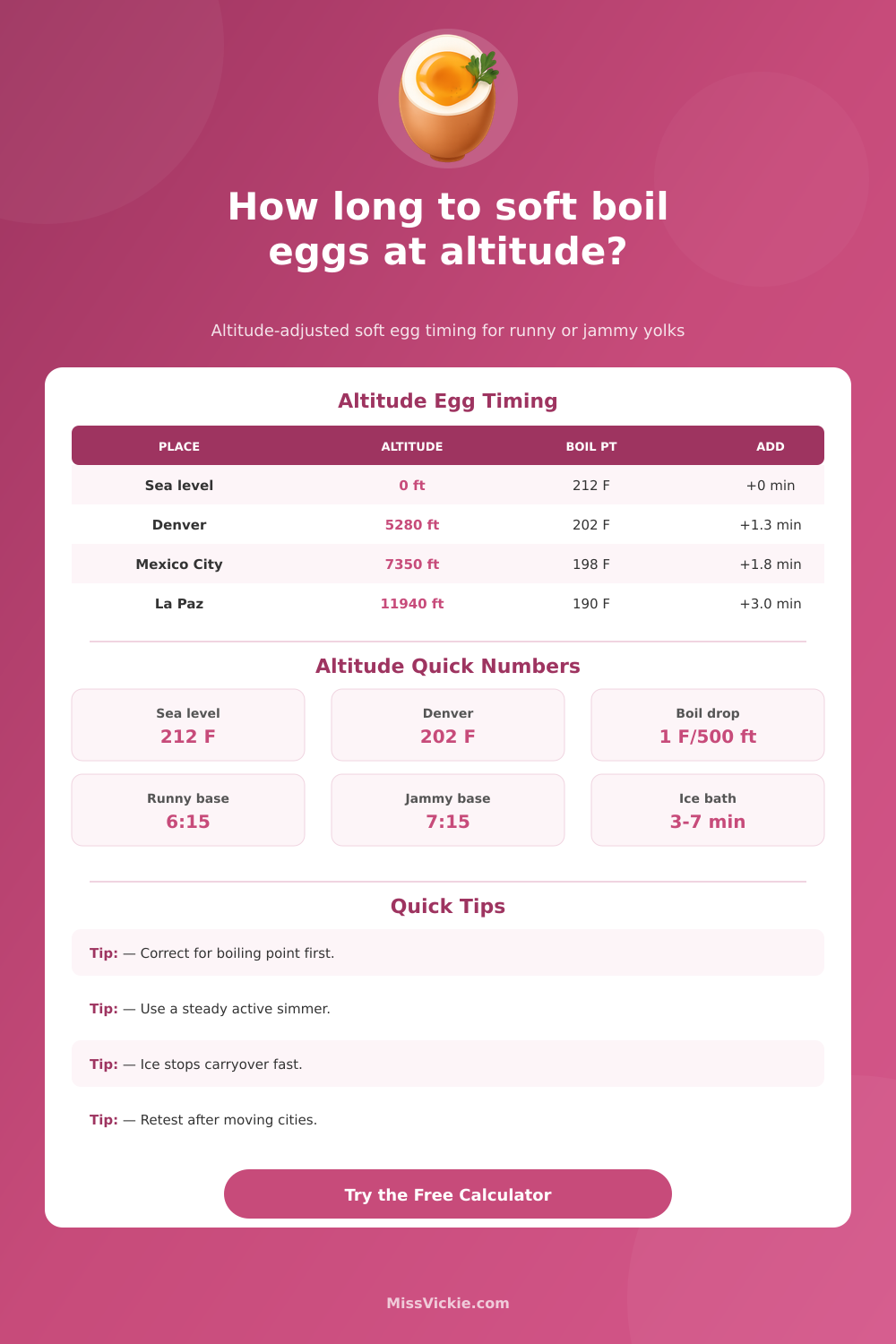
| Kitchen altitude | Approx boiling point | Soft egg effect | Runny target note | Jammy target note |
|---|---|---|---|---|
| 0 ft / 0 m | 212°F / 100°C | No altitude add | Use normal timing. | Large eggs often land near 7 minutes. |
| 2,500 ft / 760 m | 207°F / 97°C | Add about 35 seconds | Ice bath matters more. | Keep a lively simmer. |
| 5,280 ft / 1,609 m | 202°F / 94°C | Add about 1 to 1.5 minutes | Runny whites may need steady bubbles. | Denver-style jammy eggs need patience. |
| 7,500 ft / 2,286 m | 198°F / 92°C | Add about 1.8 minutes | Small eggs are easier to control. | Expect a broader jammy window. |
| 10,000 ft / 3,048 m | 194°F / 90°C | Add about 2.5 minutes | Use covered recovery. | Check one test egg first. |
| 12,000 ft / 3,658 m | 190°F / 88°C | Add about 3 minutes | Very runny centers are harder. | Jammy is more reliable than runny. |
🥚Sea-Level Egg Size Baselines
| Egg size | Typical weight | Runny center | Soft boiled | Jammy center |
|---|---|---|---|---|
| Small | About 50 g / 1.8 oz | 5:35 | 6:05 | 6:55 |
| Medium | About 57 g / 2.0 oz | 5:55 | 6:25 | 7:10 |
| Large | About 64 g / 2.25 oz | 6:15 | 6:45 | 7:30 |
| Extra large | About 73 g / 2.6 oz | 6:40 | 7:10 | 7:55 |
| Jumbo | About 80 g / 2.8 oz | 7:00 | 7:35 | 8:25 |
💧Start Method, Simmer, And Cooling Adjustments
| Factor | Setting range | Timer effect | Altitude interaction | Best use |
|---|---|---|---|---|
| Start method | Boiling, simmer, cold start | -10 sec to +2.5 min | Cold starts hide altitude differences. | Use boiling start for testing. |
| Simmer vigor | Rolling to weak simmer | -5 sec to +55 sec | Weak simmer is worse at high elevation. | Keep frequent bubbles. |
| Egg temperature | Room to very cold fridge | -25 sec to +55 sec | Cold yolks lag more in cooler water. | Use consistent fridge eggs. |
| Pot load | 1 to 36 eggs | -5 sec to +55 sec | Crowding slows recovery. | Split large batches. |
| Cooling | Ice bath to no cooling | 0 to -50 sec | High-alt eggs still carry over. | Use ice for runny centers. |
🗺City Preset Comparison Grid
Use standard soft boiled timing and tune by egg size, fridge temperature, and ice bath.
The lower boil usually needs about 1 to 1.5 extra minutes for large eggs.
Jammy eggs are more forgiving than runny eggs because the set window is wider.
Very high kitchens benefit from covered recovery and a one-egg test batch.
🧊Cooling And Carryover Reference
| Finish method | Cooling time | Carryover effect | Best target | Altitude note |
|---|---|---|---|---|
| Immediate ice bath | 3 to 7 min | Stops the yolk fastest | Runny or soft | Best for repeatable high-altitude results. |
| Cold tap bath | 4 to 8 min | Moderate carryover | Soft boiled | Works if the water is truly cold. |
| Short rinse | 30 to 90 sec | Yolk keeps thickening | Eat warm | Subtract timer seconds to avoid overset yolks. |
| No cooling | None | Strong carryover | Serve in shell | Most risky for runny eggs at any elevation. |
📌Altitude Timing Anchors
💡Altitude Egg Tips
Soft-cooked eggs are not the same as fully hard-cooked eggs. Anyone who needs fully cooked eggs for food-safety reasons should choose a firmer target and verify doneness.
At sea level, most of us learned how long to cook an egg through rote memory: six minutes if you want something runny; seven if you want something that’s kind of jammy (and add a bit longer if they came right out of fridge). Until the day you find yourself up in the mountains, maybe in a cabin above the tree line, or maybe just in Denver. Now, your carefully time-tested eggs emerge barely set in center but rubbery all around. Did someone steal your watch? No, no, it’s not the time, exactly, but rather the air pressure. As you gain altitude, water doesn’t boil at 212 degrees anymore. Its heat transfer into whatever you’re cooking more slowly, meaning less gets transferred to your egg.
That’s where the magic of the calculator comes in. It’ll do the exact math based off where you are. Understanding what’s actualy happening will help you solve the puzzle when things don’t work out. For every five hundred feet of altitude gained, boiling point decreases about one degree Fahrenheit. It may not sound like much, but when it comes to proteins like eggs, small differences in temperatures is everything. The boiling point of water is two hundred twelve degrees Fahrenheit at sea level. At more than seven thousand feet above sea level (as in Mexico City), that number rounds off to nineteen eight.
How to Boil Eggs at High Altitude
Fourteen degrees isn’t nothing, that’s why egg whites require additional time to set, and the yolks longer still, since heat only travel inward. You’re not just extending the cook time; you’re adjusting to an entirely new cooking medium. Guessing will not work as well here; accuracy of input is important.
Since altitude affects how long it takes food to reach boiling but does not affect the rate at which water cools from a boil back to room temp, cold-water starts conceal these effects (the effects are immediate when boiling water to start). Dropping eggs directly into a pot of already-simmering water exposes them to the same shock at any elevation, making the time accurate no matter what. Coldwater starts introduce variables: How fast did the water heat up? The boiling point is lower. This adds another problem and makes the timing more confusing. It makes consistency hard or even impossible. Consistency is half the battle.
Other big variables that most people overlook are egg size and storage temperature. A larger egg has more mass and will take longer to come up to the same internal temperature as a smaller egg. And if you pull it out of a very cold fridge instead of letting it warm up first, that’s another layer of thermal resistance. The baseline is adjusted based on egg size and starting temperature and then the altitude correction are applied. That makes sense; the altitude penalty doesn’t start to apply until you’ve brought the egg up to temperature. If you ignore the starting temp, you’re like driving with the parking brake on and complaining about how slow the road is.
The other side of the equation is also critical: cooling. And that’s particularly true at higher elevation, where carryover cooking gets crazy. As soon as a cooked egg comes out of water it keeps cooking inside. At sea level, that carryover isn’t so bad. But higher up, the whole system have less total heat; the gradient from hot to cool (the yolk to white) changes. That means you can freeze your eggs immediately in an ice bath and stop the process dead in its tracks, fixing them into the texture you were going for. Without the ice bath, you’re basically making a guess about how thick the white will end up after you wait to serve it. This is what the table on the page spells out so well, how different types of cooling affect the carryover risk at different altitudes.
Other cooks react by cranking up the burner. No matter how much the water bubbles, that bubbling won’t make it hotter then its own boiling point. High-altitude water can’t get there, even though it might do a lot more active bubbling than at sea level. All that affects is the speed with which the pot regains temperature once you plunk those cold eggs into it. To hold that temperature… And this is where the tool’s got the right idea, use extra liquid. Adding water does that. So does leaving more space in the pan, which lowers the temperature even more. Consistency beats perfect every time.
To test this, try an egg in your standard pan on your standard burner at your altitude. Write down how long it took, and work from that point forward. The calculator gives you a highly educated starting point, saving you the trial and error of ruined breakfasts. But remember, your kitchen is odd. Your stove could be running hot/cold, and your eggs may be older than they appear. Get the range of possibilities from the calculator, then trust your tongue for the rest. Everything you need to know will show up in the first bite, except what the thermometer says.