Hard Boiled Egg Air Fryer Time Calculator
Estimate dry-heat hard boiled chicken egg timing from egg size, batch count, air fryer wattage, basket crowding, preheat, shell thickness, fridge temperature, yolk target, ice bath, altitude, ambient kitchen temperature, and peelability.
🥚Air Fryer Egg Presets
These presets use air-fryer dry heat, not water boiling. Pick a situation, then fine tune for your basket and eggs.
⚙Eggs, Basket, And Kitchen Conditions
Your Dry-Heat Egg Plan
Adjust inputs to calculate a hard-boiled egg time for your air fryer.
Timing Breakdown
Condition Corrections
📊Chicken Egg Air-Fryer Reference
Best for fewer cracked shells.
Stops dry-heat carryover.
Airflow should reach all shells.
Calibrate a new air fryer first.
🌡Baseline Dry-Heat Timing Table
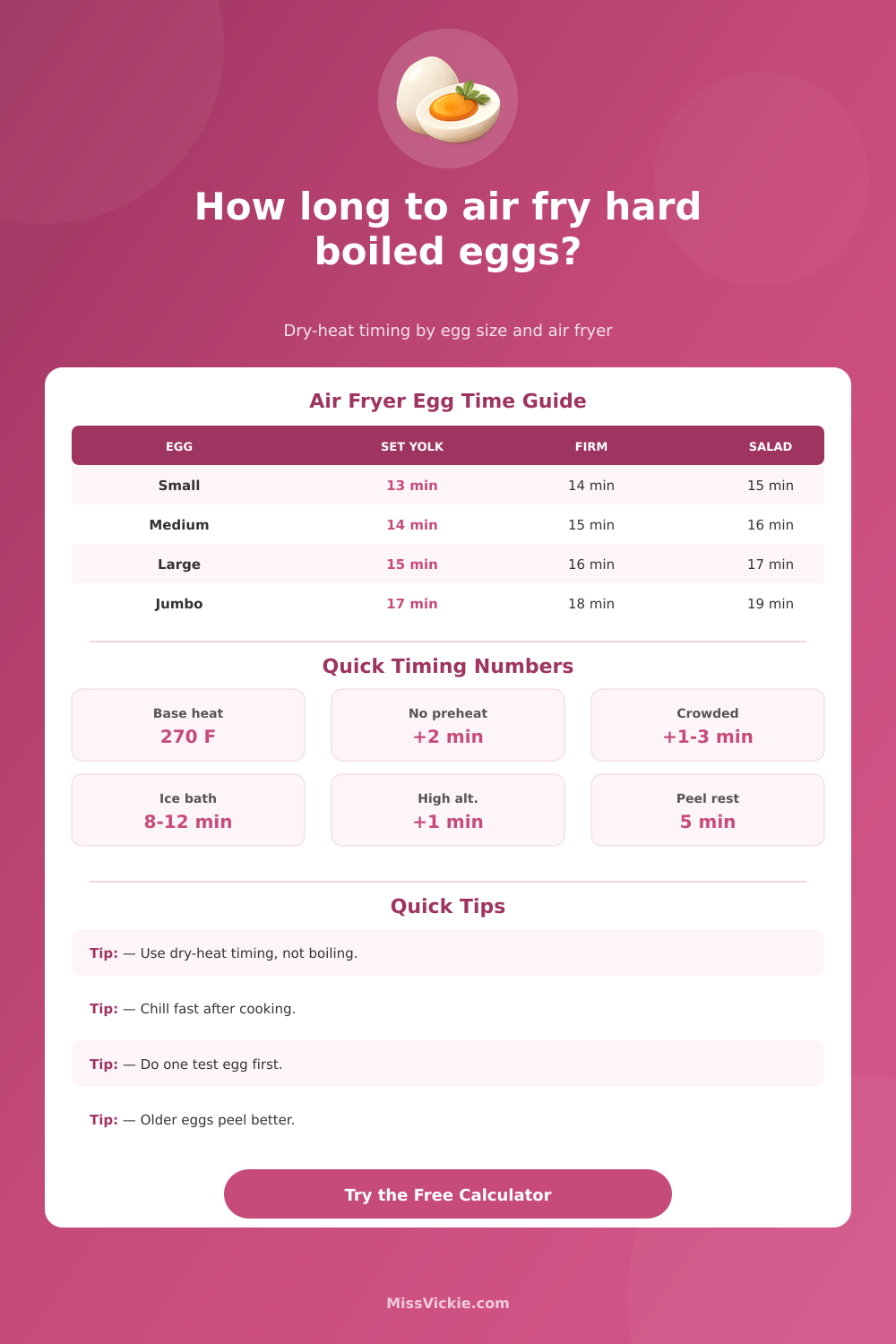
| Chicken egg size | Approx weight | Just hard set | Classic firm | Salad or deviled |
|---|---|---|---|---|
| Peewee | 35 g | 12 to 13 min | 13 to 14 min | 14 to 15 min |
| Small | 43 g | 13 to 14 min | 14 to 15 min | 15 to 16 min |
| Medium | 50 g | 14 to 15 min | 15 to 16 min | 16 to 17 min |
| Large | 57 g | 15 to 16 min | 16 to 17 min | 17 to 18 min |
| Extra large | 64 g | 16 to 17 min | 17 to 18 min | 18 to 19 min |
| Jumbo | 71 g | 17 to 18 min | 18 to 19 min | 19 to 20 min |
Table assumes a preheated basket air fryer at 270°F, refrigerated eggs near 38°F, a single spaced layer, and an immediate ice bath.
🌬Air Fryer And Basket Adjustment Table
| Condition | Typical adjustment | Why it changes | Best check |
|---|---|---|---|
| No preheat | Add 1.5 to 2.5 min | The basket, grate, and cavity heat with the eggs. | Use the first batch as calibration. |
| Mini low-watt basket | Add 1 to 2 min | Small heating elements lose more heat to a cold batch. | Keep eggs in one open layer. |
| Oven-style tray | Add 1 to 3 min | Larger cavities move heat less aggressively around shells. | Rotate tray halfway if needed. |
| High-flow basket | Subtract 0.5 to 1 min | Fast convection warms the shell surface more quickly. | Check for over-firm yolks. |
| Crowded basket | Add 1 to 3 min | Eggs block airflow and act like a cold thermal mass. | Shake gently only if shells are stable. |
| Stacked rack | Add 2 to 4 min | Top and lower layers receive uneven fan exposure. | Swap racks halfway through. |
🧊Peelability And Finish Guide
Usually peel cleaner than same-day eggs.
Enough for a few same-day eggs.
Better for deviled egg halves.
Tap, roll, and peel under cool water.
📘Common Air-Fryer Egg Scenarios
| Scenario | Setup | Starting point | Ice bath |
|---|---|---|---|
| Breakfast for 2 | 4 large eggs, preheated basket | 15 to 16 min | 8 min |
| Meal prep dozen | 12 large eggs, touching layer | 17 to 18 min | 10 min |
| Deviled eggs | 12 older large eggs, clean peel target | 17 to 19 min | 12 min |
| Egg salad | 8 extra-large eggs, very firm yolks | 18 to 20 min | 10 min |
| Mini fryer | 4 medium eggs, 900 W basket | 16 to 18 min | 10 min |
| Oven-style tray | 12 large eggs on tray | 18 to 20 min | 12 min |
💡Dry-Heat Notes
There’s nothing quite as satisfying as peeling an egg so its shell simply slides off in one piece. It is like the universe just lined up for you. If they say the air fryer has precision, it’s precisely because it doesn’t use splashing water. Instead, it dries out heat. That eliminates splash risk, and sometimes yields a cleaner peel.
But circulating hot air around a delicate shell require careful timing. Too short and the insides is still gooey, derailing your salad goals. Too long, and you’ll notice a gray-green donut ring surrounding the yolk. That tells you sulfur compounds has reacted with too-cooked protein. It takes a starting point that considers your eggs fridge and the machine itself. So having something that does the math for you can help sidestep guesswork.
How to Cook Perfect Eggs in an Air Fryer
But the problem with cooking eggs in an air fryer lie at the heart of why they cook at all: how does mass interact with airflow? In other words, larger eggs has higher volume than smaller ones, and thus take longer to get heated through. That’s why you don’t overcook the white on the outside. That’s why I ask for egg size (see calculator above) and how you like your yolk cooked. Do you want it just set? Do you want them firm enough to slice into and serve atop deviled eggs? By changing the time to match, we’re accounting for that factor.
Air fryers aren’t one-size-fits-all appliance. Some models is small and compact; others are big and oven-like, meaning they recover heat quicker after a sudden blast of cold food tossed inside (like refrigerated eggs). Low wattage machines struggles to hold their own as heat builds up. Account for that, and you’ll need a few extra minutes to make up the difference.
Another thing I see people mess up on quite often that throws their timing way off is overcrowding the basket. Stacking and touching eggs block airflow, which slows down the rate of heat transfer. Adding some extra time depending on how tight you pack things in is a factor that the tool accounts for when it calculates times (cooking a single egg vs. A dozen meal prep batch).
If you’re feeding a crowd, don’t attempt to save time by piling them on top of each other; just trust the adjusted time and go with it. Cooking two slightly longer batches are preferable to one perfect disaster that results in underdone eggs here and rubbery ones there.
One variable that people often overlook is preheating. It makes all the difference in starting conditions. When the basket starts cold, the oven must both cook the eggs and heat up both the air cavity AND the metal grate. This basically lowers the actual temperature inside for the first several minutes of the cycle. So subtract out these extra minutes when skipping preheat. However, when preheating, shave off an additional minute or two if your fryer was previously hot from baking chicken thighs.
The last thing you should of do is put them in and have the whites boil away immediately while the shell cracks in half. Thickness of the shells matter too. Since brown shells are thicker, they provide more insulation which will slow down the heat penetration by just enough to require a small buffer period.
Cooking time aside, however, I’d say the ice bath is the most critical step. Because the interior temperature of the egg is still hot, it’s continuing to “cook” via dry heat once the timer sounds. You’ll notice if you keep them in the warm basket they’re going to overcook beyond your desired doneness. Placing them directly into an ice water bath ends the carryover process and also makes it easier to separate the membrane from the shell during peeling.
As eggs age, their pH gradually increases until the inner lining becomes looser, making older eggs easier to peel compared to fresher ones. Add a good chill to that equation, and voilà, slip right out of the shell each and every time.
In the kitchen, the best tool you have is a calibrated tool. Because of where the heating elements are located and because different machines use different speeds for their fans, every air fryer acts a little bit differently. Take your range of calculations and go from there, but first, try an egg by itself. Was it undercooked? Next time, add a minute. Was it exactly right? Save that number.
Perfection isn’t the objective; consistency is. After a few experiments with your particular appliance and its ability to conduct (or not conduct) heat, you won’t need generic charts anymore, you’ll know what your data says. This means you’ll feel confident enough to trust yourself. Because of that, a potentially risky experiment becomes a repeatable routine. Before long, you realize that the air fryer doesn’t only make eggs quicker, it also makes them more predictable.