Soft Boiled Duck Egg Time Calculator
Estimate soft boiled duck egg timing for runny, jammy, or custardy yolks using egg weight, fridge or room temperature, cold-start or boiling-start method, altitude, simmer intensity, shell thickness, ice bath, toast or ramen use, and carryover.
Choose a starting scenario, then fine-tune the duck egg weight, yolk target, start temperature, altitude, simmer, shell thickness, ice bath, and serving style. Soft boiling is more sensitive than hard boiling, so small changes matter.
Soft duck egg plan
Use the timer as a target window, then adjust by 15 to 30 seconds after your first batch.
Timing Breakdown
Batch Details
A bigger center than a 50 g chicken egg.
Most medium to large duck eggs land here.
Enough to slow carryover without fully cooling breakfast eggs.
Small adjustments visibly change duck yolk texture.
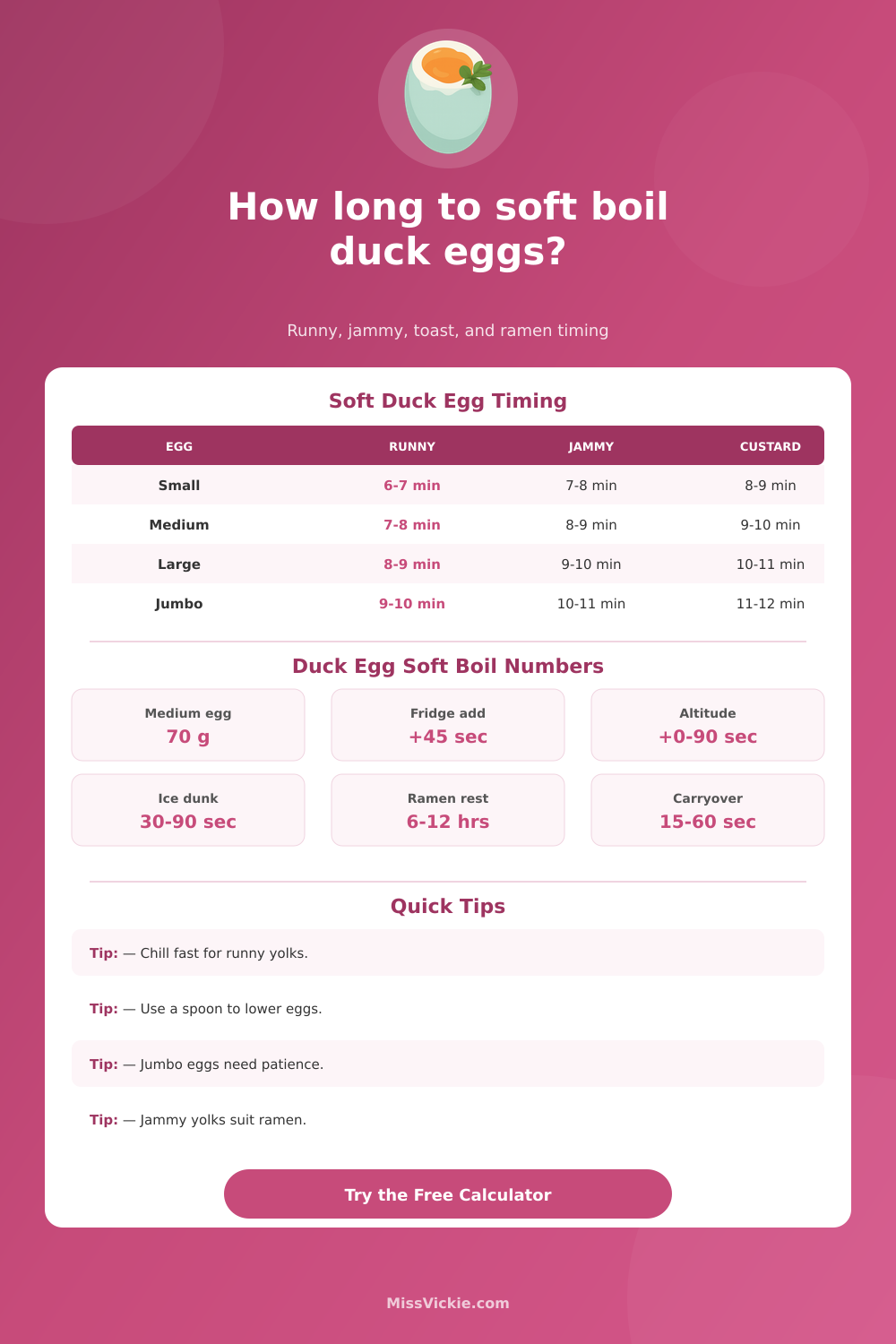
| Duck egg size | Approx. weight | Runny yolk | Jammy yolk | Custardy almost-set |
|---|---|---|---|---|
| Small duck egg | 55 to 62 g / 1.9 to 2.2 oz | 6:15 to 7:00 | 7:15 to 8:00 | 8:15 to 9:00 |
| Medium duck egg | 63 to 74 g / 2.2 to 2.6 oz | 7:00 to 7:45 | 8:00 to 8:45 | 9:00 to 9:45 |
| Large duck egg | 75 to 88 g / 2.6 to 3.1 oz | 7:45 to 8:45 | 8:45 to 9:45 | 9:45 to 10:45 |
| Jumbo duck egg | 89 to 105 g / 3.1 to 3.7 oz | 8:45 to 9:45 | 9:45 to 10:45 | 10:45 to 11:45 |
Times assume a boiling start at low altitude, gentle simmer, and immediate short chill or cold rinse.
| Condition | Typical change | Effect on soft yolks | Best kitchen move |
|---|---|---|---|
| Refrigerated duck eggs | Add 30 to 60 seconds | The larger yolk center starts colder and lags behind the white. | Lower gently and keep water moving at a gentle simmer. |
| Room temperature eggs | Subtract 15 to 30 seconds | They reach jammy faster, especially in small batches. | Use the lower end for runny toast eggs. |
| 3,000 to 5,000 ft altitude | Add 25 to 45 seconds | Cooler boiling water slows setting but keeps yolks glossy. | Use a lid between additions and avoid weak simmering. |
| Over 5,000 ft altitude | Add 60 to 90 seconds | Runny targets become less predictable without a steady simmer. | Test one egg and add 15 seconds if the white is loose. |
| Use | Best yolk target | Chill or rest | Carryover warning |
|---|---|---|---|
| Toast soldiers | Runny yolk, just-set white | 30 to 45 second cold rinse | Serve fast; the yolk thickens while the egg sits. |
| Ramen egg | Set-edge jammy yolk | Ice 2 to 4 minutes before peeling | Marinade firms the outer yolk, so do not overcook first. |
| Salad topper | Loose jammy to custardy | Ice 2 to 5 minutes for slicing | Short chill makes cleaner halves without a hard-boiled center. |
| Warm snack | Loose jammy yolk | Brief rinse, peel warm | A thick duck shell holds heat longer than a chicken egg. |
| Cooling choice | Time | Best for | Texture result |
|---|---|---|---|
| Quick cold rinse | 30 to 60 seconds | Toast and breakfast bowls | Warm white, very loose yolk, more carryover. |
| Short ice dunk | 1 to 2 minutes | Loose jammy eggs | Peelable shell with a warm center. |
| Ramen chill | 3 to 5 minutes | Peeling before marinade | Cleaner peel and a yolk that holds shape. |
| Full cold set | 6 to 10 minutes | Meal prep or slicing later | Less carryover, but the egg is no longer warm to serve. |
Larger yolks need more time than chicken eggs, but the pull window is still narrow.
Hard-boiled duck egg timing pushes past jammy and fully sets the rich center.
Most chicken egg soft-boil charts are too short for medium and large duck eggs.
Quail eggs are tiny and should never be timed from a duck egg calculator.
Don’t assume a duck egg is just a larger version of a chicken egg. It’s not. Boiling them for seven minutes typically lead to a rubbery/undercooked result. Duck eggs are different; they contain more water, have a richer yolk, and the shell itself is thicker. All these factors alters their cooking characteristics. In fact, the timing window is smaller then you may expect.
That’s why there are soft boiled duck egg time calculators. And they do deal with the factors that is difficult to estimate with the naked eye. So what’s the catch? How do we make this work? That’s the variable: Egg starting temperature. If the egg starts in a fridge (cold), it will turn out different than an egg that start at room temperature. Your pot of water is roughly 100 degrees; your refrigerator is about three degrees Celsius. That’s a significant difference, and that’s why the yolk need more time to “set” as the heat travels further into it. To get around this, I’ll put my eggs on the counter until they come up to room temperature. This saves me time in the kitchen but it makes it easier to overcook them. With the warm vs. Cold input, the calculator do the math for you. No more guesswork based off instinct.
Why Duck Eggs Are Different to Cook
And there’s altitude as well. The lower the air pressure, the lower the boiling point of water. Your water may boil at ninety-six degrees Celsius, not a hundred, if you’re at five thousand feet. And that little variation can make all the difference; it take longer for proteins to thicken in cooler water. To compensate for the more gentle heat, plan on adding a bit of extra time. People who lives in valleys often overlook this fact. When the recipe goes awry, they fault their technique, but in reality they are victims of atmospheric pressure.
But how hard you simmer also counts, not just for how long. If you have too high a simmer, it will bounce the egg around hard. That can crack the shell and cause the white to be scrambled unevenly. You should of aim to have something closer to a gentle simmer so that the egg stays put. If you choose between a bare vs strong simmer, this adjustment moves your baseline time up or down. But it’s more about control than speed. You don’t want to wreck the outside while letting the inside cook evenly.
Most people’s soft- or hard-boiled eggs end up peeling poorly. One reason: duck eggs are thick-skinned; the membrane sticks tightly to the white. To get it out easily: Ice water will stop the cooking action and shrink the cooked egg within its shell just enough to make room. But here’s the trick: Chill timing is everything. A half minute in cold water rinses the breakfast egg well but it remains sticky. Three minutes in cold water produces a clean peel suitable for marinading in ramen broths, but cools the yolk too much for immediate dipping. The chart on the page links chilling time with application.
There’s also carryover cooking to think about. Once you’ve taken your pan off the heat, there’s still some residual energy at work: it keeps on cooking the yoke. To get a runny yoke, then, you need to pull the eggs sooner. And you need to have faith that whatever leftover heat remains will do its thing as soon as you crack ’em open. With jammy yolks destined for salad, you can go longer. That’s because the high-protein content last longer when faced with further exposure.
The shell is porous. Shell thickness depends on freshness. Ducks will often produce porous, thick-shelled eggs, especially if they are farm fresh. They insulate more than store-bought eggs, which is usually older. This means they slow down heat transfer. These are tiny details, but they is important for getting the exact texture. The older egg peels off easier (the air cell has expanded). Taste-wise, the fresher the egg, the better. To each their own, convenience versus taste.
Soft boiled duck eggs are different than large chicken eggs. They have their own biology that you need to respect. Don’t think of them simply as bigger chicken eggs. They are a unique ingredient with their own rules. To get started, use the calculator. Then adjust + or, fifteen seconds based off your pot and stove. You want a perfectly creamy yolk and firm whites every time. Test it out with one egg. Get to know how your kitchen behaves. Scale up from there. Knowing what you’re realy measuring is the trick.