Blanching Zucchini Time Calculator
Estimate zucchini blanching time for shredded zucchini, coins, half-moons, diced pieces, spears, batch weight, boiling water or steam, water volume, altitude, ice bath strength, casserole prep, squeeze level, and texture target.
🥒Zucchini Blanching Presets
Choose a zucchini-specific starting point, then adjust thickness, total batch, pot water, cooling, moisture removal, freezer packing, and final texture.
⚖Zucchini, Pot, And Texture Inputs
Zucchini blanch plan
Enter a batch to calculate timing, cooling, and drain steps.
Timing Breakdown
Batch And Moisture Plan
📌Zucchini Blanching Reference Cards
Brief heat sets color before squeezing for bread, fritters, casserole, or sauce.
Good freezer baseline for 1/3 inch slices when water volume is adequate.
Useful for chunky half-moons, large garden pieces, or softer recipe prep.
Steam needs longer contact and a shallow basket to heat the center evenly.
⏱Cut Style And Thickness Timing Table
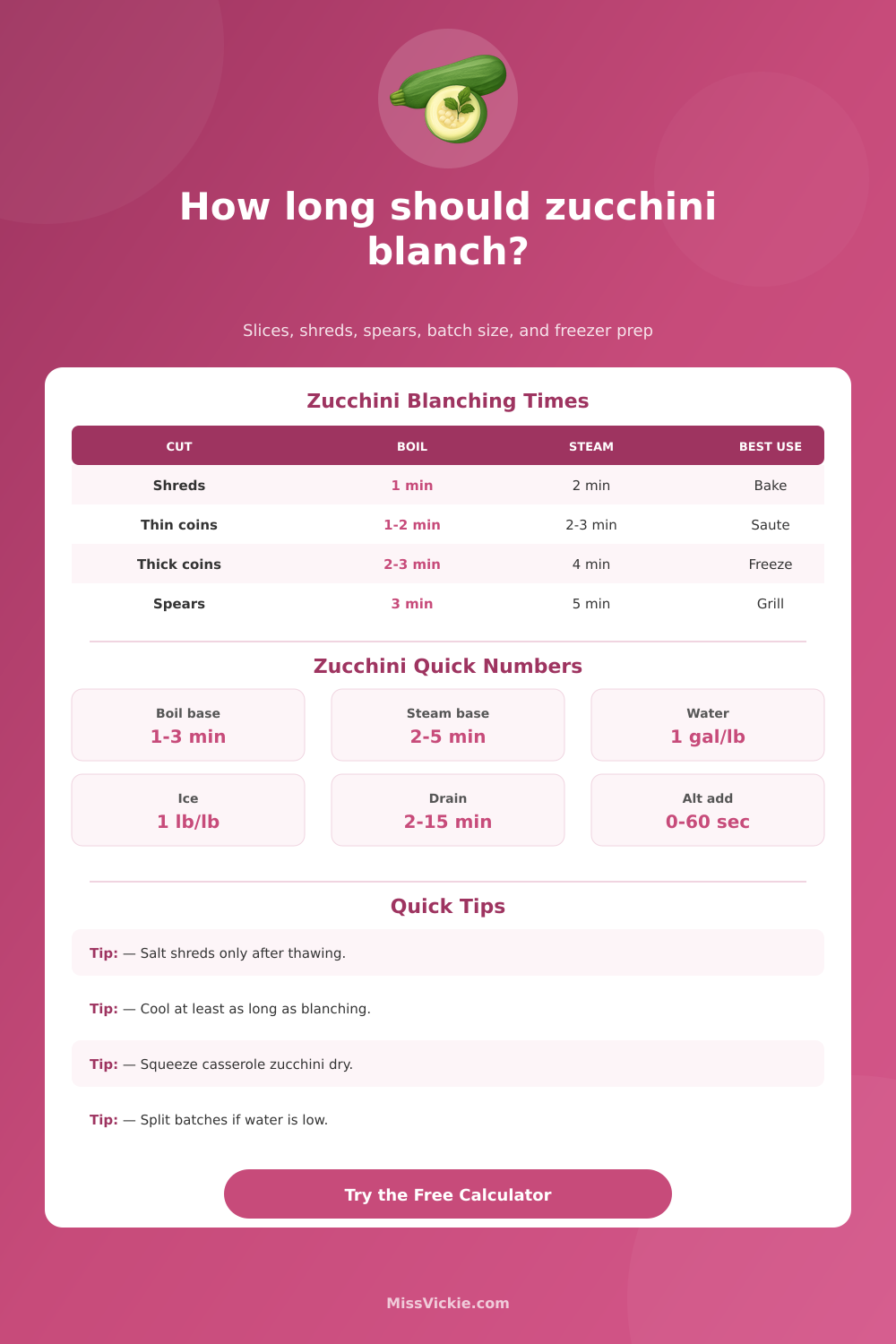
| Zucchini cut | Typical thickness | Boiling water | Steam blanch |
|---|---|---|---|
| Shredded zucchini | Fine to coarse shreds | 45 to 75 seconds | 1.5 to 2.5 minutes |
| Thin coins or half-moons | 1/8 to 1/4 inch / 3 to 6 mm | 1 to 1.5 minutes | 2 to 3 minutes |
| Medium freezer coins | 1/3 inch / 8 mm | 2 minutes | 3.5 to 4 minutes |
| Thick coins or chunks | 1/2 inch / 12 mm | 2.5 to 3 minutes | 4.5 to 5 minutes |
| Long spears or sticks | 1/2 to 3/4 inch / 12 to 19 mm | 3 minutes | 5 minutes |
| Diced zucchini | 1/2 inch / 12 mm cubes | 2 to 2.5 minutes | 4 minutes |
Start boiling-water timing when the water returns to a strong boil after the zucchini goes in. For steam, start when the basket is covered and steaming hard.
💧Batch Weight, Water, And Ice Table
| Prepared zucchini | Boiling water target | Ice bath target | Best batch note |
|---|---|---|---|
| 0.5 lb / 225 g | 0.5 gal / 1.9 L | 0.5 lb / 225 g ice | Easy small saucepan batch for shreds or thin coins |
| 1 lb / 450 g | 1 gal / 3.8 L | 1 lb / 450 g ice | Good home-freezer load for coins and half-moons |
| 2 lb / 900 g | 2 gal / 7.6 L | 2 lb / 900 g ice | Use a stockpot or split into two quick rounds |
| 4 lb / 1.8 kg | 4 gal / 15 L | 4 lb / 1.8 kg ice | Refresh ice water halfway through garden batches |
⛰Altitude, Method, And Recovery Table
| Condition | Timing adjustment | Why it matters | Kitchen move |
|---|---|---|---|
| Under 3,000 ft / 900 m | No extra time | Boiling temperature is close to standard | Use normal zucchini chart timing |
| 3,000 to 5,000 ft / 900 to 1,500 m | Add 15 to 30 seconds | Cooler boiling water slows heat transfer | Keep slices even and loads modest |
| Over 5,000 ft / 1,500 m | Add 45 to 60 seconds | Soft vegetables still need enough heat for freezer prep | Use strong ice water after heating |
| Low water ratio | Add 15 to 45 seconds | The pot takes longer to rebound after loading | Split batches instead of overcooking |
| Steam basket packed deep | Add 30 to 60 seconds | Steam reaches the center slowly | Spread zucchini in a shallow layer |
🧊Freezer, Casserole, And Moisture Finish Table
| Final use | Texture target | Drain or squeeze | Packing advice |
|---|---|---|---|
| Freezer side-dish coins | Firm but heated through | 2 to 4 minutes towel or tray dry | Pack flat bags with air pressed out |
| Tray-frozen slices | Firmest practical slice | 4 to 6 minutes tray dry | Freeze loose, then bag for scoopable portions |
| Zucchini casserole | Tender, less watery | 8 to 12 minutes press under towel | Measure after pressing so sauce stays thick |
| Zucchini bread shreds | Briefly set, then squeezed | 10 to 15 minutes squeeze or wring | Freeze in recipe-size cups or weights |
| Same-day saute | Crisp-tender | Quick drain, then hot pan | Season after draining to avoid extra water |
📊Zucchini Method Comparison Grid
Best for freezer chart-style prep because water surrounds every cut surface quickly.
Helpful for casserole zucchini and spears, but use shallow layers and longer timing.
Blanch briefly, cool hard, and squeeze after thawing or before freezer packing.
Remove spongy seed cores from oversized zucchini before blanching for better texture.
💡Zucchini Blanching Tips
Blanching is a bridge to long-term storage for when all those zucchinis suddenly come in faster than you can eat them. Not only are they quick-growing but they take over the countertop, too.
Blanched: Not merely a way to kill any lurking bacteria, but also a way to manage moisture so it doesn’t turn your lasagna into soup or your bread into a soggy brick. Once you choose shape of cut, the blanching time math is done for you by the calculator above, sparing you guesswork about whether 3 minutes will be too long for shreds or if thick coins need it longer.
How to Blanch Zucchini
Zucchini’s pretty finicky: most home cooks think of it as indestructible, but in fact its cell walls are thin and packed with water, which means heat penetrates quickly. Shredded into strands, it takes far less time than a coin-slice of equal thickness would in the same boiling water; cook a piece too long and you have no remaining texture to enjoy, and a mushy exterior from undercooking compared to the inside. Cut too short and you’ll end up with mush on the outside and raw middle, even after what you thought was enough cooking.
This is why the appliance asks you what style of cuts you want and how thick they should be. Because denser pieces take longer for steam to penetrate than boiling water, this changes the clock.
Another factor that catches veteran home chefs by surprise: altitude. If you’re over three thousand feet, then water will boil at a different temperature than shown on standard charts. Sure, the water may be boiling and rolling around, but the heat exchange happens more slowly. So you set your timer, thinking everything’s cool, but realy the zucchini’s cooking in slightly cooler water than expected. To account for that physics issue, the calculator adds time to make sure those enzymes get deactivated just right. Otherwise, your frozen vegetables can end up with off-flavors, or going gray; within a month of being stored. It is a small fix but it leads to less waste.
Most folks skimp here: the ice bath. This part of the process is as critical as the heating up. Blanching stops the cooking process only once the vegetables reaches near-freezing temperatures in an ice bath. Drain your hot zucchini in a colander and let them sit. Residual heat will still be softening the inside. What’s required is a bath of ice sufficient to quickly lower their temp.
The calculator calculates weight of ice needed, depending on what size batch you’re making. A general rule of thumb: Use one pound of ice for every pound of zucchini to quickly cool them. Are you working in batches or running out of ice? Beware bruising textures and uneven cooking.
The key to success with your finished dish: how do you manage moisture? Water will get into zucchini, like a sponge. Where does it go? How do you drain it? With frozen foods, especially in freezer bags, it is good to keep some moisture inside for reheating, but the outside should be dry. For baking dishes, casseroles, etc., removing as much water as possible are necessary. Your purpose (baking vs freezing) ties into the right way to deal with water. That’s why I matched the moisture removal guidance to each purpose on the calculator.
If you pack your food while it is still wet, even the best blanched coins is ruined. Ice forms between the vegetables as they freeze. This ice burns away at the exposed surface of your vegetable. Remove as much extra water as you can and squeeze out the air. You will have better-quality food all winter long.
With shredded zucchini, on the other hand, you need to think differently. Its surface area is enormous, meaning just half a minute in boiling water can be all that’s needed to set the color. There’s no point cooking it at this stage; you’ll be squeezing it in a moment. All you’re after is a brief exposure to heat then thorough drying. Skipping the blanching stage for shreds is a recipe failure common among home cooks: Their fritters and breads has raw flavor notes. A brief dip solves that problem without compromising shred structure (which would make it impossible to squeeze).
Batch size depends on your kitchen set-up. Boiling a big pot full of anything will take time to re-heat, so don’t load it with too many vegetables, or else you’ll crash the temp. Overfilling a gallon of water with four pounds of zucchini do not result in blanching; it is more like stewing. To avoid this, divide up large hauls into portions that you can handle comfortabley. Everyone in the batch will get an even amount of hot water; this may feel slow but it will look a lot better at the end. Keep a good pace going, prep the ice bath as the initial load comes to temp and you’ll be working smart!
Blanching lets me enjoy home-grown zucchini long after harvest time, when the vegetable dissapears from the garden and I am left with too much summer produce. All that’s required is to control the amounts of moisture, time and temperature, and transform a momentary glut into freezer fillers you can count on all year.
If you plug in the numbers on the calculator above, it’ll do the math for you; it will tell you exactly how long to boil or steam it, depending on your circumstances. The result: Freezer bags whose contents don’t stick together and thaw nicely, and casseroles that stay intact. What does it take? It is primarily about knowing what happens during each step, which isn’t so much following a recipe as honoring the laws of water and heat. Get the timing right, and you’ll have some mountains of summer zucchini under control instead of in crisis mode in the kitchen. Out come crisp-tender slices or perfectly dry shreds, waiting for the next meal.