Blanching Cauliflower Time Calculator
Estimate cauliflower blanching time for floret diameter, stem-piece load, prepared batch weight, boiling water or steam, pot volume, altitude, ice bath strength, freezer versus salad texture, color and firmness target, and final drain time.
Pick a real cauliflower prep scenario, then adjust the cut, stem mix, batch size, water, altitude, chill, and draining plan.
Cauliflower blanch plan
Start timing when the water returns to a full boil or the steamer is fully steaming.
Timing Breakdown
Batch Setup
Best for riced cauliflower, quick salads, and small curd clusters.
Classic freezer blanch for even 1.5 inch cauliflower pieces.
Use for thick roasting pieces or florets with attached stalks.
Covered steam runs longer and rewards shallow, uncrowded baskets.
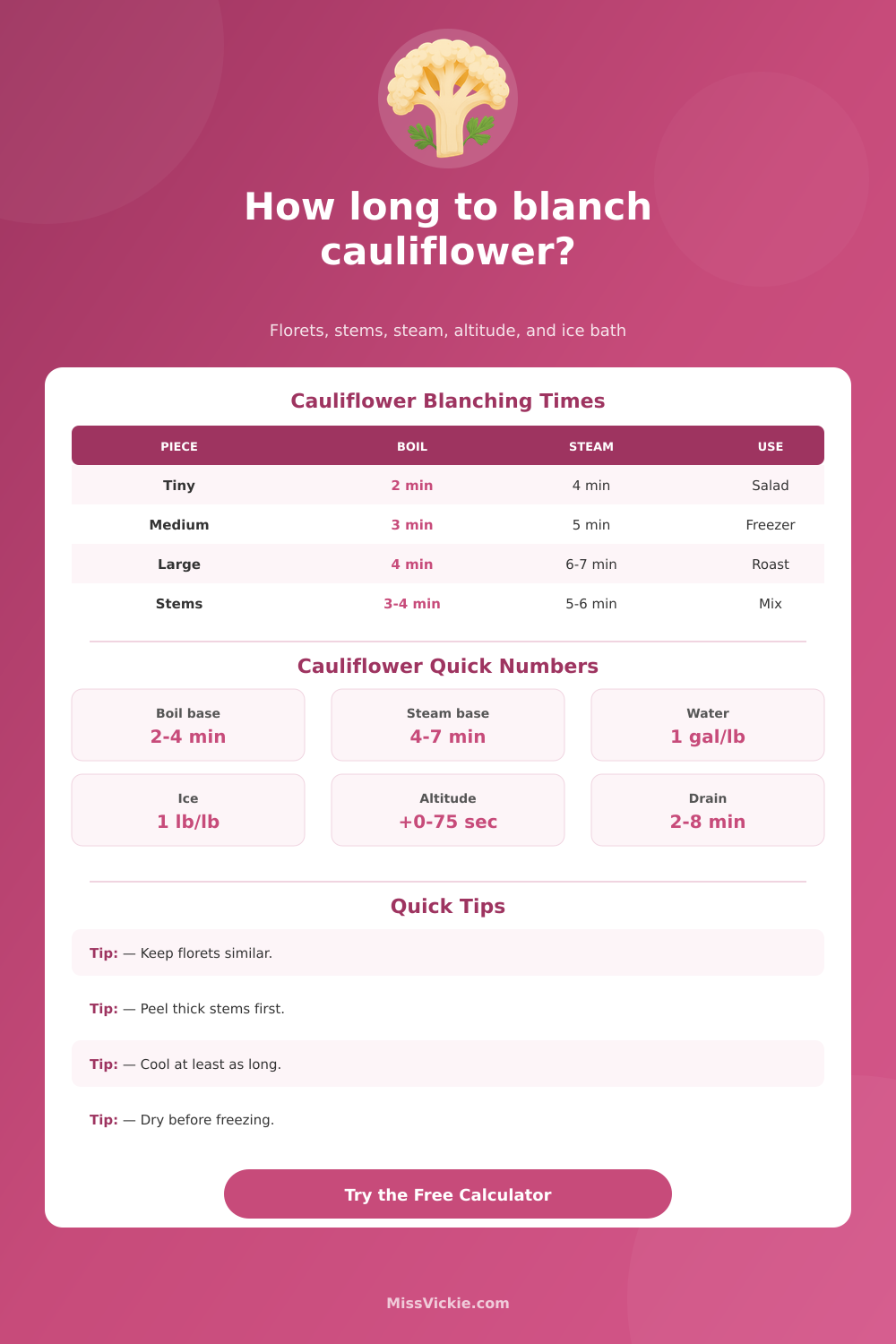
| Cauliflower piece | Typical size | Boiling water time | Steam time | Best target |
|---|---|---|---|---|
| Tiny clusters or coarse rice | Under 1 inch | 1.5 to 2.5 minutes | 3.5 to 4.5 minutes | Salad, rice base, fast saute |
| Small salad florets | About 1 inch | 2 to 3 minutes | 4 to 5 minutes | Crisp salads and crudite trays |
| Medium freezer florets | About 1.5 inches | 3 minutes | 5 to 6 minutes | Freezer bags and meal prep |
| Large roasting florets | About 2 inches | 4 minutes | 6 to 7 minutes | Roasting, gratins, sheet pans |
| Peeled stem batons | 1/2 inch thick | 3 to 4 minutes | 5 to 6.5 minutes | Mixed veg packs and soups |
| Batch condition | Boiling water guidance | Steam basket guidance | Calculator effect | Kitchen cue |
|---|---|---|---|---|
| Comfortable pot | 1 gallon per pound or more | Single shallow layer | No recovery penalty | Water returns quickly to boil |
| Slightly crowded | 0.75 to 1 gallon per pound | Pieces stacked lightly | Adds 15 to 25 seconds | Stir once after boil returns |
| Crowded pot | 0.5 to 0.75 gallon per pound | Basket over 2 lb | Adds 35 to 55 seconds | Split the batch if color dulls |
| Very crowded | Under 0.5 gallon per pound | Dense basket load | Flags split-batch warning | Uneven stems and soft curds likely |
| Altitude band | Boiling cue | Boil add | Steam add | Why it matters |
|---|---|---|---|---|
| 0 to 2,999 ft | Normal rolling boil | 0 seconds | 0 seconds | Sea-level timing works well |
| 3,000 to 4,999 ft | Slightly cooler boil | 30 seconds | 45 seconds | Dense stems heat more slowly |
| 5,000 to 6,999 ft | Cool high-altitude boil | 60 seconds | 75 seconds | Full freezer blanch needs more time |
| 7,000 ft and up | Plan conservative checks | 75 seconds | 90 seconds | Cut one floret and test the core |
| Final use | Texture target | Ice bath length | Drain approach | Pack or serve cue |
|---|---|---|---|---|
| Freezer bags | Fully blanched, still firm | At least timer length | Towel-lined tray | Pack when surface moisture is gone |
| Cold salad | Snappy and bright white | Timer length plus 30 sec | Salad spinner | Dress after cauliflower is cold |
| Roast later | Firm, dry, lightly blanched | Timer length | Tray dry | Oil after steam has escaped |
| Puree or mash | Tender stem and curd | Short cool or drain hot | Colander rest | Blend while still warm if serving now |
Best for freezer batches because the curds heat quickly when the pot is large enough.
Helpful for delicate small florets, but use a shallow basket and a longer timer.
Pulls time back so cauliflower stays crisp once chilled and dressed.
Uses a complete blanch, quick ice bath, and dry surface before packing.
This calculator gives practical kitchen timing for trimmed cauliflower. For canning, long storage safety, or commercial processing, follow a tested preservation guide for the exact product and process.
When it’s time to blanch your cauliflower, remember: physics matter. Avoid one of the most common kitchen mishaps by understanding that your water temperature will plunge if you simply drop a huge head in the pot. Next thing you know, you’re waiting forever for it to come back up to a boil. Before you know it, the exterior curds is mush but the inner stems remain stubbornly hard.
Batch management and heat transfer rate separate the grays from the whites in your bag and on your plate, not just your intuition. So you don’t have to guess at adding a few minutes for extra elevation, or a full pot: the calculator above do the math when you enter your altitude and weight. Better yet, it’s even more useful if you understand why these variables affects timing.
Why Cauliflower Is Hard to Cook Right
Why’s cauliflower tricky? It’s non-uniform. The airy curd cook quickly. The dense, fibrous stem acts as if it were insulated from the heat. When you cut up your florets unevenly, you’re really making yourself cook two distinct vegetable in the same pot. The calculator asks for stem share, and piece style, and that lets it model the heat needed for this density mismatch.
Most folks overlook amount of water you use, but only when it’s too late. If your pot is small, dropping raw vegetables into boiling water sucks up a massive amount of energy. Water will stop boiling completely, leaving your cauliflower dangling in lukewarm liquid. This is not blanching; it is called poaching.
Crowding affects recovery time, and the reference table on page illustrates how. You want the water back to a rolling boil within half a minute of adding the veg. If it takes longer, you need less food per batch or more water altogether. This rule applies whether you are steaming or boiling. Steam is gentler, and you will need a covered basket to hold in pressure.
In many kitchens, altitude works silently, since water boils at lower temperatures the further you get from sea level. In other words, your boiling water will be much cooler different than at sea level (at five thousand feet, for example), so it will soak into the cauliflower more slowly. It’s a factor that the tool automatically accounts for, but knowing why make it easier if something goes awry. Don’t fault the clock if your stems remain raw in Boulder or Denver; it just takes longer because of thermodynamics.
Freezer prep: This is where things get real in the ice bath. After blanching, enzymes that would otherwise make your vegetables go bad are halted. However, the cooking do not stop. This means carryover heat still happens as the cauliflower exits the pot. If you don’t quickly cool it down, your cauliflower will be mushy (and who wants that?) when thawed. It will be dull-colored, too.
You can prevent all of this with an ice bath full of enough ice to bring the temperature down immediately. This maintains its bright white color and crisp crunch while preventing stem from going slimy.
Last but not least: If your plans involve freezing some of these treats, then yes, really, definitely, absolutely dry them off; water expands when it freezes, which means ice will clump, which leads to icky blocks that’re tough to defrost and even tougher to employ come dinner time. Each floret should of been separated in its freezer bag, after it’s been drained well on a towel-lined tray. It is a little thing that makes a big difference each time I dig my hand in the freezer looking for something fast.
It’s more a matter of regulating the exchange of heat than a matter of time. With that said, if you’ve taken into account the size of the pot and the coolness of the ice bath and also respected the cauliflower’s dense and fibrous stems, you’re going to end up with consistently blanched cauliflower: No raw centers, no mushy curds, but clean, bright curds ready to go in whatever dish you have planned next.