Blanching Corn Time Calculator
Estimate corn blanching time for ears, halves, whole kernels, cut kernels, cob diameter, cob length, batch ears, water volume, altitude, freezer prep, ice bath size, and sweet crisp or tender texture goals.
🌽Corn blanching presets
Load a corn-specific setup, then fine-tune ear size, batch load, water reserve, altitude, freezer style, cooling ratio, and texture target.
⚖Corn and pot setup
Corn Blanching Plan
Use the result as a freezer-prep timing guide and cool immediately.
Timing breakdown
Water, ice, and yield
⏲Corn time reference
For whole kernels or cream-style corn after cutting from blanched ears.
Use for ears under about 1.5 inches across the middle.
Good default for 1.5 to 1.75 inch sweet corn ears.
Use for thick ears over 1.75 inches or dense field corn.
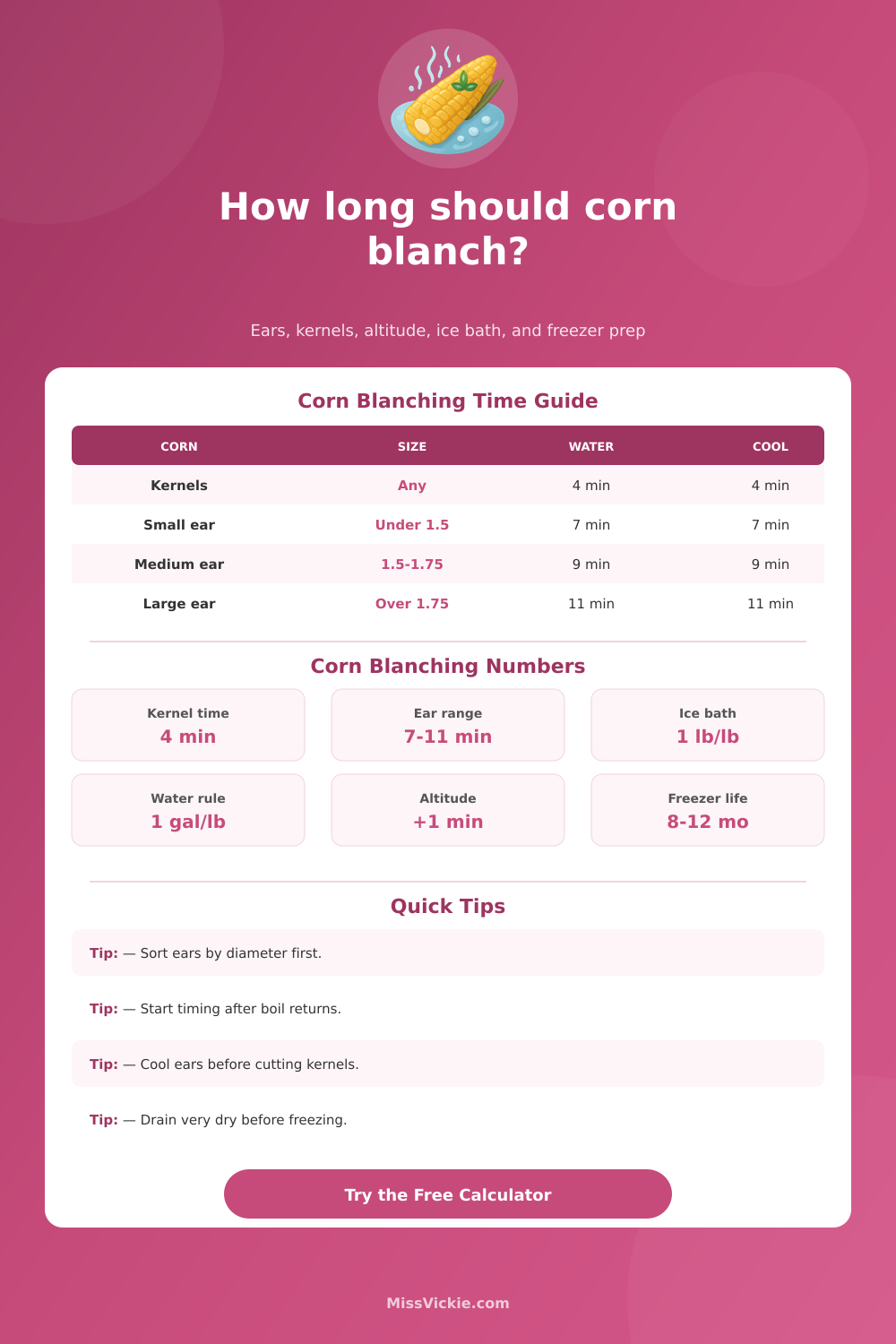
For freezer corn, these times follow the common home-freezing pattern: blanch ears by size, cool promptly, drain, then cut kernels or pack ears.
🌽Ear size, kernels, and cob yield table
| Corn size or form | Diameter or cut | Water blanch time | Ice bath minimum | Freezer yield estimate | Best freezer use |
|---|---|---|---|---|---|
| Small ears on cob | Under 1.5 in | 7 min | 7 min | 0.4 to 0.5 cup kernels per ear | Whole-ear packs or side portions |
| Medium ears on cob | 1.5 to 1.75 in | 9 min | 9 min | 0.5 to 0.6 cup kernels per ear | Default freezer corn batches |
| Large ears on cob | Over 1.75 in | 11 min | 12 to 13 min | 0.65 to 0.8 cup kernels per ear | Wrapped ears or cut kernels |
| Ears before cutting | Use cob diameter | 7 to 11 min | Match blanch time | About 2 cups from 4 medium ears | Cool first, then cut from cob |
| Loose whole kernels | Cut from cob | 4 min | 4 min | About 2 cups per pound | Tray pack or flat freezer bags |
| Cream-style corn | Scraped kernels | 4 min | 4 to 5 min | About 1.5 to 2 cups per pound | Shallow bags or rigid containers |
🚰Altitude, ice, and batch water table
| Batch or condition | Estimated corn load | Batch water volume | Boiling point cue | Time adjustment | Ice bath target |
|---|---|---|---|---|---|
| 4 medium ears | About 2 lb corn | At least 2 gal water | Sea level: 212 F | Use chart time | 2 lb ice plus cold water |
| 8 medium ears | About 4 lb corn | At least 4 gal water | Boil returns within 1 min | Use chart time | 4 lb ice plus cold water |
| 12 medium ears | About 6 lb corn | At least 6 gal water | Wide stockpot needed | Reduce batch if slow | 6 to 9 lb ice for repeat loads |
| Loose kernels | 2 lb cut kernels | 2.5 to 3 gal water | Stir as boil recovers | 4 min after return | 2 to 3 lb ice |
| High altitude kitchen | 5,000 ft or higher | Keep 1 gal per lb | About 203 F at 5,000 ft | Add 1 min | Cool for added time too |
| Very high altitude | 7,500 to 10,000 ft | Use smaller loads | About 198 to 194 F | Add 1 min, verify boil | Use 1.5 lb ice per lb corn |
The calculator uses 1 gallon of boiling water per pound of corn per load, a same-time-or-longer ice bath, and about 1 pound of ice per pound of corn as the standard freezer baseline.
📋Corn blanching chart by form
| Corn form | Size input | Base water time | Best prep | Calculator note |
|---|---|---|---|---|
| Whole ears on the cob | Diameter drives timing | 7, 9, or 11 min | Freeze wrapped ears or serve soon | Length changes water and cooling load more than time. |
| Cob halves or thirds | Use original ear diameter | 6 to 10 min | Side dishes, grill packs, meal prep | Cut pieces heat faster, but freezer prep should not be underblanched. |
| Ears before cutting kernels | Diameter still matters | 4 to 11 min | Loose kernel freezer bags | Cool ears first, then cut kernels from the cob. |
| Already cut whole kernels | Loose kernels | 4 min | Tray pack or portioned bags | Stir once as the boil returns so kernels heat evenly. |
| Cream-style corn | Scraped kernels and milk | 4 min | Flat freezer bags or containers | Use a wide basket or pouch so the mixture chills quickly. |
🧊Water, ice bath, and batch planning
| Planning item | Calculator rule | Why it matters | Good kitchen cue |
|---|---|---|---|
| Water volume | About 1 gallon per pound per load | A crowded pot returns to a boil slowly and makes timing unreliable. | Boil should recover within about 1 minute. |
| Batch ears | Based on ears per load and estimated ear weight | Eight small ears may be lighter than six very large ears. | Corn should move freely in boiling water. |
| Ice bath time | At least the blanch time, longer for big ears | Residual heat keeps cooking the cob core after draining. | Ears should feel cold near the cob. |
| Ice amount | 0.5 to 2 lb ice per lb corn | Repeated hot batches warm the bath quickly. | Add ice before the water feels merely cool. |
| Altitude | Add 1 minute at 5,000 ft or higher | Water boils cooler at elevation, so heat transfer is slower. | Use a steady, vigorous boil before timing. |
🧺Freezer prep choices
Blanch by diameter, cool deeply, drain, then wrap tightly to limit freezer burn.
For best texture, blanch ears first, cool, then cut kernels into a tray or bowl.
Spread drained kernels in a shallow layer before bagging for scoopable freezer corn.
Chill and drain thoroughly so warm corn does not steam inside the sealed bag.
💡Corn blanching tips
The most common failure with freezing corn is that someone skips (or rushes) the blanching process. Boil your fresh-picked peak-sweet corn for just long enough then take it out. Believe that when you freeze it, it is simply pausing. The enzymes that start breaking down corn after it is picked actualy work faster in the freezer than they normaly would. High-heat blasts halt them, meaning you need to get it right; within hours of picking, corn turn starchy instead of sweet, and there’s no turning back.
This tool will tell you how long to cook it, depending on batch size and ear diameter. It’s based off the fact that most home cooks use just one timer for all their veggie and assume each veggie has same cellular density. But corn isn’t consistent: An ear less than an inch and a half in diameter won’t reach the doneness of a large ear, almost two inches wide, and will instead become mushy if treated as such. The tool take the difference into account and adjusts the base cooking time to match actual dimensions of the cob. That makes sure the heat gets through to center. It also ensures you don’t boil the life out of the outer kernels. In the case of frozen sweet corn, texture is really what matters most.
How to Blanch Corn for Freezing
Another variable that we tend to neglect until the pot boils over or no longer bubbles when veggies go in is water volume: How much water do you use? When you crowd your stockpot, addition of the corn dramatically reduce the temperature, and it’s slow getting back up to a vigorous boil. In this lag time, flavor will be dulled, as will the cell walls of the corn, which won’t begin to soften properly until true blanching clock begins. About one gallon of water per pound of corn per load is rule of thumb; thus you maintain a high enough ratio so that the temperature returns to normal promptly. Vigorous boiling, not quiet simmering, is what you’re looking for. It should of take less than a minute for the water to come back up to a rolling boil.
For those of us who live down low, we sometimes overlook all the other factors that go into altitude: As elevation rises, water boils at a lower temperature. So not only is there less heat transferred into the corn then there would be at sea level, but you will also have to account for the fact that temperature of your water isn’t boiling hot when cooking corn. If you’re at 5,000 ft or above, plan on adding about a minute to your blanching time to make up for the cooler boiling point. That little bit of extra time makes all the difference between retaining that fresh flavor and sealing in the cooked mediocrity. Thankfully, the calculator does this for you, simply enter where you are and the altitude will automatically adjust. You won’t have to guess about high-altitude freezing anymore.
You’ll want to cool your cooked corn quickly (the cooling part is as important as the hot part) and stop it from continuing to cook by placing the corn in an ice water bath. Again, the ice bath should last at least as long as the blanching time; residual heat in the corn will continue to cook center if left on the counter to cool down. Why does residual heat from not using an ice bath create that softness we all attempt to prevent? Keep the ice water near freezing using enough ice to make the water stay cold while soaking.
Once drained, pack it well without any other moisture on surface. Even small amounts of moisture will turn into ice crystals inside the package, which can damage your corn over time when stored. Corn freezes: It’s one part science (temperature and timing), one part technique (the put-it-in-a-box part). If you nail the right heat level and cool it quickly, you’ll hold onto some of summer’s sweetness through next spring. And no, this doesn’t require that you end up with that sad gray mush in the back of your freezer. If you can preserve the vegetable, you can also preserve the season.