Blanching Carrots Time Calculator
Estimate carrot blanching time by cut style, coin or baton thickness, baby versus mature carrots, batch weight, boiling water or steam, altitude, ice bath, texture goal, peel choice, and drain time.
🥕 Carrot Prep Presets
Load a carrot-specific freezer, meal prep, or dinner scenario, then tune thickness, batch weight, altitude, ice bath strength, and drain time.
⚖ Carrot And Batch Setup
Carrot blanching plan
Calculated from carrot cut style, thickness, method, altitude, and cooling setup.
Timing Breakdown
Cooling And Packing
📌 Carrot Timing Reference
🔪 Cut Style Table
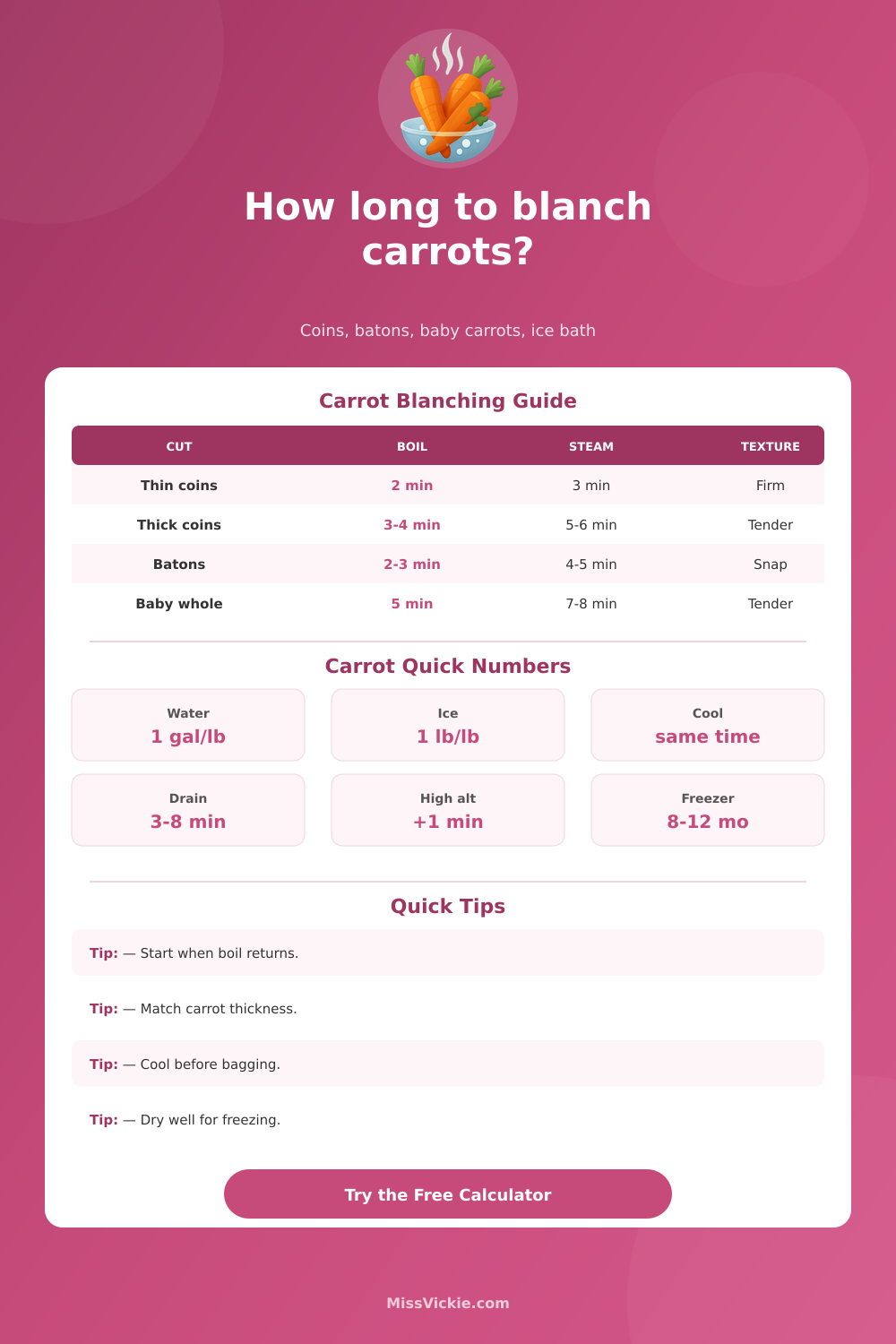
| Carrot Prep | Typical Thickness | Boiling Water Time | Steam Time | Best Use |
|---|---|---|---|---|
| Thin coins or rounds | 1/8 to 1/4 in / 3 to 6 mm | 2 to 2.5 min | 3 to 4 min | Freezer bags, soups, quick sides |
| Thick coins | 3/8 to 1/2 in / 10 to 13 mm | 3 to 4 min | 5 to 6.5 min | Glazed carrots and reheated meal prep |
| Batons or sticks | 1/4 to 3/8 in / 6 to 10 mm side | 2 to 3 min | 4 to 5 min | Snack trays, stir-fries, freezer mixes |
| Dice | 1/4 to 1/2 in / 6 to 13 mm | 2 to 3 min | 3.5 to 5.5 min | Soup starters, fried rice, pot pie filling |
| Whole baby carrots | About 1/2 to 3/4 in thick | 5 min | 7 to 8 min | Freezing whole or finishing in butter |
| Roll-cut chunks | 1/2 to 3/4 in thick | 4 to 5 min | 6.5 to 8 min | Roast prep, braises, stew vegetables |
Carrot reference times are modeled from common home-freezing guidance: sliced, diced, or lengthwise strips blanch faster than small whole carrots because heat reaches the center sooner.
🧊 Ice Bath And Drain Guide
Cool for at least the hot blanch time, then drain until surface water stops pooling.
Use towels or a salad spinner after draining so carrot pieces freeze loose.
Blanch less for crisp-tender carrots that will be reheated within a few days.
Whole pieces hold heat, so leave them in ice until the centers feel cold.
| Carrot Destination | Ice Bath Ratio | Cooling Time | Drain Time | Expected Packed Yield |
|---|---|---|---|---|
| Freezer coins or dice | 1 lb ice per 1 lb carrots | Same as blanch time, 2 min minimum | 5 to 8 min | About 3 cups per lb trimmed |
| Tray-freeze pieces | 1.25 lb ice per 1 lb carrots | Same as blanch time plus 1 min | 8 to 12 min, towel dry | 2.8 to 3.2 cups per lb |
| Whole baby carrots | 1.5 lb ice per 1 lb carrots | 5 to 7 min, center cold | 6 to 9 min | About 2.5 cups per lb |
| Crisp meal-prep carrots | 0.5 to 0.75 lb ice per 1 lb | 1.5 to 3 min | 3 to 5 min | Use within 3 to 4 days |
| Glaze-ready chunks | 0.75 lb ice per 1 lb carrots | 3 to 5 min | 3 to 6 min | About 2.6 cups per lb |
Packed yield depends on carrot diameter and peel loss. Peeled mature carrots commonly lose about 4 percent before blanching, while scrubbed unpeeled carrots keep closer to the original trimmed weight.
⚡ Carrot Altitude And Batch Recovery
| Altitude Range | Boil Adjustment | Steam Adjustment | Carrot Batch Signal | Best Correction |
|---|---|---|---|---|
| 0 to 2,999 ft | No extra time | No extra time | Boil returns in under 1 min | Use standard cut table |
| 3,000 to 5,999 ft | Add 30 sec | Add about 45 sec | Rolling boil weakens after carrots go in | Split batch or add water |
| 6,000 ft and above | Add 1 min | Add 1 to 1.5 min | Thick coins still firm at center | Check largest piece before cooling |
| Any altitude, crowded pot | Add 30 to 60 sec | Use shallower basket | Water takes over 2 min to recover | Limit to 1 lb carrots per gal |
| Any altitude, dense garden carrots | Add 15 to 30 sec | Add 30 sec | Wide tops and woody cores | Cut smaller or sort thick ends |
Start timing carrot boiling-water blanching only after the water returns to a rolling boil. At high altitude, the lower boiling temperature matters most for thick coins, chunks, and whole baby carrots.
💡 Practical Carrot Blanching Tips
Carrots: Blanching Between harvest and storage, root vegetable must be blanched. When you bring home your big haul in October, it can be tempting to think you’ve won the race, until you realize that if you don’t treat these perishable items propery, they’ll go bad fast. Why does any home cook freak out on this part? Because the process only works if timed just so.
Boil the carrots too briefly and you have an enzyme-filled mass of tasteless, rapidly aging gray. Boil them to long and they’re mush. Stopping their chemical deterioration without destroying their texture is the trick. To pull it off you need a bit of culinary instinct, but also knowledge of how heat transfer.
How to Blanch Carrots Properly
Because thickness matter more than weight (which affects how long any vegetable will take), you’ll need to use a calculator to figure out timing once you plug in your cut style and altitude. The thinner the vegetable, the quicker it’s going to cook: a thick piece won’t blanch before a thin slice of same weight. A whole baby carrot retains its heat longer in middle; make sure you keep your finger poised by the off switch just a little more then you think necessary.
Boiling water surrounds all surfaces instantly, transferring energy quickly. Steam is kinder to nutrients and color, but requires a minute or two longer. If you input your altitude and cut style, there’s even calculator tool that does math for you, eliminating guesswork from enzyme inactivation.
Altitude is another variable. In places where elevations are high, Salt Lake City, Denver, etc., water will boil at a lower point and therefore be less aggressive. “Five minutes is five minutes, right?” you may think, but higher up, heat doesn’t punch as hard. That’s why veggies that pack density into them (like those carrots) require more time.
Ignore this fact of physics, however, and the carrots appear cooked but are still chemically alive in freezer. The graph spells out such tweaks. And it proves that a thousand feet of elevation can change your approach, from standard to extended boil time.
While we often ignore cooling, remember: It’s just as critical as heating. You want an ice bath potent enough to stop the cooking action at once. Without sufficient ice (and/or cold water) compared to weight of the carrots, they continue to cook within their own leftover heat; this carryover cooking transforms crisp-tender bits to soft dissapointments before they reach colander. One pound of ice for each pound of carrots is a good start, but for heavier loads you’ll need that buffering effect to cool the temperature quick and preserve that bright color.
Nothing’s more boring than draining until you’ve got a brick of frosty orange slush in freezer bag. Moisture hurts good freezing because water forms ice crystals that burn texture from within. A few minutes to let carrots drip-dry on counter (or patting them off with clean towels) makes all the difference in finished product. This is an additional step, but it keeps each vegetable distinct so they separate easy later.
If your meal prepping is headed for fridge rather than the deep-freeze, you’re allowed to get a bit loose with the wetness. In this case, the veggies won’t need to withstand months of refrigerator chill. But in the end: Carrots, as all things, aren’t so much about following hard-and-fast rules as it’s about getting them just right, as much as possible, with respect to the heat they recieve. Because you’re trying to denature the enzyme without damaging cells. And that’s where this helps.
It makes food science easy to see because it factors in your particular set-up, such as your pot size, batch size, and cool-down mechanism. This creates an actual picture for you to refer to based off the boiling vat. As soon as you understand how variables like thickness and altitude interact. Then you stop fearing it, or even thinking of it really, as risky at all.
It is a way to get those many October carrots that would of gone to the compost pile into your kitchen all winter long instead.