Blanching Broccoli Time Calculator
Estimate broccoli blanching time for floret size, stem coins, batch weight, boiling water or steam, pot water volume, altitude, ice bath ratio, carryover delay, texture goal, and drain or spin time.
Choose a broccoli-specific scenario, then tune the exact batch, cut size, pot volume, altitude, ice bath, texture, and drying plan.
Broccoli blanch plan
Results update as you adjust the batch.
Timing breakdown
Batch setup
Crisp salad texture when cooled fast.
Classic boiling-water freezer blanch.
Useful for thick crowns and chunky pieces.
Typical steam-blanch target for florets.
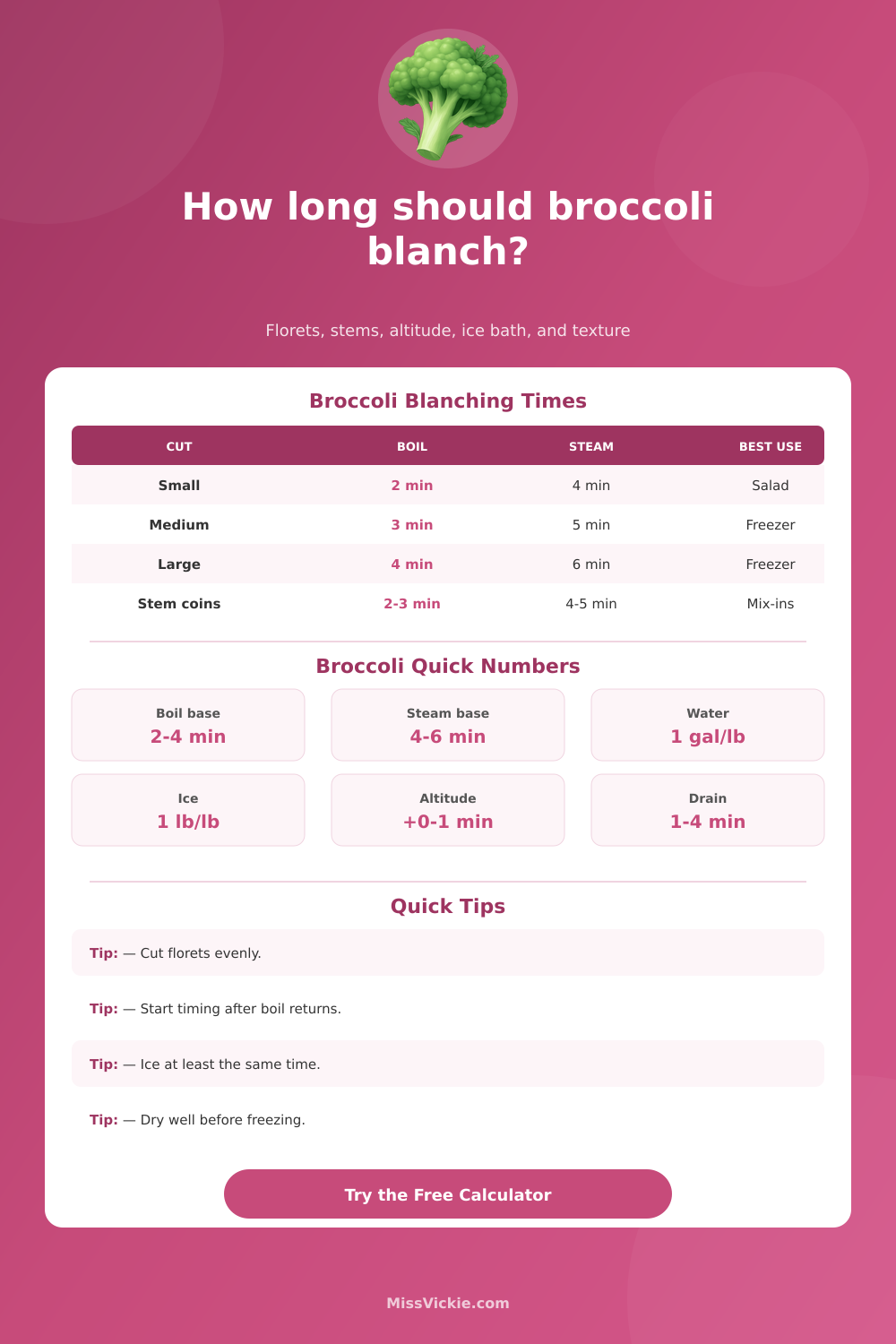
| Broccoli cut | Boiling water time | Steam blanch time | Best texture use |
|---|---|---|---|
| Small florets, about 1 inch | 2 to 2.5 minutes | 4 to 4.5 minutes | Salads, grain bowls, quick sauteing |
| Medium florets, about 1.5 inches | 3 minutes | 5 minutes | Freezer bags, casseroles, reheating |
| Large florets, about 2 inches | 4 minutes | 5.5 to 6 minutes | Freezer packs and thicker crown pieces |
| Peeled thin stem coins | 2 minutes | 4 minutes | Stir fries, slaws, mixed freezer packs |
| Peeled thick stem coins | 2.5 to 3 minutes | 4.5 to 5 minutes | Soups, casseroles, softer mixed batches |
| Mixed florets and stems | 3 to 3.5 minutes | 5 to 5.5 minutes | Family freezer portions and meal prep |
For boiling water blanching, start the timer when the water returns to a strong boil after adding broccoli.
| Trimmed broccoli | Boiling water target | Ice target | Practical batch note |
|---|---|---|---|
| 0.5 lb / 225 g | 0.5 gal / 1.9 L | 0.5 lb / 225 g | Small saucepan batch, easiest for salad prep |
| 1 lb / 450 g | 1 gal / 3.8 L | 1 lb / 450 g | Good home-freezer baseline |
| 2 lb / 900 g | 2 gal / 7.6 L | 2 lb / 900 g | Use a stockpot or split into two rounds |
| 4 lb / 1.8 kg | 4 gal / 15 L | 4 lb / 1.8 kg | Best done in batches for steady heat recovery |
| Condition | Timing adjustment | Why it matters | Kitchen move |
|---|---|---|---|
| Under 3,000 ft / 900 m | No extra time | Boiling temperature is close to standard | Use normal broccoli chart times |
| 3,000 to 5,000 ft / 900 to 1,500 m | Add about 30 seconds | Water boils cooler and heat transfer slows | Keep batches smaller if texture matters |
| Over 5,000 ft / 1,500 m | Add about 1 minute | Broccoli needs longer heat exposure | Check color and stem tenderness |
| Slow transfer to ice | Count 15 to 35 seconds carryover | Hot florets keep softening after draining | Scoop directly into ice water |
| Texture goal | Blanch target | Ice bath | Drain or spin finish |
|---|---|---|---|
| Salad crisp | Short end of the range | Same time as blanch, heavy ice | 45 to 90 seconds in spinner |
| Meal prep reheat | Middle of the range | Same time plus 30 seconds | 1 to 2 minutes until surface-dry |
| Freezer firm | Full freezer chart time | Same time plus 30 to 60 seconds | 2 to 4 minutes, towel plus spin |
| Softer side dish | Upper end of the range | Brief chill if serving soon | Quick drain, then season while warm |
Best for freezer prep because water surrounds florets and gives predictable timing.
Good when you want less waterlogging, but use a shallow basket and longer timing.
Peel tough stems, slice coins evenly, and blanch them separately if very thick.
Cool fully, drain thoroughly, and tray-freeze if you want loose broccoli pieces.
Blanch broccoli a second too long, five seconds! It lose its bright green color and turns a muddy olive color. And that’s just within half a minute: Most home chef end up either giving up (undercooking their veggies) or burning rubber (reducing them to mush). Proper use of ice and a mere half-minute can separate good from bad. After entering your altitude and desired batch size, the calculator above take over with the math.
First, you choose the type of cut. Thick-stem coins blanch much slower than florets, whether small or large, because they has different surface area to volume ratios. A loose crown has very little stem left after peeling; heat move into the stem piece at a completely diffrent rate from what happens with a thick slice of stem. To freeze them together would of been to risk destroying the small while keeping the big unsafe. To deal with this, the tool determines a baseline time based off the real-world nature of whatever cut you’re using.
How to Blanch Broccoli Correctly
Next, select either steam or boiling water. Because steam doesn’t conduct heat as well than water, and water doesn’t conduct heat as well as air, steam blanching will take longer. It’s also slower acting though gentler on the texture.
Also factor in how much broccoli (or whatever) weighs compared to the amount of water you’re using. Put a pound of cold veggies into a couple cup of water and temperature plummets. Cooking basically comes to a standstill until the water has boiled up again. To recover fast from the boil, the calculator determines the amount of water needed for your vegetables; it recommends about a gallon per pound for large batches. A lot of water! But that way it hold onto thermal energy and preserves color.
If you live atop a high plateau or mountain, altitude will change everything. Because of decreased air pressure, water doesn’t boil as hot, your broccoli’s actualy simmering instead of bubbling. To make up for the reduced heat strength, the timer add time to the process. You may not think so with a soup, but with raw blanching, peak heat shock halts breakdown; without that added minute (or two), those enzyme are still doing their thing and your freezer stock will be tasting off within weeks.
When time’s up, it’s onto the cool-down race. Heat stays trapped inside, so the broccoli will continue to cook even in a colander. You want an ice bath powerful enough to stop it ASAP. This is called carryover cooking, and it happens. To get an idea of how much ice you’ll need, the calculator suggests ice-to-batch-weight ratios (that way, you know exactly what size ice bath to make).
For maximum crispness, the general rule of thumb is one pound of ice for every pound of broccoli. Want to bump it up? Maybe your ice cubes are tiny or your kitchen’s warm; if so do it. Adding more ice not only slows down the cooling period but also maintains that bright green color better than leaving it lukewarm for too long.
If you’re freezing rather than meal prepping, texture goals becomes important. You want salad broccoli to remain crisp. Pull it out early. If you’re going in the freezer, you need to deactivate all enzymes. This might look a little underdone to your eye but you should hit the recommended time, even if it’s long.
The last key thing everyone forgets about is drying. When broccoli goes in frozen, it’ll be a rock-hard block of ice crystals if there is moisture on it. Towel it off or spin it ’til it’s damp but not wet. That way you can use single floret months down the road without clumps.
And it’s precise, not intuitive. It’s about balancing moisture levels, enzyme action, and temperature transfer simultaniously. Instead of having to memorize each variable, the calculator above show you how to adjust the time to account for everything. Cut straight across, honor the ice bath, use the calculator for the math, and then thank yourself later (six months from now) when that flash-frozen broccoli is just as good as the day you froze it.