Blanching Time Chart for Vegetables Calculator
Estimate vegetable blanching time for boiling water or steam, then plan batch size, water volume, altitude adjustment, cooling time, ice bath weight, and freezer packing.
🥬 Blanching Presets
Load a common garden, market, or freezer prep scenario, then adjust vegetable type, cut size, pot volume, altitude, ice bath ratio, and texture goal.
⚖ Vegetable And Batch Setup
Blanching Plan
Use a rapid boil or steady steam, then cool immediately.
Timing Breakdown
Pot And Freezer Check
📊 Core Blanching Rules
🗂 Broad Chart Adjustment Guide
| Chart Factor | Use This Choice | Typical Adjustment | Quality Check |
|---|---|---|---|
| Vegetable category | Leafy, pod, root, floret, ear, or squash | Start with the closest chart vegetable | Similar density and piece size matter more than name |
| Cut size | Fine, small, medium, large, or whole | Fine pieces shorten only for serve-soon use | Freezer prep should stay near the published chart time |
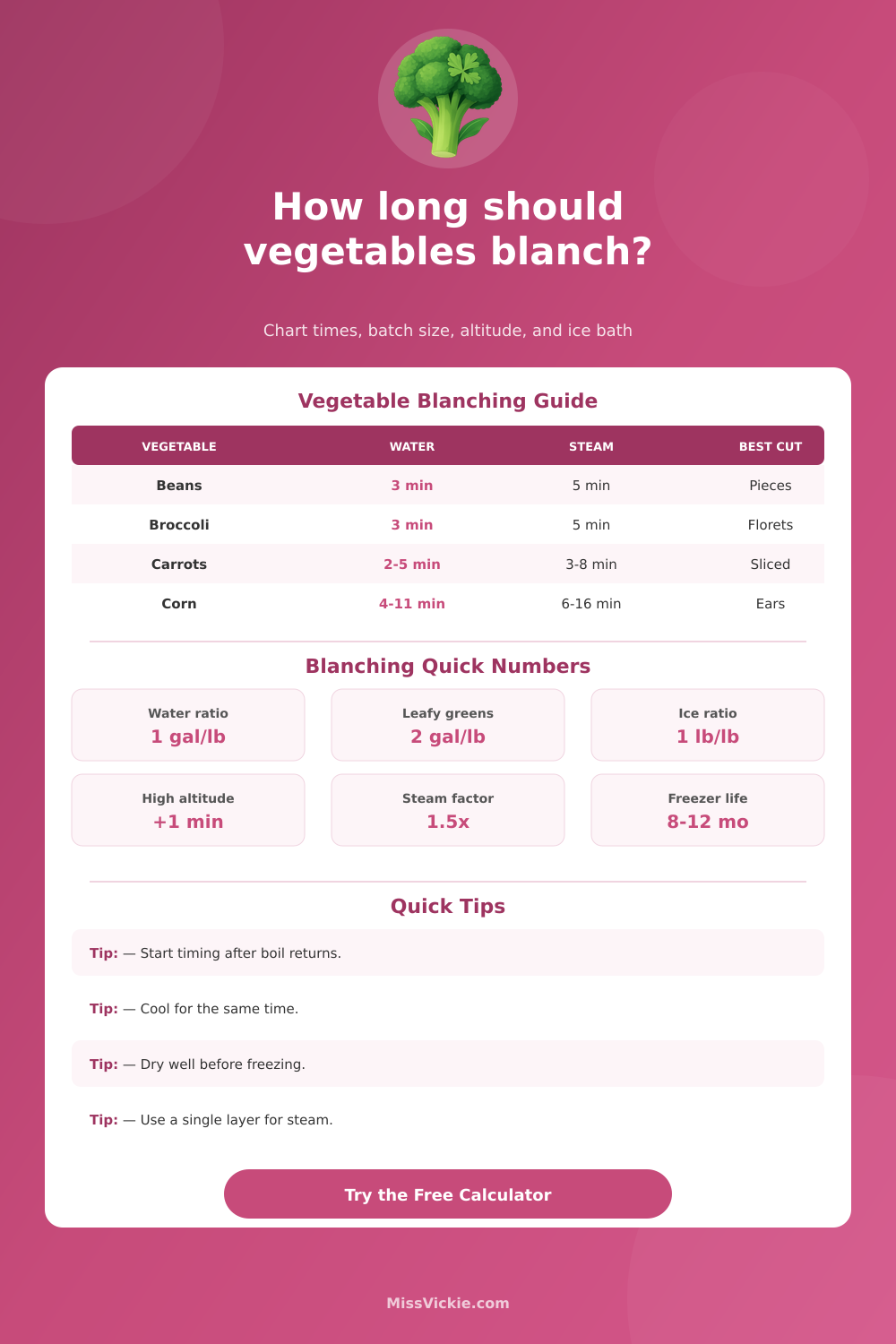
| Boil vs steam | Boil for fast heat, steam for gentler batches | Steam usually runs about 1.5 times water time | Use a single layer so steam reaches every piece |
| Altitude | Sea level to 4,999 ft, or 5,000 ft and higher | Add 1 minute at high elevation | Water boils cooler, so enzyme control needs more time |
| Finishing Choice | Guideline | Best Use | Texture Target |
|---|---|---|---|
| Ice bath ratio | Use 1 lb ice per 1 lb vegetables | Standard freezer batches | Bright color with stopped carryover cooking |
| Extra ice | Use 1.5 to 2 lb ice per 1 lb vegetables | Large loads, warm kitchens, or corn | Fast chill without a lukewarm bath |
| Tray pack | Drain, spread, freeze, then bag | Peas, beans, florets, squash, and mixed vegetables | Loose pieces that scoop from the freezer |
| Solid pack | Drain, portion, press out air, and freeze | Greens, corn, meal-size portions, and soup vegetables | Compact packs for one-recipe use |
| Serve soon | Shorten only when not freezing for storage | Crisp-tender sides, salads, stir-fries, or reheating | Firm bite with less enzyme-control margin |
Use these broad-chart rules when a vegetable variety or cut is not listed exactly. For long freezer storage, choose the closest Extension chart time instead of trimming the time aggressively.
🥗 Vegetable Blanching Time Chart
| Vegetable | Chart Cut Or Size | Boiling Water | Steam | Best Freezer Prep |
|---|---|---|---|---|
| Asparagus | Small, medium, or large stalks | 2, 3, or 4 min | 3, 5, or 6 min | Trim woody ends, sort by diameter |
| Snap green or wax beans | Whole or cut pieces | 3 min | 5 min | Cut to meal size, drain well |
| Broccoli | Flowerets about 1 1/2 inches | 3 min | 5 min | Soak briefly in salt water if needed |
| Brussels sprouts | Small, medium, or large heads | 3, 4, or 5 min | 5, 6, or 7 min | Sort by size for even blanching |
| Carrots | Diced, sliced, strips, or small whole | 2 to 5 min | 3 to 8 min | Slice evenly; whole baby carrots need longer |
| Cauliflower | Flowerets about 1 inch | 3 min | 5 min | Keep pieces similar in size |
| Corn on the cob | Small, medium, or large ears | 7, 9, or 11 min | 10, 13, or 16 min | Cool fully before wrapping ears |
| Corn for kernels | Blanch ears before cutting | 4 min | 6 min | Cut from cob after cooling |
| Greens | Collards or other leafy greens | 2 to 3 min | 3 to 5 min | Use extra water because greens are bulky |
| Okra | Small or large pods | 3 to 5 min | 5 to 8 min | Sort pods; keep caps intact |
| Peas | Green peas or edible pods | 1 1/2 to 3 min | 3 to 5 min | Freeze loose on trays for easy measuring |
| Summer squash | Slices or pieces | 3 min | 5 min | Drain very well to avoid watery packs |
Reference times are adapted from the National Center for Home Food Preservation, University of Minnesota Extension, and Colorado State University Extension. Use current local Extension guidance for unusual vegetables, varieties, or preservation questions.
🧊 Cooling, Ice Bath, And Freezer Prep
Cool vegetables for about the same length of time as blanching to stop carryover cooking.
Use about 1 pound of ice for each pound of vegetables when using ice water.
Freeze drained pieces on a tray first when you want scoopable bags.
Pack drained vegetables closely in containers when portions will be used together.
🍳 Batch Planning Table
| Setup | Vegetable Load | Boiling Water Needed | Ice Bath | Quality Check |
|---|---|---|---|---|
| Small saucepan | 1/2 lb | 2 qt, or more for greens | 1/2 lb ice | Best for peas, sliced carrots, or small tests |
| Stockpot batch | 1 lb | 1 gal, or 2 gal for greens | 1 lb ice | Water should return to boil within 1 minute |
| Large harvest pot | 2 lb | 2 gal, or 4 gal for greens | 2 lb ice | Use a basket so removal is immediate |
| Steam basket | Single layer | 1 to 2 inches below basket | Equal cooling time | Do not pile pieces so steam can reach all sides |
💡 Blanching Tips
Most of us are not instinctive blanchers; timing is a science rather then an art. There’s a reason why green beans gets pulled from the garden, then brought to the blanching station where every second matter more than instinct. If you don’t time things well, frozen green beans might turn out mushy… Or lack brightness in their color, due to continued activity by certain enzymes. When these is stopped during blanching, they preserve nutrients, flavor and texture for months of freezer storage.
Once you know how much of a specific vegetable you have and how it is cut, the tool will do the math for you. No need to wonder if five minutes or three will be too long for your cut. Everyone talks about how hot the water gets (the boiling part), but no one thinks about what happens to the heat once the water hits the pot. Putting too big a batch into not-enough water will cause the temperature to crash and remain at that level until it comes back up. This is what counts as cooking time. Instead of getting a quick shock of cold water to stop them from decaying, your veggies is just simmering away in lukewarm broth.
Simple Tips for Blanching Vegetables
The calculator asks for the weight of each batch plus the amount of water so that it can calculate whether or not you have sufficient thermal mass to recover to a boil fast. Because density is as important as temperature, it will flag when your batch-to-water volume ratio are too small. Root vegetables are denser than leafy greens. They take up less space in the pot and contain less air. This means they needs half the water leafies do.
For us high-elevation gardeners (above five thousand feet), altitude matter. Up here, water doesn’t boil as hot which means that even when the water appears to be rolling along strongly, enzymes are not deactivated as quickly. To counteract this effect, you need to increase the amount of time, otherwise your freezer stash will go bad sooner then expected. If you input your elevation, the tool does all this for you and you don’t have to remember another chart if you happen to live in the mountains.
Note: Steam blanching also deserves extra care because steam has less heat energy per unit of mass than boiling water. Typically, steaming takes approximately 1.5x the amount of time as boiling. This is a detail that many home preservers forget about until they notice their broccoli is now bright yellow due to under-processing.
Even though we all know to cut off the cooking process as soon as it’s done, that’s when most of us fall down on the job: The cooling phase. Carryover cooking will continue even after dumping those still-hot veggies into warm tap water. Instead, you need a cold-enough ice bath to shock the system instantly (which generally means half-again as much ice as vegetable by weight). Slow cooling wastes all that blanching effort (and results in loss of texture over time); if you scrimp on ice, the bath quickly warms up. The calculator figures out how much ice you’ll need for your total harvest, so plan ahead and have your sink ready before the first pot hits the stove.
One prep tip is to sort your vegetables by size before processing them. This will save you headaches down the road, since larger items take longer to cook than smaller ones. If you have some thicker and thinner stalks mixed together, for example, you’ll end up either undercooking the former or overcooking the latter, kind of defeating the point of following a typical recipe. Get ’em into groups by approximate size so each gets the appropriate treatment to last as long as possible in the freezer.
Keep them cool and dry! Once cooled, be sure to dry the veggies really well before packing; any wetness left on their surfaces will create ice crystals which will damage their cell walls as they sit in the freezer. Good drying and draining is almost as critical as getting the blanching time correct (if you’re looking for crispness upon thawing months down the line).