Deep Fry Catfish Time Calculator
Estimate catfish frying time for whole fillets, strips, and nuggets using thickness, cornmeal coating, oil temperature, starting temperature, batch crowding, soak style, 145°F doneness, rest time, and crust color.
Choose a real catfish setup, then fine-tune fillet thickness, cut style, cornmeal crust, oil recovery, starting temperature, batch size, and drain time.
Catfish Fry Plan
Set inputs to calculate a catfish fry window.
Timing Breakdown
Batch And Doneness Cues
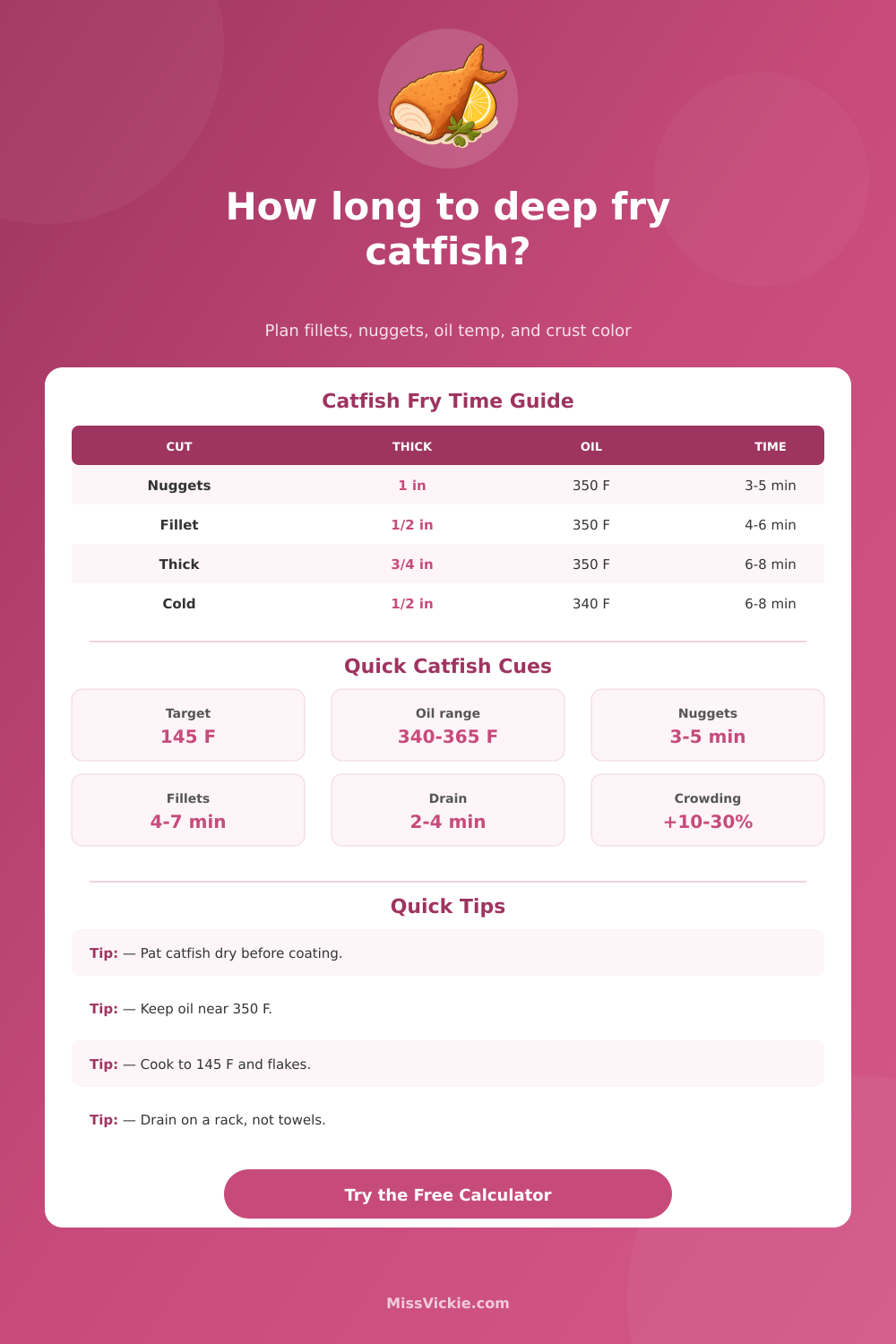
These estimates assume 350°F oil, drained cornmeal coating, and a final center temperature of 145°F with opaque, flaking catfish.
| Catfish cut | Typical thickness | 350°F fry time | Why it differs from cod or tilapia |
|---|---|---|---|
| Whole catfish fillet | 1/2 to 3/4 inch | 4 to 7 minutes | Irregular fillet shape means the thick center sets the schedule. |
| Thick center fillet | 3/4 to 1 inch | 6 to 8 minutes | Denser center needs more time than thin tilapia. |
| Catfish nuggets | 3/4 to 1 inch chunks | 3 to 5 minutes | More surface area browns cornmeal quickly. |
| Long strips | 1/2 inch average | 4 to 6 minutes | Edges brown quickly but the center strip still needs 145°F. |
| Thin tail pieces | 1/4 to 1/2 inch | 2 to 4 minutes | Thin pieces finish faster than cod loin or thick catfish centers. |
| Bone-in steaks | 3/4 to 1 1/4 inch | 8 to 10 minutes | Bone and thickness slow center heating. |
| Oil situation | Catfish effect | Time adjustment | Best action |
|---|---|---|---|
| 325°F to 335°F | Crust absorbs oil before browning | Add 1 to 2 minutes | Wait for oil to recover before the next batch. |
| 340°F to 365°F | Best catfish frying range | Use normal timing | Keep pieces moving freely in one layer. |
| 370°F to 380°F | Crust browns before the center catches up | Check early | Lower heat for thick fillets and bone-in pieces. |
| Snug basket | Oil recovery slows | Add about 10 percent | Shake gently after the crust sets. |
| Crowded batch | Steam softens cornmeal | Add 20 to 30 percent | Split into another batch for better color. |
| Preparation | Surface behavior | Timing effect | Catfish cue |
|---|---|---|---|
| Dry seasoned cornmeal | Browns fastest | Normal or slightly shorter | Good for thin tails and small fillets. |
| Classic cornmeal flour | Balanced crunch | Normal timing | The standard catfish fish-fry crust. |
| Buttermilk, drained well | Clings thicker | Add about 30 seconds | Color should be golden, not pale yellow. |
| Wet buttermilk surface | Cools oil and delays color | Add 1 minute or more | Drain longer before dredging if possible. |
| Double dipped crust | Insulates the fish | Add 45 to 90 seconds | Check internal temperature before chasing darker color. |
| Check point | Target | What to look for | Why it matters |
|---|---|---|---|
| Internal temperature | 145°F / 63°C | Check the thickest piece in the batch. | Catfish is done when the center reaches the safe fish target. |
| Flaking | Opaque flakes | Center separates with gentle pressure. | Catfish can look browned before the center flakes. |
| Crust color | Golden brown | Cornmeal looks crisp, not dusty. | Color confirms the coating has cooked through. |
| Drain rest | 2 to 4 minutes | Steam escapes on a rack. | Rack draining protects crunch better than paper towels. |
Irregular thickness and cornmeal crust make the thick center and color goal matter.
Small pieces brown fast, so use a thermometer before extending for darker crust.
Cod is flakier and often thicker; this calculator does not use cod loin timing.
Tilapia is thinner and leaner, so it usually cooks faster than catfish fillets.
Cold catfish dropped in hot oil will cool it down fast. Now you’ve got a basket full of dredged fillets waiting in your hand. You’re trying to get cornmeal golden without getting fish all greasy. Seconds, or minutes, can make the difference between soggy and crispy. It’s not because you didn’t trust the recipe; rather, it’s because you don’t control your variables well enough. If you had the same cut of fish and the same pot as a vague recipe assumed, then maybe so. But most times? Not hardly.
For most of us home cooks, we tend to overemphasize importance of oil temperature. We don’t pay nearly enough mind to interaction between surface and our food. If I know what my cooking environment is like… Which is where the calculator comes in; it spares me all guesswork about crowded batches and longer-cooking times. It accounts for differences in thickness, such as between a thick center fillet and a thin piece from tail end of the same fish. This level of understanding change everything about how you cook around the fryer.
How to Cook Catfish Perfectly
Cooking times depends mostly on how thick they are. From the outside in, heat penetrates until it hit the middle. For example, if you’re making about a one-inch-thick nugget, you’ll probably finish in three to five minutes. In this situation, heat can quickly travel across exposed surface area.
A whole fillet is another matter entirely. It’s packed with meaty density near the shoulder, then tapers outward until reaching the edge. The thickest portion has to reach 145 degrees Fahrenheit to be done. Pulling them too early because the thinner ends look brown will leave center raw and translucent. By allowing you to specify precisely how thick your most difficult item is, the tool helps you understand this compromise.
Another problem is starting temperature. Putting cold fish out of fridge or an ice bath creates a heat sink. The oil temp takes a big hit when they goes in. The lower you cool the oil, the more fat gets absorbed by cornmeal instead of creating a crisp shell on the fish. Fifteen minutes of letting the fish come to room temperature make a difference. Also, pat them dry well before dredging. A wet surface steams, not fries so it slows down browning and results in a greasy product.
Perhaps the most underrated element in home frying is how much your batches will crowd one another. Steam can get caught between items in same batch. That steam will soften what’s already trying its hardest to be crispy and dry: the crust. To account for it, the calculator estimates how much longer each piece need if the oil doesn’t have room to flow around it.
Why would you want to increase time with more food? It sounds counterintuitive, but heat loss isn’t forgiving. If there’s space for the oil to bounce back, there is. Maintaining enough heat to properly sear are important.
Now, not only do you have the fry itself, but also you’ve got to drain it. That’s where things get tricky. You might think: “Well, I’ll put them on some paper towels and lift them up.” Bad idea. The steam that comes off of warm insides is actualy captured between the paper and the crust. When that steam cools, it becomes condensation which will turn your carefully made crispy exterior into mush in mere minutes.
A wire rack lets this steam vent out into the open air. It won’t allow the moisture to soak back into breading. It is a small detail but it maintains texture you built up in the hot oil.
Cooking catfish (frying, that is) involves understanding the laws of physics concerning heat transfer, and adjusting your expectations accordingly. It’s a race to get the outside crust done while letting the inside cook more slow from the center out. It’s all about getting it right, making sure each fillet fell apart cleanly without being either overcooked or drowned in oil.
Let the thickest fillet be the timekeeper. If the thin end is overdone, you could of cut it off, but you can’t UN-cook the middle if it’s not done yet.