Deep Fry French Fries Time Calculator
Estimate blanch time, crisping time, batch count, oil recovery, and serving hold quality for fresh-cut or frozen french fries.
🍟 Real Fry Presets
Each preset loads a full fryer scenario with weight, cut thickness, method, oil temperature, batch load, soaking, salt timing, and hold time.
⚖ Fry Setup
Your Fry Timing Plan
Adjust the inputs above to estimate blanch, final fry, batch count, and serving quality.
Fry Breakdown
Oil and Holding Breakdown
📏 Fry Cut Serving Grid
📋 Cut Thickness Timing Table
| Cut Style | Typical Thickness | Best Method | Blanch Stage | Final Crisp Stage | Best Use |
|---|---|---|---|---|---|
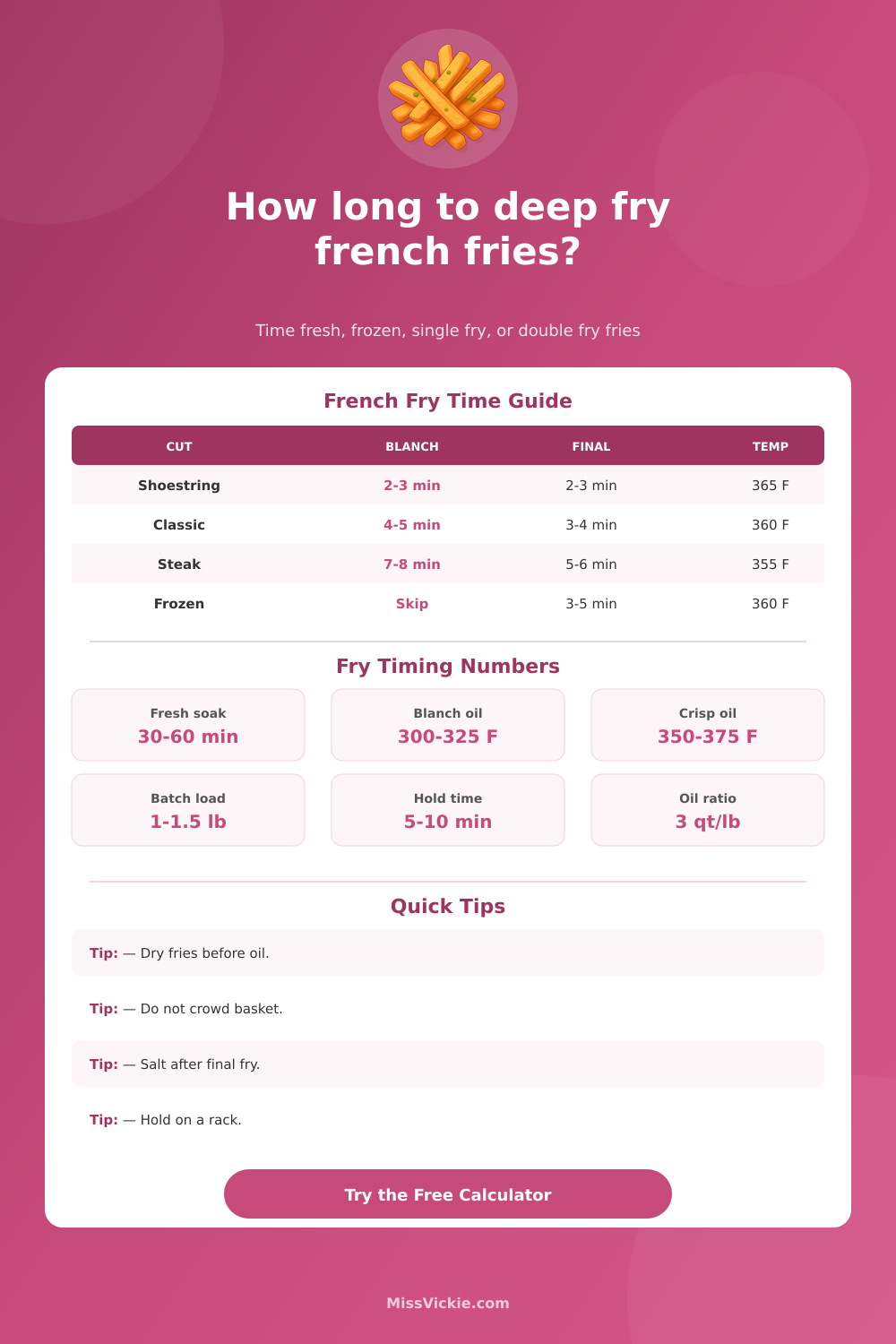
| Matchstick | 3/16 in / 5 mm | Single or quick double | 1.5 to 2.5 min | 1.8 to 2.6 min | Snack fries, topping baskets |
| Shoestring | 1/4 in / 6 mm | Double fry | 2 to 3 min | 2 to 3 min | Very crisp, fast service |
| Classic | 3/8 in / 10 mm | Double fry | 4 to 5 min | 3 to 4 min | Diner-style french fries |
| Pub cut | 1/2 in / 13 mm | Double fry | 5 to 6.5 min | 4 to 5 min | Thicker side fries |
| Steak fry | 5/8 in / 16 mm | Double or triple fry | 7 to 8.5 min | 5 to 6.5 min | Creamy center, crisp shell |
| Wedge | 7/8 in / 22 mm | Triple fry or long double | 9 to 12 min | 6 to 8 min | Potato wedges, skin-on platters |
🌡 Temperature and Method Table
| Method | Blanch Oil | Final Oil | Rest Between Stages | Texture Result | When To Use |
|---|---|---|---|---|---|
| Single fry | None | 335 to 350 F | None | Good color, softer center | Small quick batches |
| Double fry | 300 to 325 F | 350 to 375 F | 10 to 30 min | Crisp exterior, fluffy center | Fresh cut fries |
| Triple fry | 280 to 310 F | 365 to 375 F | Chill after first fry | Restaurant-style crunch | Thick cuts or service prep |
| Frozen finish | Already done | 350 to 365 F | None | Fast crisp from frozen | Bagged frozen fries |
| Pre-blanched | Already done | 355 to 370 F | Chill until needed | Reliable service timing | Meal prep or parties |
🛢 Batch Size and Oil Recovery Table
| Oil Per Batch | Recovery Rating | Expected Drop | Timing Adjustment | Best Basket Load | Practical Note |
|---|---|---|---|---|---|
| 4 qt per lb | Excellent | 15 to 25 F | Base timing | Up to 1.5 lb | Good for crisp double fries |
| 3 qt per lb | Good | 25 to 35 F | Add about 5% | 1 to 1.25 lb | Most home Dutch ovens |
| 2 qt per lb | Borderline | 35 to 55 F | Add 12% to 18% | 0.75 to 1 lb | Split the batch if pale |
| Under 2 qt per lb | Slow | 55 F or more | Add 20% or more | 0.5 to 0.75 lb | Oil may steam before frying |
🧂 Salt Timing and Hold Table
| Salt or Hold Choice | Crisp Effect | Best Window | Use With | Avoid With |
|---|---|---|---|---|
| Salt immediately | Best seasoning cling | Serve within 5 to 8 min | Classic and shoestring fries | Covered bowls |
| Salt before serving | Slightly drier hold | Serve within 10 to 15 min | Party batches | Very thick fries |
| Seasoned salt | More surface moisture | Serve within 5 min | Pub fries and wedges | Long holds |
| Wire rack hold | Best steam release | 5 to 12 min | All fresh fries | Cold rooms |
| Heat lamp rack | Best service hold | 8 to 18 min | Double fried batches | Paper towel piles |
🔍 Fry Method Comparison
Fastest path, best for thin fries and small batches, but less fluffy inside.
Best all-around method for fresh russet fries with crisp shells and tender centers.
Useful for thick steak fries, wedges, and service prep where a chilled stage helps structure.
Frozen par-fried fries need enough hot oil recovery more than a raw potato blanch.
💡 Fry Timing Tips
These times are planning estimates for deep frying potatoes. Use visual cues too: a cooked center, active bubbling that slows, and the final color you want.
Making fries at home is a bit nerve-wracking. You have these spuds that you’ve washed, peeled, and sliced into matchstick. There’s oil spluttering on stove, and you’re holding a wire basket ready to drop them in. How do you know whether they’ll be golden perfection or pale and limp inside? Is three minutes long enough? Will they be crunchy, or will this all end up as a sad pile of raw, sticky failure?
The answer isn’t so much “how well you can cook” but rather a matter of physics… Of how much water gets displaced by what volume of hot fat, and how fast the moisture evaporate off the surface. Enter the plan-ahead meal. Once you input your desired cut and the weight of the potatoes into the calculator above, it crunches the numbers for you… Removing any need to guess at units of measure, conversions, and coefficients. Suddenly, what was a frenzied scene in the kitchen turn into a doable schedule of events.
How to Make Perfect Fries at Home
“Thickness is one of the variables that matter most. You can cook a shoestring fry all the way through in just a few minutes; it’s thin enough for heat to reach the center quickly. With something like a wedge or a really thick-cut steak fry, you need a totally different approach. If you take an uncooked, thick cut and drop it right into the hot oil, the outside will burn while the inside doesn’t soften up yet. That’s where the double-frying technique comes from: the gold standard of cooking fresh potatoes.
The first time around, the lower-temperature (typically about three hundred and fifteen degrees Fahrenheit) blanch cooks the insides but won’t brown the outsides. It also starts to gelatinize the starch which make the potato tender. During the second fry, cooked at a higher temperature (usually above three hundred and sixty degrees), the surface dries out fast to form that shattering crust. This tool breaks these stages down, allowing you to observe exactly how long each phase should be depending on what cut you’re working with.
There’s another thing: the soak. Washing off the surface starch keeps it from bonding to the spuds and forming a gooey mess. But letting them sit in cold water for half an hour (or even hours) firm things up. Without it, your fries may exit the fryer looking delicious. But turn to rubber bands once cooled down. This affects the timing and predicted texture: the calculator takes into account how long you soaked them (or not at all), and adjusts for those effects.
A tiny bit of prep work makes a huge difference based off the bite. The most practical variable for home cooks is batch size. Overloading the fryer cause oil temperature to drop substantially. As the temperature falls, the food soak up the oil like a sponge instead of frying, making it greasy no matter how long you cook it. To avoid overloading, the device predicts how many batches will fit in your pan given its capacity and total weight.
Follow this guidance; if it tells you to split a batch into two, do it. It is better to wait five minutes for the oil to recover than to burn a pound of potatoes because the oil temperature dropped. Texture is another factor of salt timing. Fries should be lightly warm and oiled when they are first seasoned, so that the salt stick. If you wait, the fries will cool down; and their seasonings won’t stick as well, they’ll just sit on top.
Crispiness depends partly on airflow, which means you want to hold your fries on a wire rack where air circulates around each one from every side. If you stack your fries in a bowl, they trap moisture and steam, making their crust soggy again in no time at all. The reference tables on the page explain how different holding methods affects fry quality over time.
At the end of the day, how to fry potatoes depends on what you can measure and see. Time equals thickness. Texture equals temperature. Behavior of oil equals volume. While you don’t have to hold a degree in food science to make it happen, you should of know enough to respect the process. The tool provides the roadmap, but your nose and eyes will confirm completion of the task.
Seek gold coloring (meaning dehydrated, not just browned) along with slowed-down bubbling to indicate activity. Begin with the plan. Trust your senses. And revel in the crunch. That’s where that simple balance of crispy on the outside and tender on the inside happen again.