Cornish Hen Deep Fry Time Calculator
Estimate deep fry timing for whole 1 to 2 lb Cornish hens using hen weight, count, cavity dryness, oil temperature, chilled or thawed state, brine or injection, fryer pot size, oil recovery, rest time, skin crispness, and 165°F breast / 175°F thigh targets.
🐔Cornish hen fry presets
Choose a real Cornish hen setup, then adjust the bird weight, cavity dryness, oil temperature, fryer size, start temperature, brine, injection, rest, and crispness target.
⚖Units and fryer setup
🌡Hen condition, safety targets, and finish
Estimated deep fry plan
Run the calculator to estimate fry time, check timing, oil recovery, and rest.
Full timing breakdown
Use a thermometer for the final decision.
📌Cornish hen fryer quick specs
Most Cornish hens fry predictably in this weight band.
Hot enough to crisp skin without racing the breast.
Check the thickest breast away from bone.
Dark meat is more tender above the minimum.
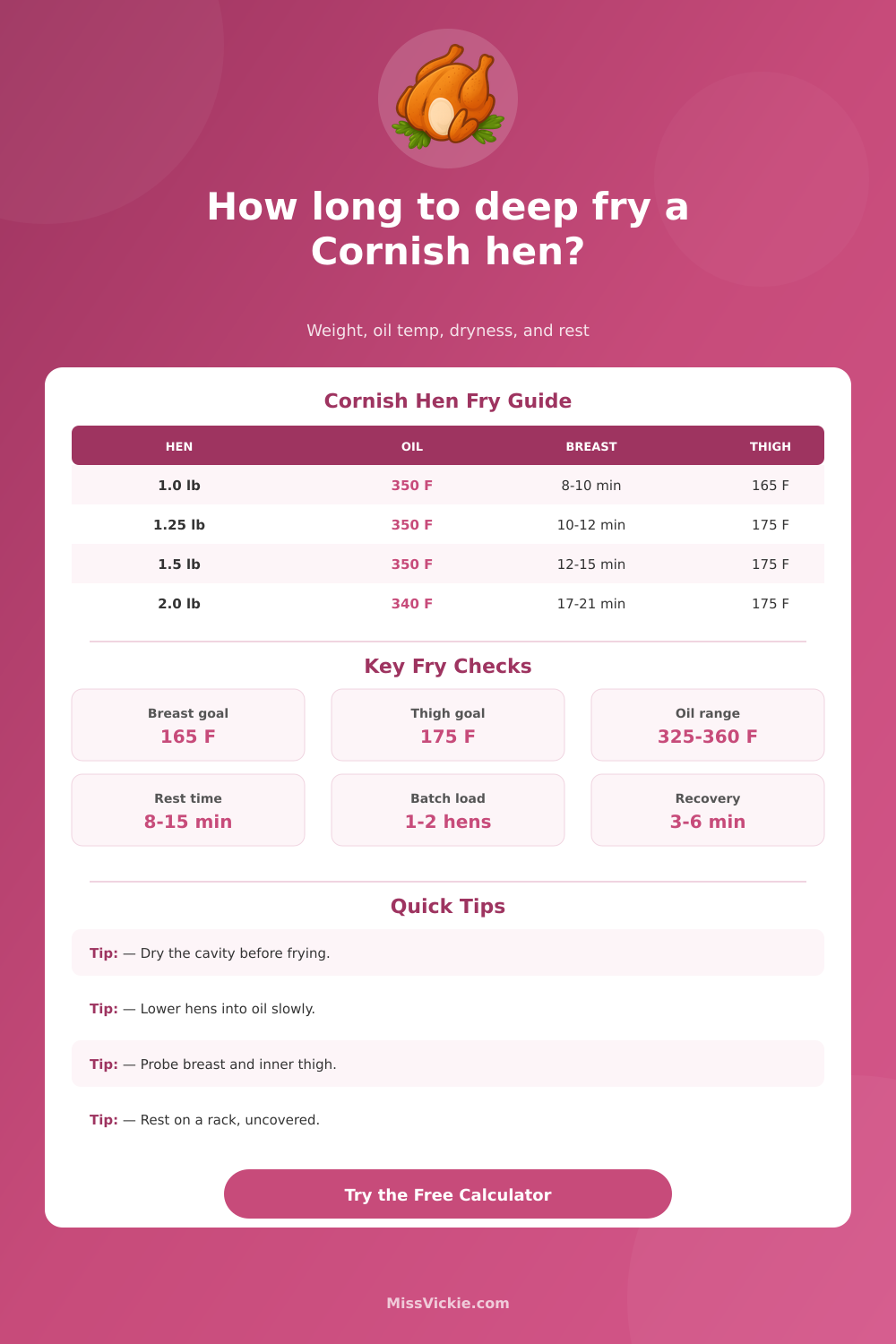
⏱Whole Cornish hen time by weight
| Raw hen weight | Oil temperature | Estimated fry time | Best thermometer check |
|---|---|---|---|
| 1.0 lb / 0.45 kg | 350°F / 177°C | 8 to 10 minutes | Breast 165°F, thigh 175°F |
| 1.25 lb / 0.57 kg | 345 to 350°F | 10 to 12 minutes | Start checking around 8 minutes |
| 1.5 lb / 0.68 kg | 340 to 350°F | 12 to 15 minutes | Check both sides of the breast |
| 1.75 lb / 0.79 kg | 335 to 345°F | 15 to 18 minutes | Thigh often lags behind breast |
| 2.0 lb / 0.91 kg | 325 to 340°F | 17 to 21 minutes | Pull only after thigh reaches target |
🛢Pot size, oil recovery, and batch load
| Fryer setup | Typical oil drop | Recovery wait | Best use |
|---|---|---|---|
| Wide turkey pot, 3 to 4 gal oil | 20 to 30°F | 3 to 4 minutes | One or two small hens with strong circulation. |
| Standard outdoor fryer pot | 25 to 40°F | 4 to 5 minutes | One 1.25 to 1.75 lb hen at a time. |
| Small narrow pot | 35 to 55°F | 5 to 7 minutes | One small hen only, lowered slowly. |
| Countertop electric fryer | 30 to 50°F | 5 to 8 minutes | Only if the hen fits below the fill line. |
| Basket fryer with open circulation | 20 to 35°F | 3 to 5 minutes | Easy lifting and draining after the check. |
🧂Dryness, brine, and injection adjustments
| Preparation state | Timing effect | Splatter risk | Calculator treatment |
|---|---|---|---|
| Dry rubbed, cavity patted dry | Baseline | Low | Fastest browning and best skin crispness. |
| Wet brined, dried overnight | Add 2 to 4% | Moderate | Juicy meat, but slightly slower browning. |
| Buttermilk marinade, wiped dry | Add 5 to 8% | Moderate to high | Extra surface moisture slows crisping. |
| Injected butter or Cajun marinade | Add 4 to 7% | Moderate | Probe multiple spots because pockets heat unevenly. |
| Wet cavity or pooled marinade | Add 10% or more | High | Drain and dry before frying; do not rush lowering. |
🌡Temperature and rest safety table
| Checkpoint | Target | Where to measure | Why it matters |
|---|---|---|---|
| Breast safety | 165°F / 74°C | Thickest breast, not touching bone | Whole poultry should reach at least 165°F. |
| Thigh texture | 175 to 180°F | Inner thigh near the body joint | Dark meat becomes more tender above the minimum. |
| Rest after frying | 8 to 15 minutes | Rack set over a tray | Carryover heat finishes settling without steaming the skin. |
| Oil recovery | Return near set temp | Clip-on deep fry thermometer | Cold oil makes greasy skin and lengthens the next batch. |
| Serving check | No pink juices | Cut near thigh joint if unsure | Time is a planning tool; temperature is the final test. |
⚔Fry method comparison
Best control for a 1 to 1.25 lb bird with quick oil recovery and crisp skin.
The most common timing range when the cavity is dry and oil starts near 350°F.
Useful in a wide pot, but only if the oil volume and headroom are generous.
Works best with dry skin, a dry cavity, and an uncovered rack rest after frying.
💡Cornish hen deep frying tips
Cornish hens are small, but don’t get it wrong: they’re shaped funny, and that shapes turbulence in hot frying oil. That means they’ll splatter and turn in on themselves as they fry. If you treats them like small turkeys, they will cook unevenly. Crisp skin is what you want, plus moist meat; make sure the breast doesn’t go dry before the thigh has reached safe temp.
Once you input weight of your bird and your oil set up, math’s done for you by the calculator above. And you don’t have to waste time guessing at recovery times while the burner tries to catch up. That’s why weight is important. A 2 pound hen has a different ratio of surface area to volume then a 1 pound hen. Smaller hens has more exposed skin relative to their volume, which means they’ll cook through quicker. Fry a 1 pound hen and a 2 pound hen according to the same timeline, and while the former will be perfectly crisp, the latter will get burnt around the edges before the inside reach temperature.
Why Weight and Dryness Matter for Cornish Hens
To account for that, the tool adjusts the fry time depending on weight of what you put in (and how many). It also takes into account how much food you’re frying. Dropping two hens into a bare minimum amount of oil will plunge the temperature down below safe levels, killing crispy skin. Once you’ve lowered your bird into the hot oil, the actual test comes: How long will it take to get back to temp? The recovery time depends off the size of your equipment, such as a cramped counter-top electric fryer or a wide turkey pot. From the chart, we see that a small pot may only recover in five to seven minutes. If you don’t account for this, the next batch won’t cook as well. The oil will be lukewarm by the time the new birds go in and you’ll have greasy birds instead of a sizzlin’ hot fat fry job. Wait ’til you see the bubbles start moving again before you add another hunk of weight to the pot.
A lack of dryness is overlooked, but it does matter when cooking. We pay attention to patting the skin dry, but we do not pat the inside dry. When you drop a moist bird in hot oil at 350 degrees, you have a problem: Steam + violent splatter = no-brown. The calculator will also adjust for interior dryness (pooled water/marinade will add time). It is a little thing, but it is important. Moist = slow browning; high risk. Dry = predictability; crisp skin.
Cooking times are adjusted for these subtle differences: Brining shifts the meat’s thermal mass, which means a slight adjustment in cooking time. Hens that were injected acts much like other meats: Internal liquids take longer to warm than do the muscle fibers. If you’ve butter- or Cajun-marinated and pumped those birds, you’ll need to add a few minutes. This adjustment prevents you from pulling them too early, thinking they are done when the injection has not yet warmed up.
It’s tempting, especially if people is waiting, to think that sitting means you’re wasting time, but as long as you’re carrying over any heat, you’re still cooking the bird. Juices will redistribute, too. When I pulled a Cornish hen out of the oil and tried to cut right in, all its moisture ran out on the cutting board. Rest on a rack for at least eight minutes. Leave it uncovered, otherwise you’ll lose some of that crust as the meat steams. Crackling skin beneath tender meat when you poke it apart with your fork. That’s what it’s all about.
And then there’s temperature verification, the last word. Breasts may dry out before thighs are safe, so check each. Knowing exactly when to walk away from the pot is half the battle; timing helps you feel confident. Then it’s just a matter of managing the heat…and being patient. It could of been more easy if you used the math.