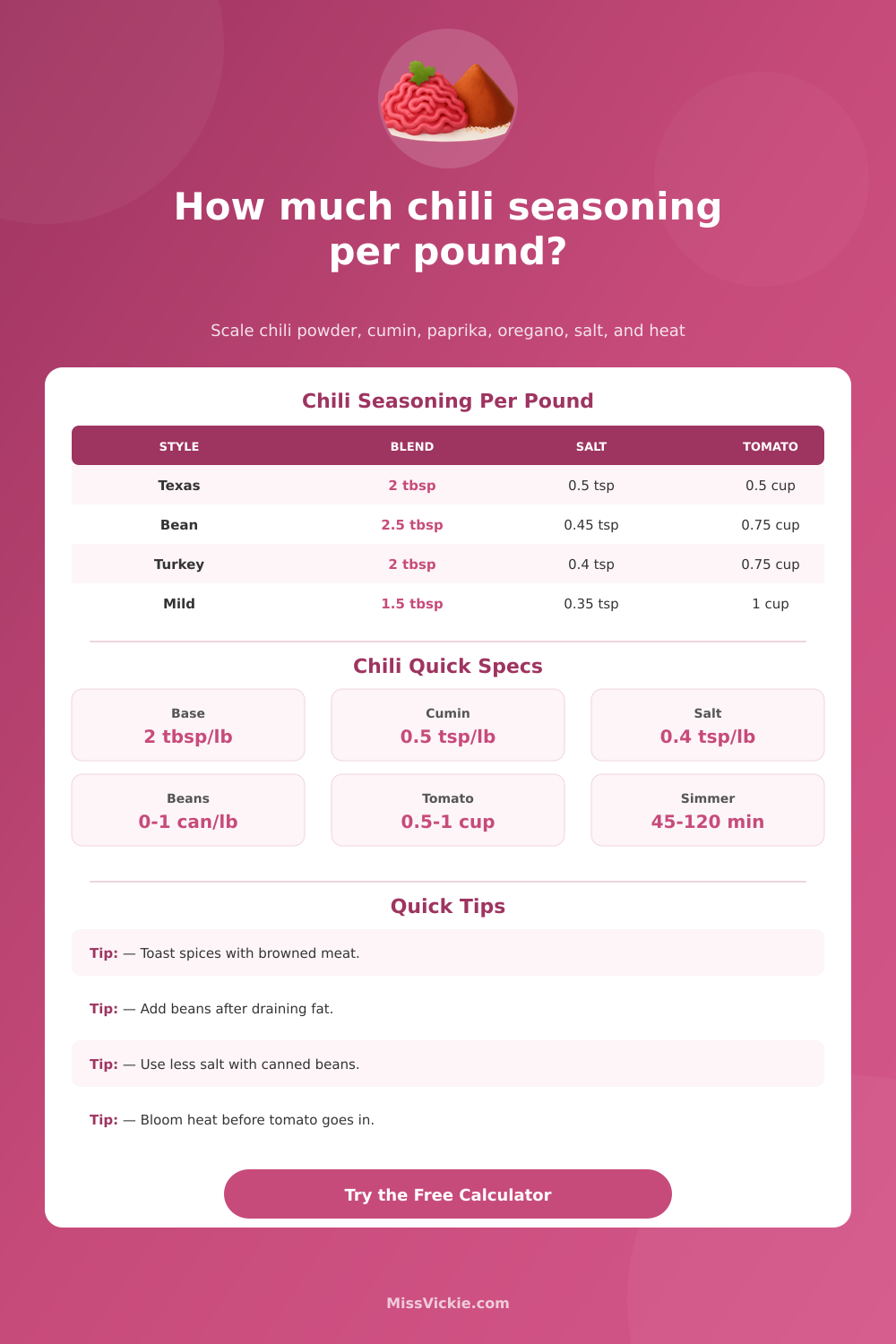
Chili powder, cumin, paprika, oregano, salt, heat, beans, and tomato
Chili Seasoning Per Pound of Meat Calculator
Build a balanced chili seasoning plan from meat weight, chili style, spice ratios, salt level, beans, tomato volume, heat, simmer time, batch size, and leftovers.
Choose a starting point, then adjust the meat, beans, tomatoes, heat, and simmer time for your pot.
Your Chili Seasoning Plan
Balanced seasoning for a pot of chili.
Full Seasoning Breakdown
Balanced tomato, beans, chili powder, cumin, and oregano for an everyday pot.
More chile flavor, less tomato, no beans, and enough simmer time to round it out.
Moderate salt, extra paprika, and enough tomato to keep lean meat juicy.
Extra seasoning reserve because beans, tomato, and reheating soften the flavor.
| Chili style | Dry blend per lb meat | Chili powder | Cumin | Paprika | Oregano |
|---|---|---|---|---|---|
| Classic beef chili | 2 tbsp | 1 tbsp 2 tsp | 1/2 tsp | 3/4 tsp | 1/2 tsp |
| Texas no-bean bowl | 2 to 2 1/2 tbsp | 1 1/2 tbsp | 3/4 tsp | 1 tsp | 1/4 tsp |
| Bean-heavy family chili | 2 1/4 to 2 3/4 tbsp | 1 1/2 tbsp | 1/2 tsp | 3/4 tsp | 1/2 tsp |
| Turkey or chicken chili | 1 3/4 to 2 tbsp | 1 tbsp 1 tsp | 1/2 tsp | 1 tsp | 1/2 tsp |
| Smoky cookoff chili | 2 1/2 tbsp | 1 1/2 tbsp | 3/4 tsp | 1 1/4 tsp | 1/3 tsp |
| Meat or batch choice | Seasoning note | Fat and yield | Salt caution | Best simmer |
|---|---|---|---|---|
| 80/20 ground beef | Blooms spices well | Drain some fat | Moderate | 60-90 min |
| 90/10 ground beef | Add oil if dry | Higher cooked yield | Moderate | 45-75 min |
| Ground turkey | Use paprika lift | Lean and mild | Lower | 45-60 min |
| Venison | Add tomato or fat | Very lean | Lower | 60-90 min |
| Chopped brisket | Use smoky profile | Rich leftovers | Watch rub salt | 90-120 min |
| Beans and tomato level | Beans per lb meat | Tomato per lb meat | Seasoning adjustment | Final texture |
|---|---|---|---|---|
| No beans, thick tomato | 0 cans | 1/2 cup | Base blend | Meaty and dense |
| Light beans, balanced tomato | 1/3 can | 3/4 cup | Add 5% | Classic bowl |
| Standard beans | 1/2 can | 3/4 cup | Add 10% | Family chili |
| Hearty beans | 3/4 can | 1 cup | Add 15% | Stretchy and filling |
| Freezer stretch | 1 can | 1 cup | Add 20% | Best for leftovers |
| Batch size | Meat | Dry seasoning | Tomato | Cooked yield |
|---|---|---|---|---|
| Dinner for 4 | 1.5 lb | 3 tbsp | 3-5 cups | 6-7 cups |
| Family of 6 | 2 lb | 4 tbsp | 4-6 cups | 8-9 cups |
| Meal prep | 3 lb | 6-7 tbsp | 6-9 cups | 12-14 cups |
| Game day pot | 5 lb | 10-12 tbsp | 10-15 cups | 22-25 cups |
| Freezer batch | 8 lb | 18-20 tbsp | 16-24 cups | 36-42 cups |
USDA-style nutrition references vary by meat leanness and canned ingredients. This tool focuses on seasoning ratios and batch planning, not medical sodium advice.
Have you ever experienced a flat cardboard-flavored chili? Panic sets in; what can be done? Tossing in some more salt doesn’t work; that’s an adjustment to the ratio, not the solution. Typicaly it isn’t the beans, or even the meat, but the ratio of seasoning per pound of meat itself. That ratio is the structure of the dish, its design. Spices gets lost in volume if under-seasoned, tasting bitter and dusty if over-done. These are the ratios the calculator spits out, but knowing why keeps us from screwing up.
Chili powder is often used like salt; most people shake it on at the last minute. This is wrong. Chili powder isn’t just powdered chilies. It’s a mixture of ground chilies, cumin, garlic and oregano. Those has to be heated up to release their essence. When browning the meat, add the powder right after fat has browned. Stir it around for half a minute, then pour in liquids. This will free the oil that gives it depth. If you don’t do this, you’re eating flour.
Why Your Chili Tastes Bad
Adjust to your meat: an 80/20 ground-beef patty has lots of flavor carried by all that fat, while leaner venison or turkey absorbs seasoning faster but needs extra paprika to simulate richness. Then there are variables like beans. Beans absorb. They are like sponges. You throw in a can of kidney beans, and that has the effect of diluting spice mix while adding volume. If you choose hearty bean, the calculator raises the ratio for dry blend. And it considers acidity of tomatoes. If you add more tomato, that means more liquid; spices will need to travel farther through it. With a saucy Cincinnati-style chili, or any other style made with lots of ketchup and onion, you’d want to add more powder to stand out. With a thick Texas-style chili, you want less overall volume but more concentrated chiles.
Many don’t understand heat. Many confuse heat with cayenne. That give it a sharp kick but fades fast. Real heat happens when you layer your ingredients. According to the calculator, try blooming ancho or chipotle flakes earlier on. They provides a slow-building warmth without an immediate punch. They also complement whatever fresh jalapeño you add later.
Simmer time is also important. If you’re making a quick 30 minute chili, use brighter spices. An all day slow cooker batch will mellow them out considerabley. Build a bit of reserve if you cook long, otherwise you’ll end up with something that tastes bland at the end. The worst of them all is salt. Canned goods and how much salt you like determine what the tool produces. But don’t add the last half-teaspoon until after simmer time. Boiling away liquid makes it more concentrated. What’s perfectly tasty at 45 minutes could be undrinkable at an hour and a half.
Taste, tweak, serve. Each style require its own approach. See the reference table below. Freezer batches demand more of a heavy hand. Flavors are dulled by freezing; you’ll want something in reserve to get back on track after thawing. Spicing it up isn’t just mindless dumping. It’s about understanding how volume, time and heat work together. Once you grasp that acidity cuts through richness and fats carries oil-soluble flavors, there’s no guessing. There’s only cooking. And the flavor will be deep, and the pot will be full.