Pearl Barley Per Person For Risotto Calculator
Calculate dry pearl barley, cups, broth absorption, risotto texture, par-cook timing, vegetables, mushrooms, parmesan finish, leftovers, and pan capacity for barley risotto.
Pick a real serving scenario, then tune the diners, texture, par-cook, add-ins, parmesan, leftovers, and pan size.
Your Barley Risotto Batch
Results update from your diners, barley style, texture, add-ins, and pan capacity.
Ingredient Breakdown
Service Breakdown
Pearl barley risotto is chewier and less starchy than arborio rice risotto, so it needs a longer simmer and a looser finishing window.
| Dry Pearl Barley | Approx Weight | Cooked Yield | Risotto Broth Hold |
|---|---|---|---|
| 1/4 cup | 50 g | 3/4 cup | 3/4 to 1 cup |
| 1/2 cup | 100 g | 1 1/2 cups | 1 1/2 to 2 cups |
| 1 cup | 200 g | 3 to 3 1/4 cups | 3 1/4 to 3 3/4 cups |
| 2 cups | 400 g | 6 to 6 1/2 cups | 6 1/2 to 7 1/2 cups |
| 4 cups | 800 g | 12 to 13 cups | 13 to 15 cups |
| Texture Target | Broth Ratio | Pan Feel | Best Finish |
|---|---|---|---|
| Firm and spoonable | 3.1x dry weight | Thick trail | Rest 3 minutes |
| Creamy defined grains | 3.4x dry weight | Slow flow | Butter or parmesan |
| Loose all'onda style | 3.7x dry weight | Gentle wave | Hold back last ladle |
| Brothy bowl texture | 4.0x dry weight | Saucy base | Serve right away |
| Add-In Type | Cooked Effect | Liquid Adjustment | Timing Note |
|---|---|---|---|
| Sauteed mushrooms | Shrinks to 55% | Add 3% | Fold in mid-cook |
| Diced vegetables | Holds volume | Add 2% | Sweat before barley |
| Wilted greens | Shrinks to 35% | No extra | Add at the end |
| Roasted vegetables | Dry and sweet | Add 4% | Fold in gently |
| Dried mushrooms | Strong broth | Add soak liquid | Strain grit first |
| Prep Choice | Time Change | Broth Change | Service Use |
|---|---|---|---|
| Start dry | Full time | Full broth | Most flavor |
| Par-cook 10 min | Save 8 min | Use 6% less | Dinner rush |
| Par-cook 20 min | Save 14 min | Use 12% less | Party service |
| Overnight soak | Save 10 min | Use 8% less | Even cooking |
| Pan over 70% | Add 6 min | Hold extra | Split batch |
Pearl barley keeps a bouncy center instead of turning creamy from starch alone.
Broth is still added gradually, but barley needs longer hydration than arborio rice.
Parmesan, butter, and rested broth help build the glossy risotto finish.
Barley expands steadily, so large batches need more working capacity.
Rice isn’t pearl barley. Pearl barley’s got some chutzpah. Even after cooking it all the way through, its core remains bouncy-chewy because it hasn’t had its hulls removed or been hollowed out the way rice has. This bounciness is loved, though, which makes for an interesting challenge when portioning; when treated similar to arborio risotto, a bowl of barley risotto can end up either too dense or too starchy, depending on how much liquid you add.
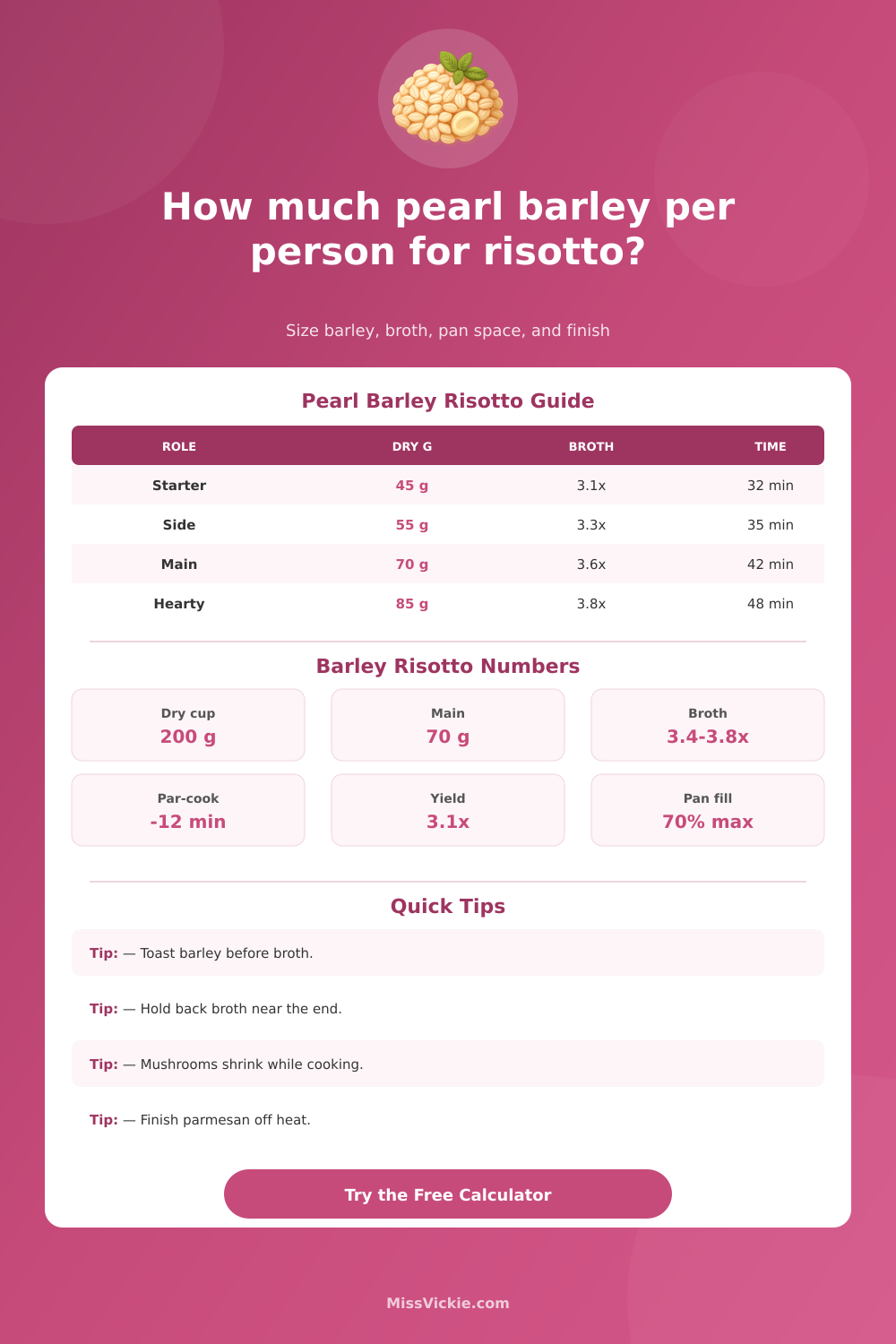
By plugging in the desired texture and number of servings, calculator figures the rest into equation, you won’t have to guess at broth ratios and pan capacity. Before anything else, determine what part the barley will play in your dish. For instance, if it’s going into a starter course, each person will probably want just forty-five grams (dry) of grain, while someone with ravenous appetite may want eighty-five or even more (dry) for a hefty main course. Why? Because cooked barley is voluminous; it nearly doubles in size, so triple the amount of dry barley for every portion you plan to serve.
How to Make Barley Risotto
Otherwise, by the time you get to the third diner, there’ll be nothing left at the bottom of your pot, unless you misjudged amount of dry grain for a main-course portion. That’s where chart on that page comes in. It tells you how many grams of dry grain matches a certain amount of cooked grain. This depends on whether you want a light side-dish portion, a large main dish helping, or something in between.
Most home cooks trip up at this point: Broth management. Barley doesn’t give off a starchy cloud like rice, but it will soak up liquid over time. You need to add more liquid than you might expect, because the grains won’t produce a thick, shiny sauce on their own. Aim for roughly 3½ parts water (or other liquid) per part dried barley, then make it as creamy as you prefer.
To do that, tool calculates your specific desired texture. Do you want it spoonable and still fairly firm, or more loose so you can stir and wave it gently in the bowl? And then it takes into consideration how fast things might evaporate, depending on how intense your simmer and what kind of pan you’re using.
Mushrooms and other vegetables bring further complications. Mushrooms significantly reduce their size during cooking, losing almost half their original volume. Meanwhile, diced veggies retain more of they shape than the others. The calculator then recalibrates the barley quantity based off how much of each bulkier ingredient you are including, and you don’t want the grains to dissapears into the heap. And it factors in the liquid contributed by those additions, which might make things easier, or harder (depending on what you’re aiming for).
This isn’t simply measuring how much liquid is in the pot. It is about creating a balance of textures on the plate. This means you have to consider exactly what you are weighing. Many cooks forget about this perfectly valid strategy: You can cook the barley partly to save yourself from having to stir so much while it’s cooking (and even more-so if you’re serving a big group). It will allow you to enter how long you’ve had the barley soaking or par-cooked, and would of calculate the correct amount of simmer time and broth needed as a result. Or just soak them overnight; that will soften up the grain, but won’t require any additional stovetop cooking time. They’re all shortcuts that work because they change the chemistry of the dish in slightly different ways.
This means that unless the grains soaked up some broth, you may want to adjust the recipe by using a touch less. Barley Risotto requires some space, which means you shouldn’t skimp on pan capacity. Overloading your pan doesn’t allow any of the liquid to evaporate, so rather than sauteing the bottom layer, it just steams it. Result? You get mushy risotto that totally defeats the point of cooking with barley in the first place.
To ensure no one gets caught with an over-filled pot (hence a boil-over disaster or an undercooked center) the calculator alerts you when your batch is too big for your pot. It is a small logistical thing, but it has such a huge impact on how it taste at the end. Contrary to popular belief, finishing is critical. Adding more butter and parmesan after removing the dish from the heat coaxes out starch for a glossy look and helps thicken the risotto so it doesn’t cook any further.
It is also important to note that barley holds its shape better then rice. This could mean the finished risotto becomes too thick if you use too much cheese. The tool advises serving a standard portion per person, but feel free to change this based on your preference.
All in all, making a barley risotto comes down to a mix of precision and patience. You’ll have to account for its increased absorption of liquids and longer cook time. You can also experiment with some new textures you wouldn’t be able to get out of rice. After you’ve dialed-in on exactly how much dry grain there should be in any given scenario, everything else starts to feel pretty naturaly. Your broth will absorb flawlessly, the center stays pleasantly chewy, and your dinner guests won’t ask why you didn’t use this grain sooner. Just know precisely what you’re starting with.