Soup Per Person Calculator
Plan soup portions for cups, bowls, mains, and buffets with soup density, ladle size, simmer evaporation, garnish volume, bread or salad pairing, leftovers, buffet buffer, and pot capacity.
🍲Soup serving presets
Pick the closest meal, then fine-tune the guest count, soup role, simmer loss, garnish, sides, leftovers, and pot size.
📝Soup portion inputs
Soup Plan Results
Amounts include soup role, density, garnish, simmer evaporation, sides, leftovers, buffet buffer, ladle size, and pot capacity.
Full soup breakdown
🥣Soup serving snapshot
📊Soup role comparison grid
Best before a full dinner, especially with bread or appetizers.
Works for a bowl of soup with crackers, salad, or a small roll.
Use for chili, chowder, bean soup, stew, and cold-weather meals.
Smaller first servings, but add buffer for self-serve seconds.
📘Reference tables
| Soup role | Finished portion | 4 oz ladles | Best use |
|---|---|---|---|
| Tasting cup | 2 to 4 fl oz per person | 1 ladle or less | Soup flights, samplers, appetizer tables |
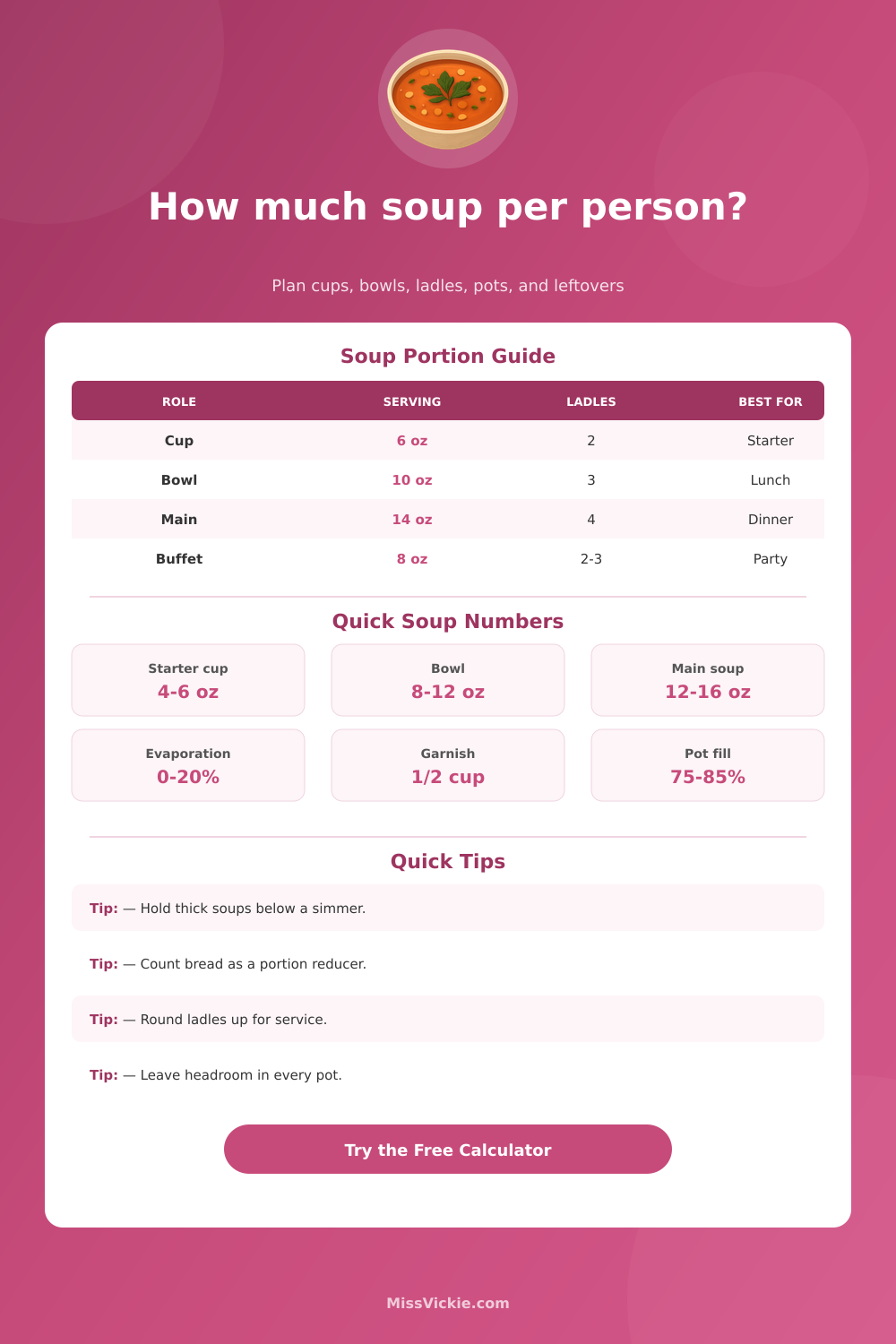
| Starter cup | 4 to 6 fl oz per person | 1 to 2 ladles | First course before a larger meal |
| Regular bowl | 8 to 12 fl oz per person | 2 to 3 ladles | Lunch, casual dinner, soup and side |
| Main soup | 12 to 16 fl oz per person | 3 to 4 ladles | Hearty soup, chili, chowder, stew |
| Buffet soup | 6 to 9 fl oz per person | 2 ladles, then seconds | Self-serve soup warmer with other dishes |
| Soup type | Approx weight per cup | Satiety | Portion note |
|---|---|---|---|
| Clear broth | 8.1 oz / 230 g | Light | Plan larger bowls unless it is a starter. |
| Vegetable soup | 8.4 oz / 238 g | Medium | Chunks make it feel fuller than broth. |
| Chicken noodle | 8.5 oz / 241 g | Medium | Noodles swell during holding and thicken the pot. |
| Tomato soup | 8.6 oz / 244 g | Medium | Often paired with bread or sandwiches. |
| Bean or lentil | 9.0 oz / 255 g | High | Use smaller servings when bread is included. |
| Chowder | 9.2 oz / 261 g | High | Creamy soups fill bowls quickly. |
| Stew-like soup | 9.5 oz / 269 g | Very high | Count as a main dish more than a soup cup. |
| Guest count | Starter cups | Regular bowls | Main soup |
|---|---|---|---|
| 4 guests | 1.5 qt | 2.5 qt | 3.5 qt |
| 8 guests | 3 qt | 5 qt | 7 qt |
| 12 guests | 4.5 qt | 7.5 qt | 10.5 qt |
| 25 guests | 9.5 qt | 15.5 qt | 22 qt |
| 50 guests | 19 qt | 31 qt | 44 qt |
| Pot or cooker | Safe fill | Finished soup | Typical servings |
|---|---|---|---|
| 4 qt saucepan | 3.2 qt | 12.8 cups | 10 starter cups or 5 mains |
| 6 qt slow cooker | 4.8 qt | 19.2 cups | 16 starter cups or 8 mains |
| 8 qt stockpot | 6.4 qt | 25.6 cups | 21 starter cups or 10 mains |
| 12 qt stockpot | 9.6 qt | 38.4 cups | 32 starter cups or 16 mains |
| 18 qt stockpot | 14.4 qt | 57.6 cups | 48 starter cups or 24 mains |
💡Soup planning tips
Twelve guests is coming over for a wintertime get-together. The menu looks good, but then you look into your bare stockpot and suddenly don’t know how much tomato soup to make. That’s when the math ceases to be about cooking and becomes logistical: How much does this soup mean? What role will it play during the meal? A colder room means a lack of hot food will kill the party mood even faster.
It doesn’t matter; it’s a little detail, yet one that the calculator can crunch while you avoid memorizing cup-per-quart equivalents or fiddling with coefficients of evaporation. All you’ve got to do is establish the meal structure, and let the calculator do the rest. This is where I’ve seen the most errors from hosts: assuming all bowls are created equal.
How to Make Enough Soup for Your Party
While you can serve a tiny cup of consommé prior to your roast chicken feast, that’s different than ladling out a big ol’ scoop of a chunky bean stew paired with some crusty bread for lunchtime food. With the tool, you indicate what kind of soup you’re dishing up, and it will factor in your base portion accordingly. As a first course, it’ll keep the servings smaller (roughly six ounces each). As a main event? That go up to fourteen+ ounces apiece.
Seems easy enough, right? But somehow folks undervalue the impact a side dish might have on eating habits. Want a salad or a hefty roll alongside that? Those items will take up precious belly space; meaning less soup gets eaten. And no one wants a big pot filled with lukewarm soup that tastes like Tuesday’s leftovers.
And then there’s simmering physics. Pots empty quickly when left uncovered. If I prepare my broth and set it aside on the stovetop for an hour while I get everything else ready, I have to start with more broth than what will be served at the end. That’s where the evaporation rate and simmer time come in. Most clear broths will go down moderately. A thicker creamy chowder may not evaporate as much while thickening. This is helpful to know because it changes the texture from being thin and watery to something richer.
Then you can tweak how much garnish goes on top, as well. Herbs or croutons takes up space in the bowl where liquid would otherwise be. Not only does it affect flavor, but capacity.
Then there’s the madness of buffets. Self-service isn’t evenly distributed. Cold weather means second helping will be taken. To make up for this variable, a typical buffet buffer provides additional servings. Yes, you’re feeding twelve heads, but you’re also feeding the appetites of twelve people who may wish to sample some more upon seeing the nice garnish.
The cushion on the calculator includes a percentage buffer to ensure that the pot stays full during the meal rather than coming up empty halfway through. Better to end up with leftovers than an empty ladle. Running out of food is something guests won’t soon forget, long after forgetting the exact taste.
Even seasoned chefs can get tripped up by the practical limitations of their pots. Seems like having a big ol’ stockpot would of served everyone? Wrong! Never fill your pot all the way to the top. It’s just too hard to stir, and things will boil over if you don’t leave some head room.
Here’s where the reference table on the page helps; it shows how much food really fits into your pan (finished volume), compared to how full you safely should fill it (safe fill level). So let’s say you’ve got an eight quart pot, but you want to be safe so you use only 64% of its capacity. That means in practice, you’ve got five quarts of soup. If not, you’re running your numbers on paper but forgetting about the physics of what happens when things start boiling, and then rushing around to pick up takeout.
Planning also means no more worry about the math; now you cook confidently instead of wondering whether there will be enough to go around (there will) or if one ladle equals one serving (it does). You won’t have pots running over and having to re-do things, or guessing about whether your pot still has a cup left in it after being held too long and some of the liquid has evaporated off.
The math works out. The pots fit. Everyone goes home full. It’s always better to take that first warming sip knowing you made room for it in your plan.