Macaroni Salad Per Person Calculator
Plan cold macaroni salad from guest count, side or main portions, elbow macaroni yield, dressing absorption, add-ins, chilling loss, picnic hold time, seconds, and scoop size.
Choose a real serving situation, then fine-tune guests, portion size, dressing absorption, add-ins, chilling loss, buffet seconds, and scoop size.
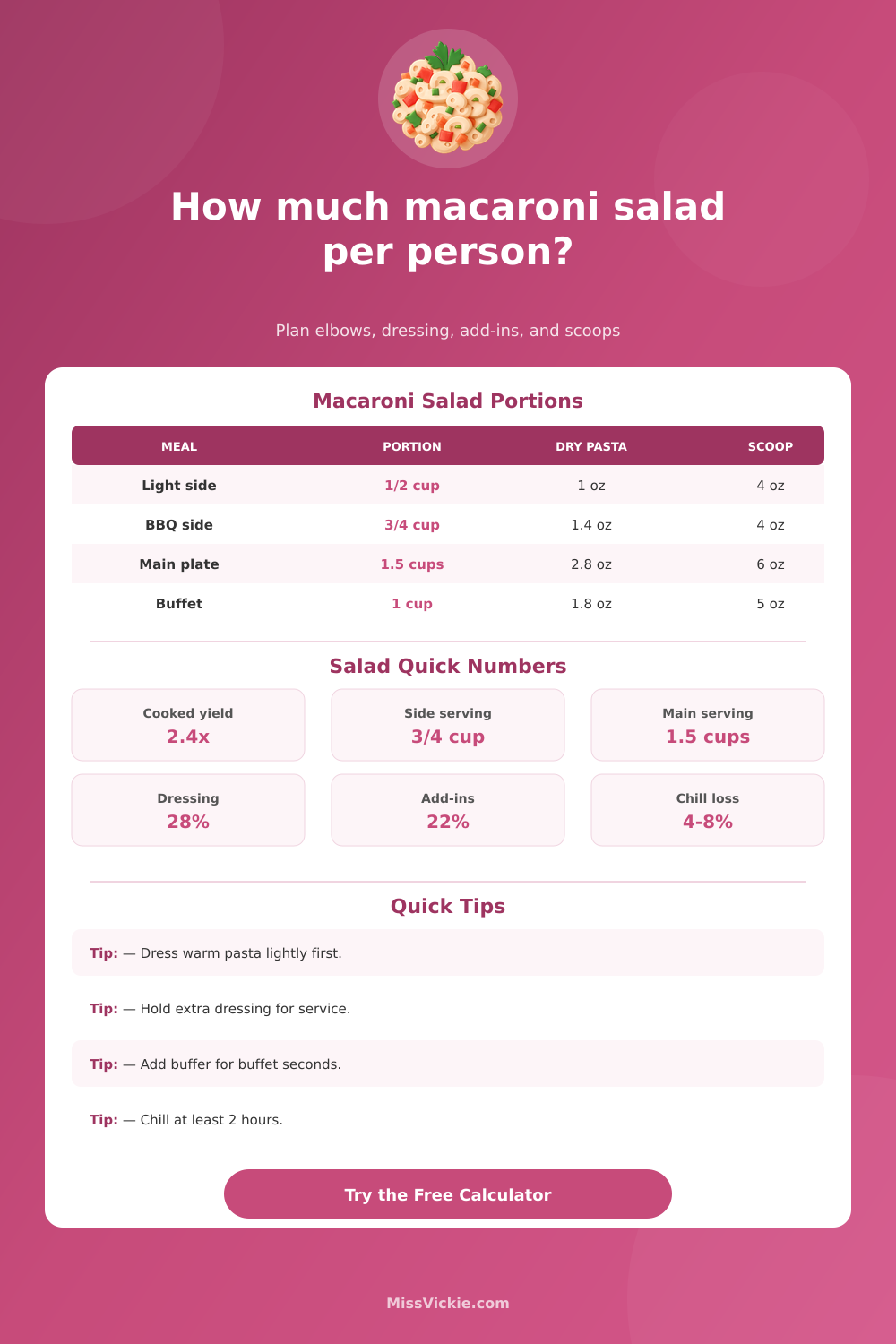
| Serving style | Per person | Best for | Dry elbows per guest |
|---|---|---|---|
| Light side | 1/2 cup | Many side dishes, kids plates, tasting portions | About 1 oz |
| Classic side | 3/4 cup | Cookouts, fried chicken dinners, potlucks | About 1.4 oz |
| Buffet side | 1 cup | Self-serve lines and mixed appetites | About 1.8 oz |
| Main dish | 1 1/2 cups | Lunch bowls, protein salads, meal prep | About 2.8 oz |
| Elbow type | Cooked yield | 1 lb dry makes | Notes |
|---|---|---|---|
| Standard elbows | 2.4x weight | About 10 cups | Most reliable for creamy salad |
| Small elbows | 2.6x weight | About 11 cups | More surface area and dressing cling |
| Large elbows | 2.25x weight | About 9.5 cups | Chunkier bite with less packed volume |
| Gluten-free elbows | 2.15x weight | About 9 cups | Rinse gently and avoid overmixing |
| Guest count | Classic side | Dry elbows | Dressing range |
|---|---|---|---|
| 10 guests | 8 to 9 cups | 1 lb | 2 1/2 to 3 cups |
| 25 guests | 21 to 23 cups | 2 1/2 lb | 6 to 7 cups |
| 50 guests | 43 to 47 cups | 5 lb | 12 to 14 cups |
| 100 guests | 86 to 94 cups | 10 lb | 24 to 28 cups |
| Service plan | Buffer | Chill loss | Best practice |
|---|---|---|---|
| Same-day meal | 5% to 10% | 2% to 4% | Dress once, chill, then stir before serving |
| Overnight potluck | 10% to 15% | 5% to 7% | Keep extra dressing to refresh after chilling |
| Picnic cooler | 12% to 18% | 6% to 8% | Pack in shallow cold containers |
| Buffet rotation | 18% to 25% | 8% to 10% | Serve smaller pans and refill from cold backup |
Best when burgers, ribs, beans, chips, and dessert share the plate.
Works for chicken, tuna, ham, egg, or veggie-loaded macaroni salad bowls.
Creamy batches often use dressing near one-quarter of the finished volume.
Self-serve lines need extra for uneven scoops and people taking seconds.
Let’s say that you’re making a big batch of macaroni salad and need to know how much dry pasta to purchase. You want enough so that there will be plenty of cold, creamy macaroni salad for all of your guests. Guess wrong and you’ll either have an excess of leftovers…or not enough to go around.
Guessing wrong is one of the most common errors at a potluck; it’s usually done by eye rather than with any sort of math in mind. When this happens, you’ll run out of sides long before you reach the end of the meal. Raw pasta isn’t as big as cooked pasta. When it cooks in boiling water, dry elbows swells up and soak in some water. When you toss them with celery, hard-boiled eggs, or dressing, the volume goes up even more.
How to Use a Macaroni Salad Calculator
But it’s not just weight that matters. There’s also the question of what happens to the structure of the food. A calculator will tell you how much to make. Simply enter the number of guests and pick a role like classic side or main plate. No more having to do the math in your head as you go along.
Each type of pasta shape has a slightly different capacity for holding liquid. Large curves hold less dressing then small tubes. That affects how much the salad expands. The time chilling also affects macaroni salad’s texture. Hours before they eats it, people keep their macaroni salad in a cooler or fridge. During that time, the moistness from the mayo dressing enters the pasta. As it chills, it gets dryer and dryer. If you put all the dressing in at the beginning, the noodles will have clumped together by the time you serve them.
The calculator takes that absorption loss into account. It tells you to hold back on some of the dressing. Just before serving the salad, you’ll mix in that reserved portion. That final step ensures the macaroni salad won’t appear dry or separated.
The total volume of your dish will depend on what add-ins you use. If it’s a plain old celery/onion salad, then it’s mainly pasta. If it’s a loaded one full of relish, tuna, pineapple, ham, etc., then those add-ins has some volume too. Those add-ins take up space that would otherwise be pasta so you need to add more pasta if you don’t want to end up with too little.
Depending on which recipe you’re making, there’s a shift in dry weight as seen in the reference table. When scooping onto plates at a buffet line, you’ll want even more of a buffer since everyone doesn’t do it evenly. People tend to go back for seconds. To adjust for the transfer loss when moving food from mixing bowl to serving dish, plan for waste.
That brings us to scoops. How large should the scoops be for dinner? For most meals, three-quarters of a cup is standard. At a kids’ party, it may be half that. On a buffet, perhaps it should of been a cup or more? The calculator will translate your preference into precise dry weight. That way you can purchase the correct quantity of pasta at time of purchase.
You won’t end up with nothing but salad dressing left in the package. Everyone should go home feeling that they had more than enough. This means you won’t have to worry about whether or not there’s going to be enough food. You’ll enjoy yourself at the party rather than guessing about your meal. The pasta will expand in proportion, the salad dressing will cling to the noodles, and everyone leaves full of food.
It turns an exercise in stress into something that actualy works. And then you get to eat too.