Marinara Sauce Per Pound Of Pasta Calculator
Scale marinara for dry pasta by pound, noodle shape, sauce texture, tomato type, simmer reduction, basil, garlic, pasta water, pairing style, and final serving count.
Choose a real pasta night, then fine-tune the sauce texture, tomato base, aromatics, reduction, pasta water, and pairing.
| Pasta shape | Best marinara texture | Finished sauce per lb | Pasta water cue |
|---|---|---|---|
| Spaghetti or linguine | Smooth classic marinara | 2.75 to 3.25 cups | Use 1/2 to 3/4 cup for gloss |
| Angel hair | Light, loose sauce | 2.25 to 2.75 cups | Add gently so strands do not clump |
| Penne or ziti | Classic to chunky | 3 to 3.5 cups | Toss until tubes are coated inside |
| Rigatoni or paccheri | Chunky spoon sauce | 3.5 to 4 cups | Use less water if sauce is chunky |
| Fusilli or rotini | Herby medium sauce | 3.25 to 3.75 cups | Ridges hold sauce well |
| Ravioli or tortellini | Spoon-over marinara | 2.5 to 3 cups | Keep water low to protect filling |
| Tomato type | Typical use | Starting tomato for 3 cups sauce | Flavor note |
|---|---|---|---|
| Whole peeled canned tomatoes | Crushed by hand for classic marinara | About 32 oz | Best balance of body and freshness |
| Crushed tomatoes | Fast weeknight sauce | About 30 oz | Already broken down, reduces evenly |
| Passata | Smooth sauce for long pasta | About 28 oz | Silky, needs less blending |
| Fresh Roma tomatoes | Summer sauce | About 2 lb 2 oz | More water cooks off during simmering |
| Cherry tomatoes | Sweet skillet marinara | About 2 lb | Sweet, juicy, and quick to collapse |
| Jarred plain marinara base | Shortcut pasta night | About 27 oz | Usually needs only warming and loosening |
| Setting | Garlic per lb pasta | Basil per lb pasta | Pasta water per lb |
|---|---|---|---|
| Mild family sauce | 1 to 2 cloves | 1 tbsp chopped | 1/3 cup |
| Classic marinara | 3 cloves | 2 tbsp chopped | 1/2 cup |
| Herby tomato pasta | 3 to 4 cloves | 1/4 cup chopped | 1/2 cup |
| Seafood linguine | 1 to 2 cloves | 1 tbsp torn leaves | 3/4 cup |
| Arrabbiata style | 4 cloves | 1 tbsp chopped | 1/2 cup |
| Dry pasta | Typical servings | Classic marinara | Extra saucy marinara |
|---|---|---|---|
| 1/2 lb | 2 to 3 | 1 1/2 cups | 2 cups |
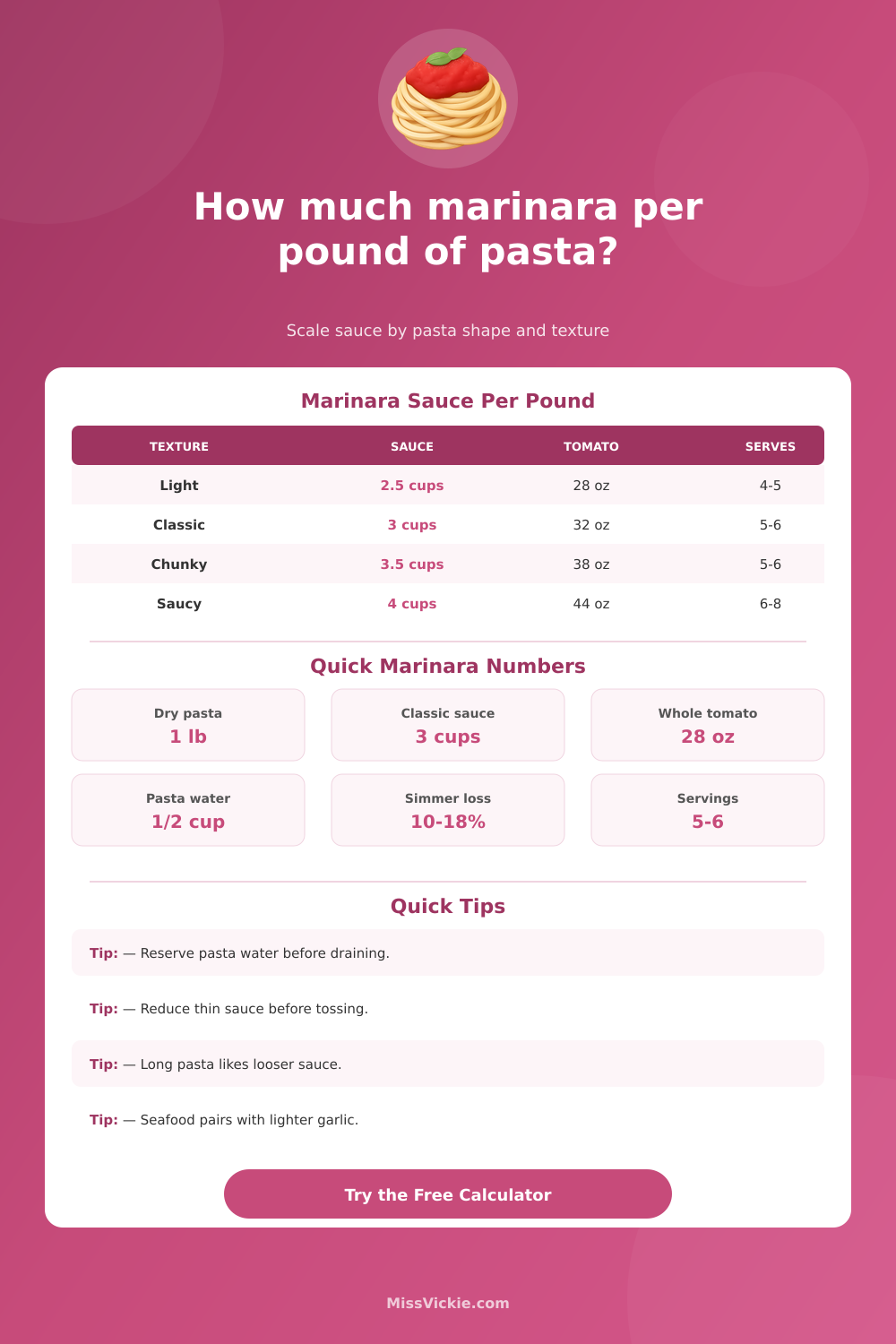
| 1 lb | 5 to 6 | 3 cups | 4 cups |
| 2 lb | 10 to 12 | 6 cups | 8 cups |
| 3 lb | 15 to 18 | 9 cups | 12 cups |
| 5 lb | 25 to 30 | 15 cups | 20 cups |
| 8 lb | 40 to 48 | 24 cups | 32 cups |
Best for angel hair, seafood, and simple tomato flavor where pasta should stay central.
The everyday tossed pasta target for spaghetti, penne, ziti, and meatless dinners.
Better for rigatoni, shells, fusilli, roasted vegetables, and tomato pieces that sit in ridges.
Use for plated pasta with extra spooned sauce, potluck trays, or meatballs served alongside.
Why? When chefs use their gut feeling rather then math to make pasta sauce, the sauce will separate from the noodles. Why? Because a different ratio is needed if you swap out spaghetti for rigatoni and your intuition doesn’t factor that in. Once you input how wet or dry you want your noodles and what shape they are, the calculator map volume to surface area. Letting the tool handle this variable means no more dry plate disaster.
Sauce clings to pasta in a specific way. A thin, glossier coat is best for long pastas such as linguini or angel hair (heavy sauce will drench them, creating a soggy dish). They also does not hold much. A thin layer is graceful, but more will overwhelm them.
How to Use the Pasta Sauce Calculator
Tubular forms such as rigatoni or penne clings to their own ridges, trapping sauce within each tube. To get an even bite, you can’t use the same amount of sauce for both types. When you want chunky sauce atop spaghetti, device gives a shape factor that allows it to fill out the hollow center without puddling on your plate.
Another variable that trips people up is texture preference. Do you want a light red coating in which the tomato flavor complement rather than dominates the wheat? Or do you prefer a saucy finish with a generous ladle of sauce? Adjust this on the calculator (which shifts the output from two and a half cups for delicate preparations to four full cups for hearty plates). Because while under-saucing a heavy dish feel like a mistake, over-saucing a light dish feels like a mistake, too.
You can easily overlook the way simmer time affects volume. A long simmer (an hour or more) create deeper flavors, but it also evaporates some water. If you use tomatoes, you will need a lot of water! Slowly reduce them and the resulting liquid gets concentrated. A rapid ten-minute toss retains most of the original liquid. The gadget will tell you how much product to start with, knowing it will decrease as you go to reach desired final volume. You won’t make the mistake of starting with too little sauce and ending up with a dried-out paste just as the pasta are cooked.
Don’t neglect the reserved starchy water when draining your pasta. A splash or two (or more) will loosen thick marinara without diluting the flavor. That cloudy stuff bond sauce with starch to form a mixture that clings to each tube and strand. Depending on how loosely or tightly tossed your dish is, the calculator even recommend how much pasta water to use.
It fills in the blanks between starting with raw ingredients and getting them onto a plate. The strength of the herbs, specifically garlic and basil (is also important), if not more importance than volume. Lighter garlic is ideal with seafood; you don’t want the delicate shells swamped by garlicky punch, and the aromatics can be dialed back or up depending on what’s being prepared to maintain focus. A little thing perhaps, but when your goal is a cohesive flavor profile rather than simply piling things into a dish it counts.
But there’s a balance between the different parts of cooking pasta. The dish feel purposeful when you get the sauce-to-noodle-surface-area ratio right and account for simmer losses. No more guesswork; just serve it up. Next time you boil water, check your numbers and keep that panic about an empty pan in the past. Your dinner will thank you.