Duck Confit Cooking Time Calculator
Estimate duck confit cure time, low oven cooking range, fat coverage, tenderness target, chill and reheat schedule, skin crisping time, and cooked yield from the size of your duck legs.
Pick a real kitchen scenario, then adjust leg weight, cure hours, fat depth, oven temperature, thickness, tenderness, chilling, crisping, and yield loss.
Your Duck Confit Timing
A low oven plan will appear here after calculation.
Timing Breakdown
Batch Breakdown
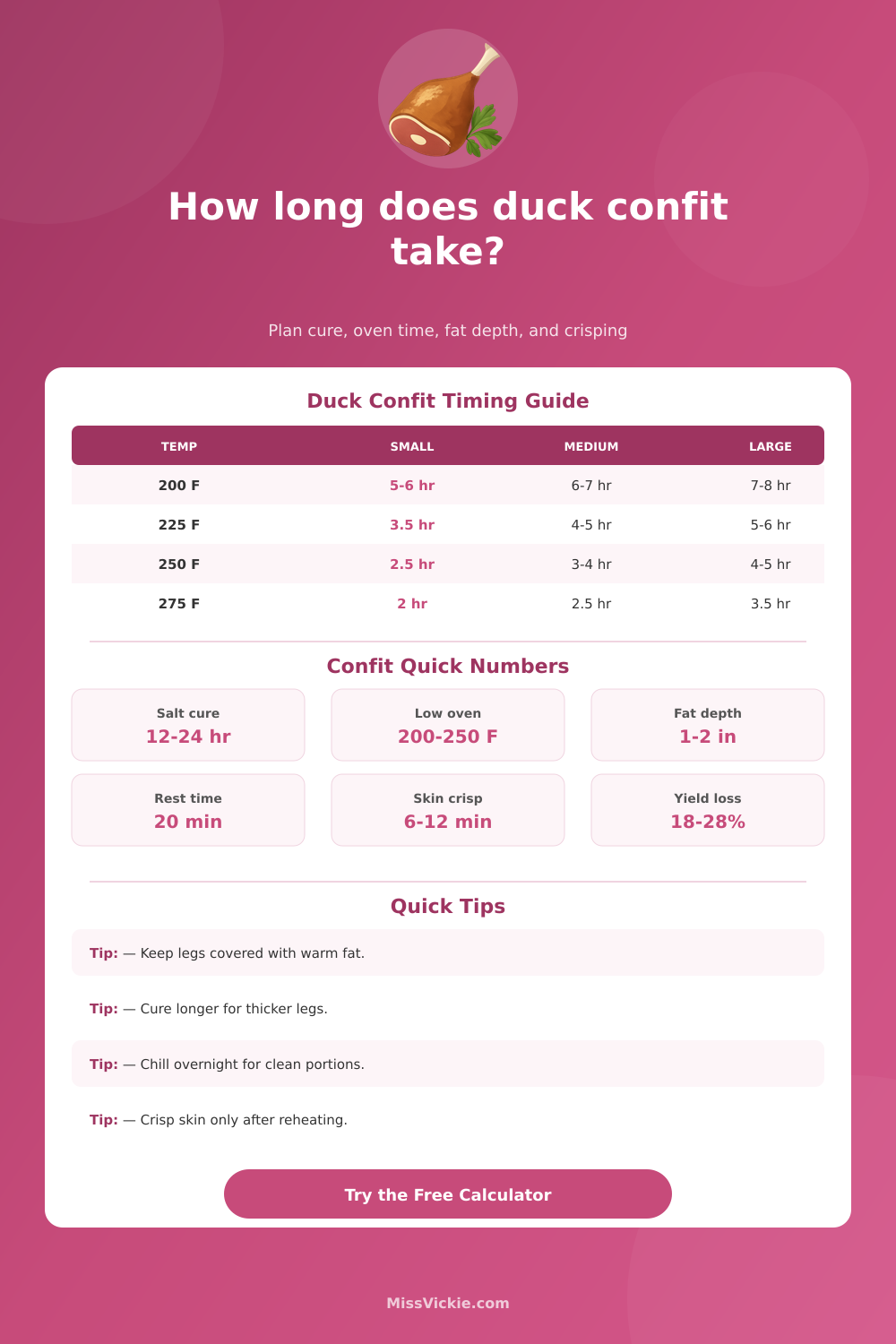
| Oven Setting | Small Leg 8-10 oz | Medium Leg 11-14 oz | Large Leg 15-19 oz | Best Use |
|---|---|---|---|---|
| 200°F / 93°C | 5 to 6 hr | 6 to 7 hr | 7 to 8 hr | Silkiest texture, long hold |
| 225°F / 107°C | 3.5 to 4 hr | 4 to 5 hr | 5 to 6 hr | Classic home oven confit |
| 250°F / 121°C | 2.5 to 3 hr | 3 to 4 hr | 4 to 5 hr | Faster tender legs |
| 275°F / 135°C | 2 to 2.5 hr | 2.5 to 3.5 hr | 3.5 to 4.5 hr | Same-day cooking |
Confit is done when the thigh is fully tender and the bone rotates easily. Use this as a timing estimate, then verify texture before crisping.
| Leg Thickness | Suggested Cure | Texture Effect | Timing Note |
|---|---|---|---|
| Under 1.1 in | 8 to 12 hr | Lightly seasoned | Reduce oven time slightly |
| 1.1 to 1.5 in | 12 to 24 hr | Classic confit balance | Use standard timing |
| 1.5 to 1.9 in | 18 to 30 hr | Seasoned to the bone | Add a tender check buffer |
| Over 1.9 in | 24 to 36 hr | Deep cure, richer bite | Use the high end of range |
| Setup | Fat Depth | Time Change | Yield Expectation |
|---|---|---|---|
| Fully covered single layer | 1.5 to 2 in | Baseline | 72 to 82% |
| Nearly covered snug layer | 1 to 1.5 in | Add 10 to 20 min | 70 to 80% |
| Shallow fat, turn once | 0.5 to 1 in | Add 20 to 35 min | 68 to 78% |
| Crowded or overlapped pan | Variable | Add 25 to 45 min | 66 to 76% |
| Finish Method | Typical Time | Best For | Watch Point |
|---|---|---|---|
| Skillet skin side down | 8 to 10 min | Very crisp skin | Start over medium heat |
| Broiler finish | 5 to 8 min | Fast browning | Move often to avoid scorching |
| Hot oven at 425°F | 12 to 16 min | Many legs at once | Use a rack over a tray |
| Gentle fat reheat | 20 to 30 min | Make-ahead confit | Crisp after reheating |
Best balance of tender meat, steady fat temperature, and dependable home timing.
Silky texture and less bubbling, useful when holding duck in fat for a long window.
Works for smaller legs when the cure is shorter and dinner timing is tighter.
Cleanest portions and excellent skin because the meat firms before reheating.
Crispy duck legs cooked in warm fat build your confidence. They provide feedback so you can tell when they are done, and they give you confidence based off feel rather than just probing with a thermometer. Collagen requires time to break down, so even though a thermometer reading tells one thing, it can be misleading because the meat might not be texture-ready yet. With confit, you need to trust and rely on timing.
Then the calculator figures out the math for you…assuming you know the thickness of the meat near the thigh, the depth of the fat covering it, the temperature you can maintain, and the weight of the leg itself. It will spit back an estimated timeframe, ensuring the meat remains tender-but not dry. And what’s important is that flavor comes from the salt cure, and the timing depends on thickness of your duck legs.
How to Cook Perfect Duck Confit
All the recipes tell you to rub the duck with kosher salt, thyme and garlic, but when? And that really changes the whole chemistry. If you’re using Pekin (smaller) ducks, their legs will be thinner, so they’ll take less time to get penetrated by the salt. If you’re using thicker Moulard duck legs, it takes longer, not only to penetrate but to season all the way through. My chart on the page gives those timings, depending on leg thickness; use that to figure out whether an eight-hour cure is enough or if you should of left them overnight. Many folks skimp here and end up with a deliciously salty exterior but dull interior.
Once the legs are cured and rinsed, it’s time to put them into the oven. Slow cooking in an oven is even more forgiving than slow cooking in general. Basically, you melt some duck fat, stick the legs in there, and pop it all in a low oven (typically around two hundred and twenty-five degrees Fahrenheit). The legs sits in the fat; the fat insulates them and helps cook them. Moisture is retained on the outside while the interior slowly heats up just enough to break down the connective tissue.
But if your legs are packed tightly in the pan, that fat won’t be able to move well and will take longer to cook through. So the calculator lets you specify whether you have your legs spread out nicely in one layer or crammed together in a sardine-like fashion. That way, it’ll adjust its estimation to make sure your legs don’t get served raw due to insufficient space in your pot.
One thing that yield trips up home cooks is that they meal-plan by raw weight. When making duck confit, for example, a lot of moisture is driven off and fat is rendered out. This means your final dish may contain much less actual meat then what you started with. You might begin with four big legs but only have half that amount once it’s finished. Depending on your inputs, the tool can estimate this loss and provide a more realistic image of quantity of cooked goods you’ll have at the end. That’s important when feeding more than one person or preparing side dishes that should match the portion size. Nobody wants to run out of duck while everybody else is already full.
Most people mess up at this point by overcooking their now-tender flesh until it becomes as leathery as shoe leather. When you refrigerate your confit, the fat hardens and locks in moisture… Good for storing but bad for serving. Reheat it gently in warm fat, then try to get skin crispy. Placing the cold confit straight into a pre-heated pan will result in an exterior that browns while the interior stays cool and rubbery. The calculator includes different reheating methods to remind you that you can’t crisp the skin until meat is thoroughly warm.
The trick: quickly shatter the layer of cooked fat so it’s like a sheet of glass, using a broiler or a heavy skillet for a final few minutes. The high temp does not drop the inner temperature; it just makes the fat pop and shatter instantly.
At its heart, duck confit is an exercise in patience. It takes the rush out of cooking, allowing time to do the work instead. Whether your goal is rillettes or spoon-tender slices, what matters most isn’t so much the inputs but the discipline to execute them. When you grasp the interaction between temperature, fat depth, and thickness, then you let go of exact minutes and trust your own senses. Is it done? When the bone spins freely in its socket. That’s the test.
Cover those legs with warm fat until serving time, and you’ll have a dish that tastes like it was easy to make; even though it took all day to get it right.