Dough Per Pizza Calculator
Calculate dough ball weight and total pizza dough by pizza count, diameter, style, crust thickness, hydration, flour protein, topping load, bake surface, and leftover reserve.
Pick a real pizza setup, then adjust the dough ball weight, crust, hydration, protein, toppings, bake surface, and reserve.
Your Pizza Dough Plan
Dough ball and ingredient weights are ready.
Portion Breakdown
Ingredient Breakdown
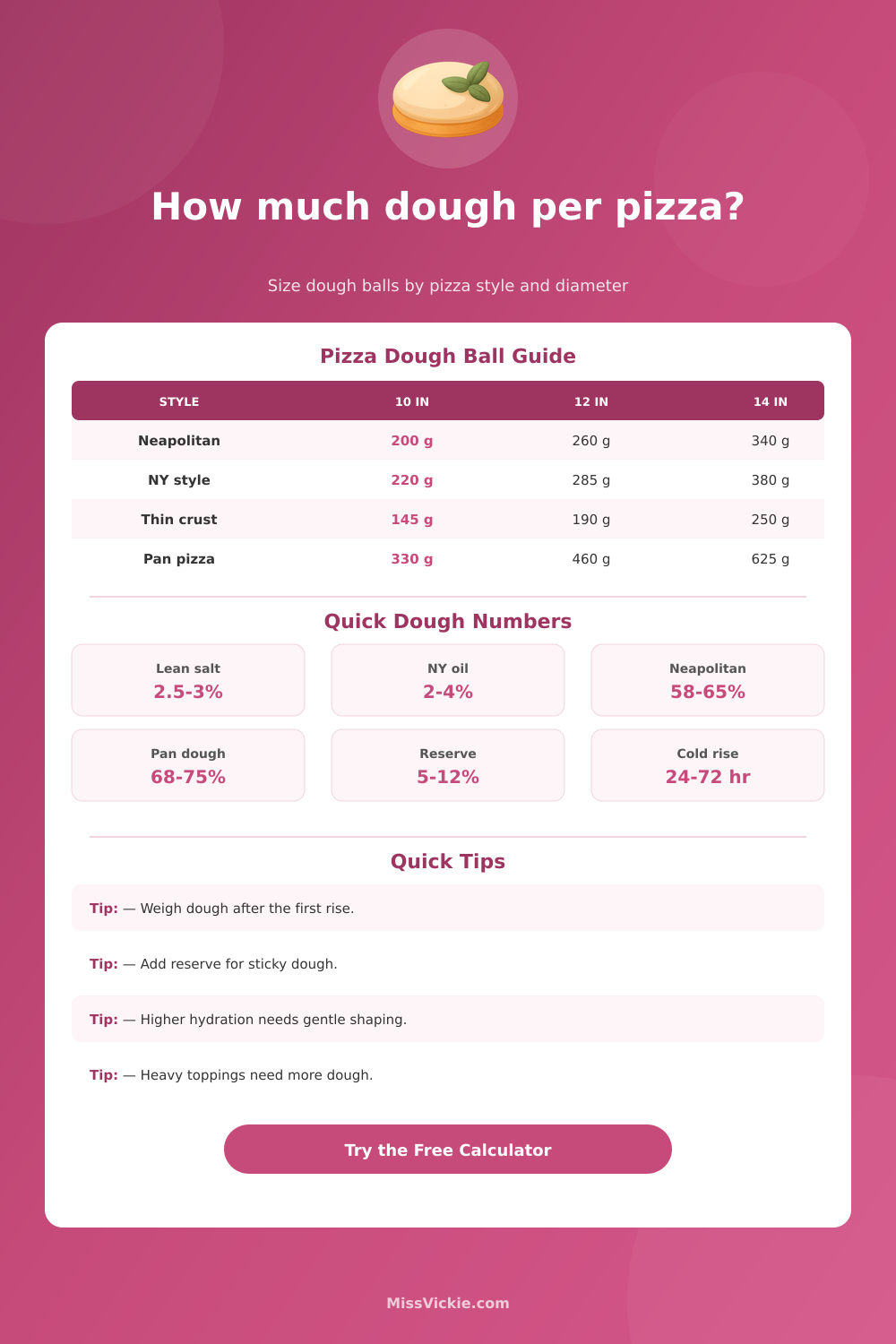
| Pizza Style | Typical Dough | Hydration | Best Surface |
|---|---|---|---|
| Neapolitan airy rim | 220 to 280 g for 12 inch | 58 to 65 percent | Stone, steel, or hot oven floor |
| New York style | 270 to 320 g for 12 inch | 60 to 65 percent | Baking steel or stone |
| Thin crust | 170 to 220 g for 12 inch | 50 to 58 percent | Screen, stone, or steel |
| Pan pizza | 400 to 500 g for 12 inch | 68 to 75 percent | Oiled pan or cast iron |
| Detroit style | 500 to 650 g per 10 by 14 pan | 68 to 75 percent | Seasoned steel pan |
| Diameter | Thin Crust | Neapolitan | Pan Style |
|---|---|---|---|
| 10 inch | 140 to 170 g | 190 to 220 g | 310 to 360 g |
| 12 inch | 185 to 220 g | 245 to 280 g | 420 to 500 g |
| 14 inch | 250 to 300 g | 335 to 390 g | 575 to 675 g |
| 16 inch | 330 to 390 g | 435 to 510 g | 750 to 880 g |
| 18 inch | 420 to 500 g | 555 to 650 g | 950 to 1120 g |
| Baker's Percent | Lean Dough | NY Style | Pan Dough |
|---|---|---|---|
| Flour | 100 percent | 100 percent | 100 percent |
| Water | 58 to 65 percent | 60 to 66 percent | 68 to 75 percent |
| Salt | 2.5 to 3 percent | 2.3 to 2.8 percent | 2 to 2.6 percent |
| Oil | 0 to 1 percent | 2 to 4 percent | 3 to 8 percent |
| Instant yeast | 0.05 to 0.3 percent | 0.1 to 0.5 percent | 0.2 to 0.8 percent |
| Reserve Use | When To Use | Add This Much | Kitchen Note |
|---|---|---|---|
| No reserve | Precise dough balls | 0 percent | Best for tested recipes |
| Small reserve | Home pizza night | 5 percent | Covers bowl and scale loss |
| Standard reserve | Sticky or wet dough | 8 to 12 percent | Helpful for high hydration |
| Party reserve | Many pizzas | 12 to 18 percent | Allows one backup dough ball |
Per square inch before crust and topping adjustments.
Foldable slice dough with enough chew for large pies.
Lower dough weight for a crisp base and small rim.
Higher dough loading for a thick, airy pan crust.
Calculator weights are practical starting points for home pizza dough. Flour brand, fermentation time, oven heat, and shaping style can shift the ideal dough ball by a small amount.
Pizza dough is often treated by most home cook as a science experiment that has gone awry. Follow the recipe to the gram, throw it in a screaming hot oven, and then emerge with either a hockey puck or a soggy frisbee. This isn’t usually a flour issue; nor is it usually a yeast issue. No, the issue is clearly located in your math: how much actual mass do you have going onto the stone? Take two hundred grams of dough, stretch it into a sixteen-inch circle, and what do you think you’re making? A pizza? You’re making a large, edible napkin. Nailing this ratio is the biggest step towards getting professional results at home.
But how? That’s where the pizza calculator above steps in and does all of the work. How much weight should I use for my chosen pizza size? Well, it figures out the amount of base dough required for your chosen surface area. Then, if you like a thick crust, it adds to that calculation, and if you like thin crust, it subtracts from it.
How to Use the Pizza Calculator
Here’s why everyone gets tripped up: they think that a twelve inch New York-style pizza requires the exact same quantity of dough as a twelve inch Neapolitan pizza. It doesn’t. In terms of style, different factors is involved. The calculator takes this into consideration without any fuss whatsoever. Do you prefer the chewy foldability of a New York-style slice? Let it know, and it’ll make your dough heavier. Or, want a thin crust with crispy edges? Let it know that too, and it’ll reduce the amount of dough so your perimeter stays crisp instead of spongy.
Beyond dividing things simply, however, hydration is transformative. With a high hydration dough, it feels like wet clay until heated up, at which point it bake out into an airy, open crumb structure that’s all very instagram-worthy looking. For lower hydrations, the dough are still stiff and fairly easy to handle. If you’re just getting started and struggle with stretching, low hydration dough is forgiving in that way.
It has a dial for your water percent. It tells you how much total flour and salt you need to make a certain amount of dough at once. This is helpful because baking percentages maintain the ratio whether you make four pizzas or forty. And when you do scale up, you don’t have to guess how much more water would of been absorbed by a bigger volume of dough.
Also note the reserve percentage input, which provides a little cushion to the overall amount of dough you weigh. Dough adheres to bowls. It sticks to hands. A bit just seems to vanish down the cracks in your work surface. By adding an eight percent reserve, if you measure right for making four balls and lose half that (thirty grams) during transfer, you’ll still be okay, rather than finding yourself with nothing left midway through a party. Having some excess scraps will feel like a waste, but running dry is much worse. The chart on the page explains it well, showing that various styles require different degrees of safety margin.
You also need to consider the type of surface you’ll be using to bake on (something most people don’t think about). For example, steel heats up faster than stone, so your dough will spread out less and set faster. Using a screen to hold your pie in place while cooking traps steam underneath. This makes your crust a bit softer, much like what happens in delivery boxes. So the calculator takes these factors into account, however minutely, and bumps the amount of dough up or down based on its anticipated ability to spring back off whatever it lands on. That little adjustment adds up over ten pies, and you get same results each time.
Flour determines how much the dough sticks together. That’s dependent on how much protein is in your flour. Bread flours has high amounts of protein. They form tight gluten networks that resist longer fermentations and support thick layers of toppings without falling apart. Conversely, lower protein flours work great for flatbreads, but probably won’t survive being stretched out super thin like an airy Neapolitan pizza with a lot of wet ingredients on top. Plug in your flour’s percent protein. It’ll help you determine how much structure the dough needs to handle the needs of the bake.
Last but not least, pay attention to the topping load. A thicker crust is needed as a foundation if toppings are heavy (like wet veggies and lots of cheese). If it’s just light sauce, you can get away with a skinnier base. This all goes into the final weight recommendation calculated by the device, which prevents tears at the edge and slumping in the middle once you lift the pizza from the oven.
It removes the guesswork from finding a balance between taste and structure. This lets you focus on what really counts: stretching the dough without fear and getting that delicious char all along the rim. With time, these variables become the keys to changing a messy kitchen experiment into a trusted ritual.