Cornstarch Per Cup Of Liquid Calculator
Estimate cornstarch per cup, total starch, slurry water, boil time allowance, reheating margin, finish clarity, serving yield, and over-thickening risk for sauces, gravies, fillings, dairy bases, and glossy glazes.
Choose the closest liquid and texture, then adjust cups, acid, sugar, dairy, boil time, serving count, clarity, and slurry ratio.
Cornstarch Thickening Breakdown
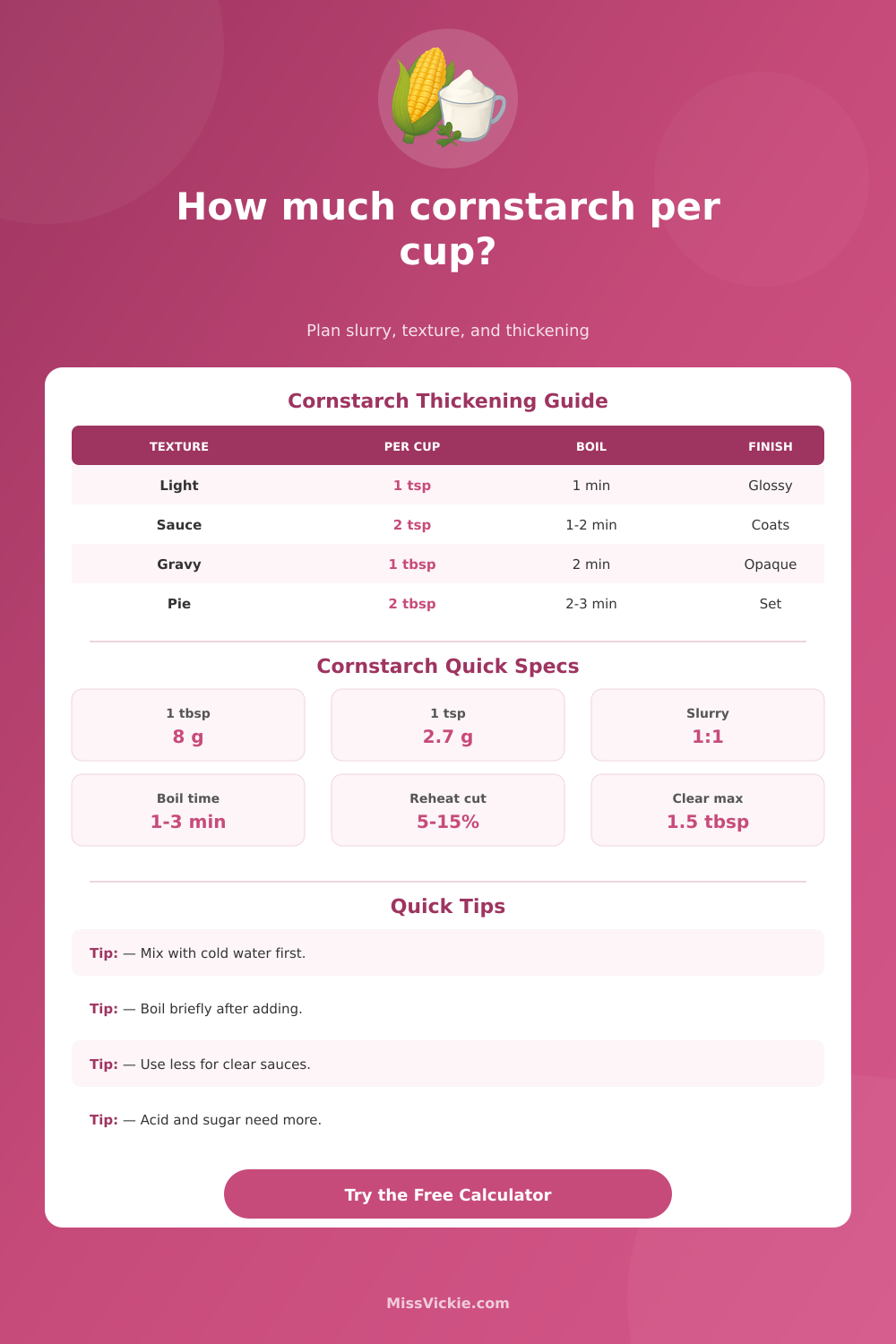
| Target texture | Typical cornstarch per cup | Best for | Finish note |
|---|---|---|---|
| Light body | 1 to 1 1/2 tsp | Soups, jus, very light pan sauce | Subtle thickening, still flows quickly. |
| Pourable sauce | 1 1/2 to 2 1/2 tsp | Everyday sauces and stir-fry bases | Coats a spoon without setting firmly. |
| Classic gravy | 1 tbsp per cup | Turkey gravy, roast drippings, brown sauce | Opaque and spoon-coating after a short boil. |
| Glossy glaze | 2 to 3 tsp | Teriyaki, fruit sauce, Chinese takeout-style glaze | Best when boiled briefly and served hot. |
| Thick filling | 1 1/2 to 2 tbsp | Pudding, pastry cream style bases, cobbler juice | Sets more as it cools. |
| Sliceable pie filling | 2 to 3 tbsp | Berry, apple, peach, or cherry pie filling | Needs cooling time to finish setting. |
| Liquid profile | Calculator adjustment | Why it matters | Kitchen cue |
|---|---|---|---|
| Neutral stock or broth | No extra starch | Starch gelatinizes predictably in clear, savory liquids. | Whisk slurry into simmering liquid. |
| Acidic liquid | Add 10 percent | Acid can weaken thickening if boiled too long. | Add slurry near the end. |
| Sugary fruit base | Add 8 percent | Sugar competes for water and slows full thickening. | Give it a full bubble. |
| Acidic and sugary fruit | Add 18 percent | Pie fillings and lemon sauces need extra support. | Cool before judging final set. |
| Dairy or cream | Reduce 5 percent | Milk solids add body before the starch finishes. | Use gentle heat and stir often. |
| Dairy plus mild acid | Add 5 percent | Acid offsets some dairy body and can split if boiled hard. | Keep the boil short. |
The calculator treats a short bubble as ideal because cornstarch needs heat to fully thicken.
Extended boiling can thin cornstarch gels, especially with acid or constant stirring.
Make-ahead gravy and buffet sauces get a small starch cushion for later loosening.
Clear glazes stay prettier when the calculator keeps starch lower and avoids over-setting.
| Liquid amount | Light body | Classic gravy | Pie filling |
|---|---|---|---|
| 1 cup liquid | 1 tsp starch | 1 tbsp starch | 2 tbsp starch |
| 2 cups liquid | 2 tsp starch | 2 tbsp starch | 1/4 cup starch |
| 4 cups liquid | 4 tsp starch | 1/4 cup starch | 1/2 cup starch |
| 8 cups liquid | 2 tbsp plus 2 tsp | 1/2 cup starch | 1 cup starch |
| 12 cups liquid | 1/4 cup starch | 3/4 cup starch | 1 1/2 cups starch |
It’s easy to say: “I’m watching this sauce cook down on the stovetop.” But that same sauce could be watery soup in five minutes. Why? Because excessive heat or strong stirring break down gelatinized cornstarch. How do you avoid making a watery mess instead of a glossy glaze?
First, know just how much starch to use before heating the pan. That’s where the cornstarch calculator (above) step in. No guessing when you’re hovering over the boiling pot, just plug your numbers into the calculator and let it do the math. It accounts for reheating plans and liquid acidity, too.
How to Use Cornstarch Correctly
Pure Cornstarch: Derived from the starchy part of the corn kernel, cornstarch is pure powder with no fat or protein. Unlike flour which has both, cornstarch will thicken differently than other thickeners.
What’s happening when you combine cornstarch with cold water to make a slurry? Those grains of starch are now sitting in your liquid, but they’re dormant. Once the mixture reach approximately one hundred sixty degrees Fahrenheit, they expand, pull in some more water, and then sort of pop open, creating a mesh-like structure that catches other molecules within the liquid.
If you try mixing cornstarch straight into hot liquid, you’ll get lumpy results because the outer part of each lump immediately gels. That seals off all the dry powder, preventing it from ever absorbs any water. Always use cold water to mix.
How much? It depends a lot on what else is in your pot. Vinegar or lemon juice (acidic) will degrade the cornstarch network; so will wine. Sugar will compete for water molecules, which weakens the starch network again. If you’re creating a traditional gravy with turkey using neutral stock, the standard rate should of been just right.
On the other hand, if you’re thickening a cherry pie filling, chock-full of sugar and fruit acids, you’ll require more starch than you would expect to get the same level of firmness. These chemical reactions are already accounted for in the calculator. As such, when it’s time for serving, your pie won’t run everywhere… It will slice properly.
The other thing about cornstarch: The amount isn’t everything. Boil briefly until it comes alive. As in, don’t drop the slurry into the pan and switch it off immediately. The cornstarch granules won’t have had time to swell fully so the sauce will be watery and disappointing. Let it go for a minute or so with that little bubble of life, but not longer; if you do, the structure unravels anew. It’s a delicate dance, and mastering how long to let things boil is a more important skill than many home cooks knows.
There is also the added complication of reheating. When cooled and reheated, some sauces, particularly those thickened with cornstarch, become delicate. Water separation occurs: the gel-like structure relaxes, letting out trapped water. To account for this, if you’re making a big pot of gravy or stew for later use, begin with a bit more starch than recipe calls for. A little overkill at the beginning allows for breakdown while stored and reheated. Otherwise, what was perfect on night one becomes soupy come leftover day.
Keep in mind that mixing cornstarch will compromise clarity (which can be good or bad). A little goes a long way; it will make your sauce translucent. It is great for clear fruit sauces or stir-fry glazes, where you prefer to see the components underneath. The more cornstarch you add, the more opaque the sauce will become. For a cloudy, rustic gravy, go higher on the starch, but for something shinier like a glassy sheen of vegetable coatings, maintain a lower ratio and focus more on precise technique than volumetric measurements. It’s spelled out neatly in the reference table at the bottom of the page.
The amount needed changes based off the texture you’re going for. A spoonful or two per cup would be plenty for a light-bodied soup, but a sliceable pie filling will require tablespoons. You also don’t just think in terms of volume; you think of what you want the finished dish to look like and feel like in your mouth.
When you realize there are many factors (like time), heat, or even acid, it stops feeling like you are tied to a recipe. Instead, it feels like you are working with ingredents on purpose, carefully controlling them.