Cheese Sauce Per Pound Of Pasta Calculator
Scale cheese sauce for dry pasta by pound, shape, sauce style, cheese blend, milk or cream, roux thickness, baked loss, extra sauciness, and final serving yield.
Pick a real kitchen scenario, then fine-tune pasta weight, shape, cooking method, sauce style, cheese, dairy, roux, and sauciness.
| Pasta shape | Sauce multiplier | Cooked yield per lb | Best cheese sauce use |
|---|---|---|---|
| Elbows or small macaroni | 1.00x | About 8 cups | Classic stovetop or baked mac |
| Medium shells | 1.08x | About 8.2 cups | Extra creamy sauces caught inside shells |
| Cavatappi or cellentani | 1.15x | About 8.5 cups | Party pans and restaurant-style mac |
| Penne or ziti | 1.06x | About 8.4 cups | Baked cheese pasta and casseroles |
| Rigatoni or paccheri | 1.12x | About 8.6 cups | Chunky cheese sauce with add-ins |
| Linguine or spaghetti | 0.90x | About 8 cups | Alfredo-style coating, less thick roux |
| Ingredient choice | Calculator adjustment | Useful range per lb pasta | Kitchen note |
|---|---|---|---|
| Whole milk with cheddar | Standard liquid and roux | 2.5-3.5 cups milk, 6-10 oz cheese | Reliable base for classic macaroni and cheese |
| Half-and-half or cream blend | Less liquid, softer roux | 2.2-3.2 cups dairy, 5-9 oz cheese | Richer sauce thickens as it cools |
| Evaporated milk | Less liquid and light roux | 2-3 cups evaporated milk, 6-9 oz cheese | Good emulsion for stovetop mac |
| Parmesan-forward sauce | Less cheese by weight | 3-6 oz Parmesan blend | Use pasta water and avoid boiling cheese |
| Plant-based shreds | More liquid and more sauce | 7-12 oz shreds, 3-4 cups liquid | Needs gentle heat and often more seasoning |
| Medium roux | 1 tbsp butter plus 1 tbsp flour per cup liquid | 2.5-4 tbsp each per lb | Classic bechamel-style cheese sauce thickness |
Small evaporation allowance. Keep sauce glossy and stop heating once cheese melts.
Build extra sauce because pasta keeps absorbing liquid while it sits.
Useful for casseroles where sauce thickens but should stay creamy under foil.
Best with extra saucy input and a looser sauce before adding crumb topping.
| Dry pasta | Classic finished sauce | Main servings | Side servings |
|---|---|---|---|
| 0.5 lb | About 1.75 cups | 3-4 | 5-6 |
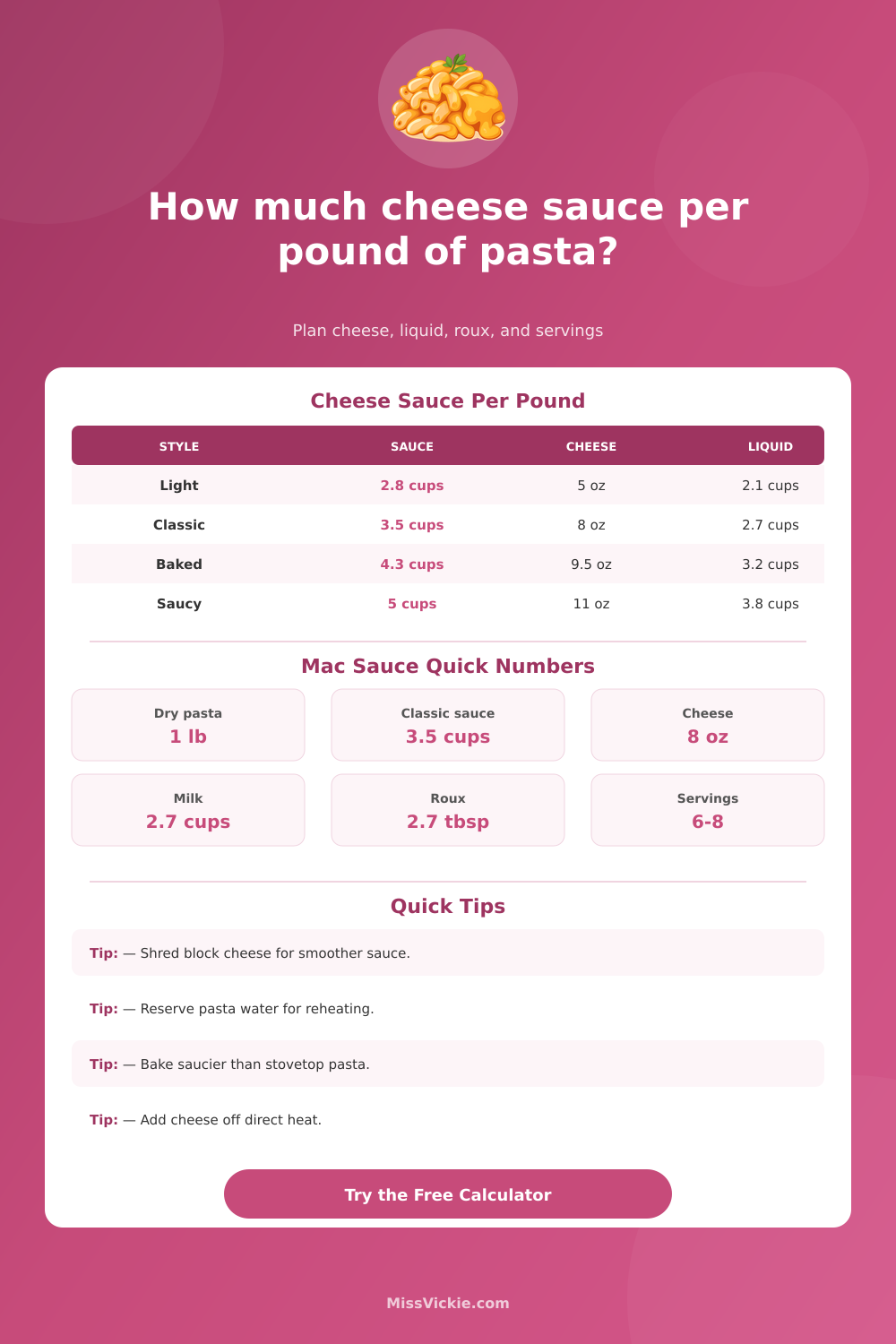
| 1 lb | About 3.5 cups | 6-8 | 9-11 |
| 2 lb | About 7 cups | 13-15 | 18-22 |
| 3 lb | About 10.5 cups | 20-23 | 28-33 |
| 5 lb | About 17.5 cups | 34-38 | 46-55 |
Instead, most cheese sauces is either soupy or dry because you think of cheese sauce as magic, not science. One thing people forget about until it’s too late is how much water stays in the food after cooking. This is usually the difference between winning (or at least decent) stovetop macaroni and a train wreck. You might be able to get your measurements of flour and butter exactly right, but you’ve got no chance if you don’t consider what happens when noodles absorbs some of the liquid or evaporate some while in oven.
So the volume of sauce you plan to make should depend on weight of dry pasta. And not just because you have a feeling for the thickness of the final product. This is where the calculator comes in: It accounts for all this real world math and does the work for you. Rather than spit out a set number for you, it takes into account the shape of noodles, knowing that some has more surface area for sauce than others. Because a long noodle like spaghetti have less surface area and holds less sauce than a tubed pasta (like cavatappi or rigatoni), the calculator uses that information when figuring out the sauce amount.
How to Make Perfect Cheese Sauce
And it’s also accounting for how you cook it. Some dishes spends time waiting in a slow cooker for an hour before being served; the pasta will be drinking up the sauce during its wait time. The calculator adds a little extra sauce in for that absorption, so even though the pasta drank up liquid while it waited for dinner, on the plate it’ll still be creamy, not clumpy.
It turns out that your cheese choice is an unexpectedly important factor in how much milk you’ll need for your sauce, too. Hard cheeses (e.g., aged cheddars) are higher in protein and lower in moisture content. Because of this, they tend to seize when overheated and thicken rapidy. Soft cheeses such as mozzarellas and certain softer blends will be handled different, and may need a slightly looser base to become as glossy as other options. Depending on what kind of cheese you choose, the tool changes the proportion of liquid to cheese accordingly, knowing that eight ounces of American blend isn’t going to act quite the same way than eight ounces of sharp cheddar.
This is not because the flavors are different, but because consistency of the resulting emulsions is different. If you follow the reference guide’s instructions and add the cheese little by little while it’s removed from the direct heat source, you’ll maintain that silky texture high temps would of otherwise wreck.
Most classic cheese sauces use a roux as their main base (that’s why even though we’re going to talk about melting cheese, it’s not completely reliant off it). How much flour and how much butter should you add? The answer is based on your desired liquid volume, enter those numbers in the calculator, and it will tell you what to do. If you’ll be baking, then you want a thick roux that won’t dry out and become an immovable brick. For a stovetop version, you want a light roux so that the sauce stays fluid enough to coat all the noodles but doesn’t becomes pasty or heavy.
Knowing this will help you prevent over-flouring the roux. This is the most frequent error. It will make the final product gluey, and no matter how much cheese you add, it still won’t come back. Evaporation is the silent killer in any casserole plan. As it bakes away, all that steam escapes, making the dish taste even better, but leaving it much less voluminous than promised. To account for the missing moisture, the tool ups the amount of sauce at the beginning so that whatever comes out on the other side will match the level of sauciness you’re aiming for.
Do you like your pasta swimming in cheesy goodness or just lightly coated? Either way, the calculation lets you know how much liquid to start with in order to wind up with exactly as much or little sauce as you want. It is the connection between recipe theory and real-world cooking. It eliminates the guesswork when you double recipes for parties or tweak them depending on the shape of your noodles. This means getting accurate measurements not only for the roux, but also for the cheese and milk based off the serving size and cooking method that you choose.
No more watery first bites or dry leftovers. Just creamy perfection each and every time you boil some water.