Polenta Per Person Calculator
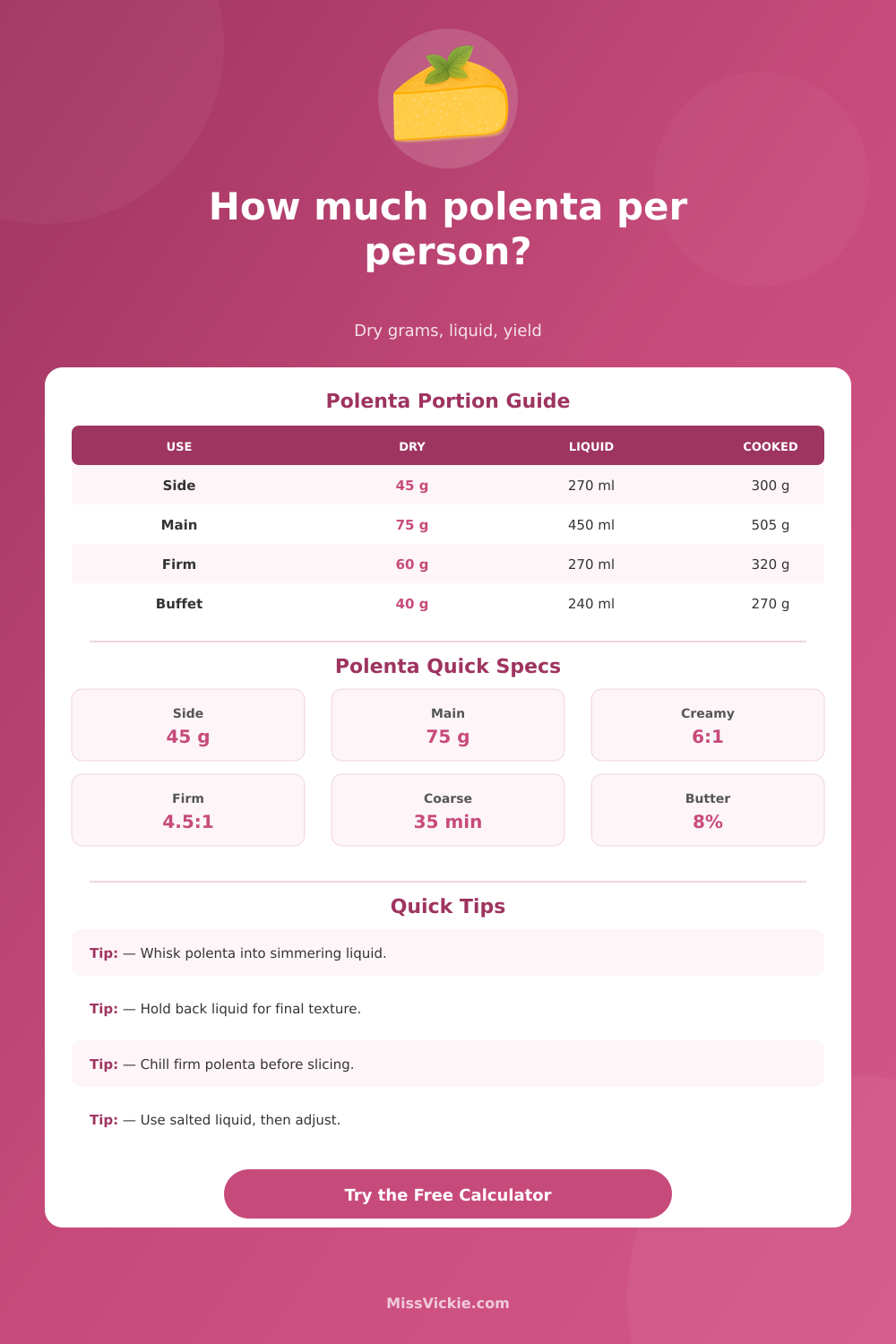
Plan dry polenta grams, coarse or fine grind liquid needs, creamy versus firm texture, dairy and butter enrichment, leftover margin, pan thickness, and cooked yield.
🌽Polenta serving presets
Choose a common meal size, then adjust the serving role, grind, target texture, enrichment, leftover margin, and pan thickness.
⚖Polenta measuring units
🍲Guest count and serving style
Polenta batch results
Polenta portion breakdown
📋Polenta serving size guide
For appetizers, tastings, or rich toppings.
Good with braises, mushrooms, or roast vegetables.
For saucy mains where polenta is the base.
Works well when chilled, cut, and fried.
🥛Liquid and enrichment reference
| Texture target | Liquid ratio | Dry per side | Cooked yield note |
|---|---|---|---|
| Creamy spoonable polenta | 6.0 ml per 1 g dry | 45 g per person | About 6.6 times dry weight after enrichment |
| Loose porridge-style polenta | 7.0 ml per 1 g dry | 40 to 55 g per person | Best served immediately from the pot |
| Soft moundable polenta | 5.2 ml per 1 g dry | 50 to 65 g per person | Holds a spoon shape without setting hard |
| Firm set polenta for slicing | 4.5 ml per 1 g dry | 55 to 70 g per person | Spread into a pan and chill before cutting |
Ratios are practical kitchen planning estimates; simmer time, evaporation, grind, and final stirring can change the exact cooked weight.
⏲Grind, ratio, and simmer table
| Polenta grind | Best use | Hydration adjustment | Typical simmer time |
|---|---|---|---|
| Coarse stone-ground polenta | Rustic creamy bowls and firm slabs | Add about 5% more liquid | 30 to 45 minutes with stirring |
| Medium grind polenta | Everyday side dishes and soft mounds | Use the selected ratio as written | 20 to 30 minutes |
| Fine grind polenta | Smooth fast sides and breakfast bowls | Reduce liquid by about 5% | 10 to 18 minutes |
| Instant polenta | Quick service and small batches | Reduce liquid by about 10% | 3 to 8 minutes |
🍽Common polenta batch quantities
| Guest count | Side dish dry polenta | Main bowl dry polenta | Creamy liquid at 6:1 |
|---|---|---|---|
| 4 people | 180 g dry | 300 g dry | 1.1 to 1.8 liters |
| 6 people | 270 g dry | 450 g dry | 1.6 to 2.7 liters |
| 12 people | 540 g dry | 900 g dry | 3.2 to 5.4 liters |
| 25 people | 1125 g dry | 1875 g dry | 6.8 to 11.3 liters |
🥘Pan set thickness guide
| Pan or tray | Approx area | 2 cm slab yield | 2.5 cm slab yield |
|---|---|---|---|
| 8 inch square pan | 413 sq cm | About 830 ml cooked polenta | About 1030 ml cooked polenta |
| 9 inch square pan | 523 sq cm | About 1050 ml cooked polenta | About 1310 ml cooked polenta |
| 9 by 13 inch pan | 755 sq cm | About 1510 ml cooked polenta | About 1890 ml cooked polenta |
| Half sheet pan | 1890 sq cm | About 3780 ml cooked polenta | About 4725 ml cooked polenta |
💡Polenta planning notes
Creamy service: Keep 5% to 10% of the liquid hot on the side. Stir it in near the end if the polenta thickens before service.
Firm trays: The pan estimate uses cooked volume and target thickness. Oil or line the pan before spreading hot polenta evenly.
Dairy batches: Milk and cream can scorch. Use part water or stock first, then stir dairy in during the last stretch of cooking.
Leftovers: Cold creamy polenta firms up. Reheat with splashes of water, stock, or milk until it loosens again.
How much polenta? That depends on what you want it to do on the plate (and how firm or soft you want it). Use too little and your guests is left wanting more. Use too much and you end up with a over-rich dish that will be abandoned unfinished on plates.
But the measurement isn’t simply about how much cornmeal to use. How many people will there be around the table? What’s the liquid like? What’s the grind like? After selecting your desired texture goal and serving role, this calculator do all of the math for you.
How to Use the Polenta Calculator
If it’s a main bowl portion, assume people are using the polenta as an anchor of their plate; if it’s a side portion, estimate they’ll be scooping out modest amount (with sauce to sop it up). These decisions determines how much dry polenta each person gets to start with, and the calculator will scales the amounts of liquid, butter and any other dairy split accordingly.
Adding in the extra is just a buffer, no need to make another pot for seconds or tomorrow’s lunch! The grind also affects the absorption of your liquid and the overall timing. For instance, fine ground like “instant” or “fine” polenta cooks faster then coarse ground (think: stoneground) but requires slightly more liquid, as it can easily becomes too thick without it. That is why switching between coarseness levels automatically adjust the amounts.
The same goes for the desired finished consistency. Thicker means less liquid). If you’re going for a firm slab that’ll be sliced or chilled afterward, you’ll need less liquid than if you want something creamier that could still be ate with a spoon. To see these tradeoffs, check out reference tables on the page and get cookin’.
You can tweak mouthfeel rather than volume by adding things like butter and dairy, which are subtle yet important. Adding a splash of cream (or even milk) keeps polenta looser longer on the plate, while adding softness to flavors. Stirring in some butter toward the end boost richness and gloss without throwing off the underlying ratio.
Because salt seasons all at once from the very beginning of cooking, I list it by the liter of liquid being cooked. Not enough, and you’ll taste nothing but bland corn. But go overboard, and other flavors; say, salty stocks or cheese (can send dish into a tailspin). You should of used more if needed.
If you’re cutting your polenta after setting it up, there’s another element of pan thickness at work here. If you specify how deep you want to pour your batter, the tool compute the surface area required to achieve that depth. It then recommends typical pan dimensions capable of containing amount of batter without making the slab any thinner or thicker than ideal. This avoids one of the most common mistakes with setting polenta: you pour too much of the still-soft mixture into a pan that can’t contain it after it sets up.
What’s most practical about any part of any tool is that it eliminates guessing with factors which can add up quickly. Will you have a few more guests, a slightly rougher grind, or a change in mind from serving polenta in bowls rather than slices? The whole batch will be off kilter based off that. Running the math through this one time makes rest of your meal prep simple.