Gelatin per Cup of Liquid Calculator
Calculate powdered gelatin for cups of liquid by dessert type, target firmness, dairy, acid, alcohol, sugar, unmolding need, bloom water, packet equivalent, servings, and chill time.
Choose a real dessert setup, then adjust the cups of liquid, bloom method, texture target, and serving plan.
Gelatin Batch Breakdown
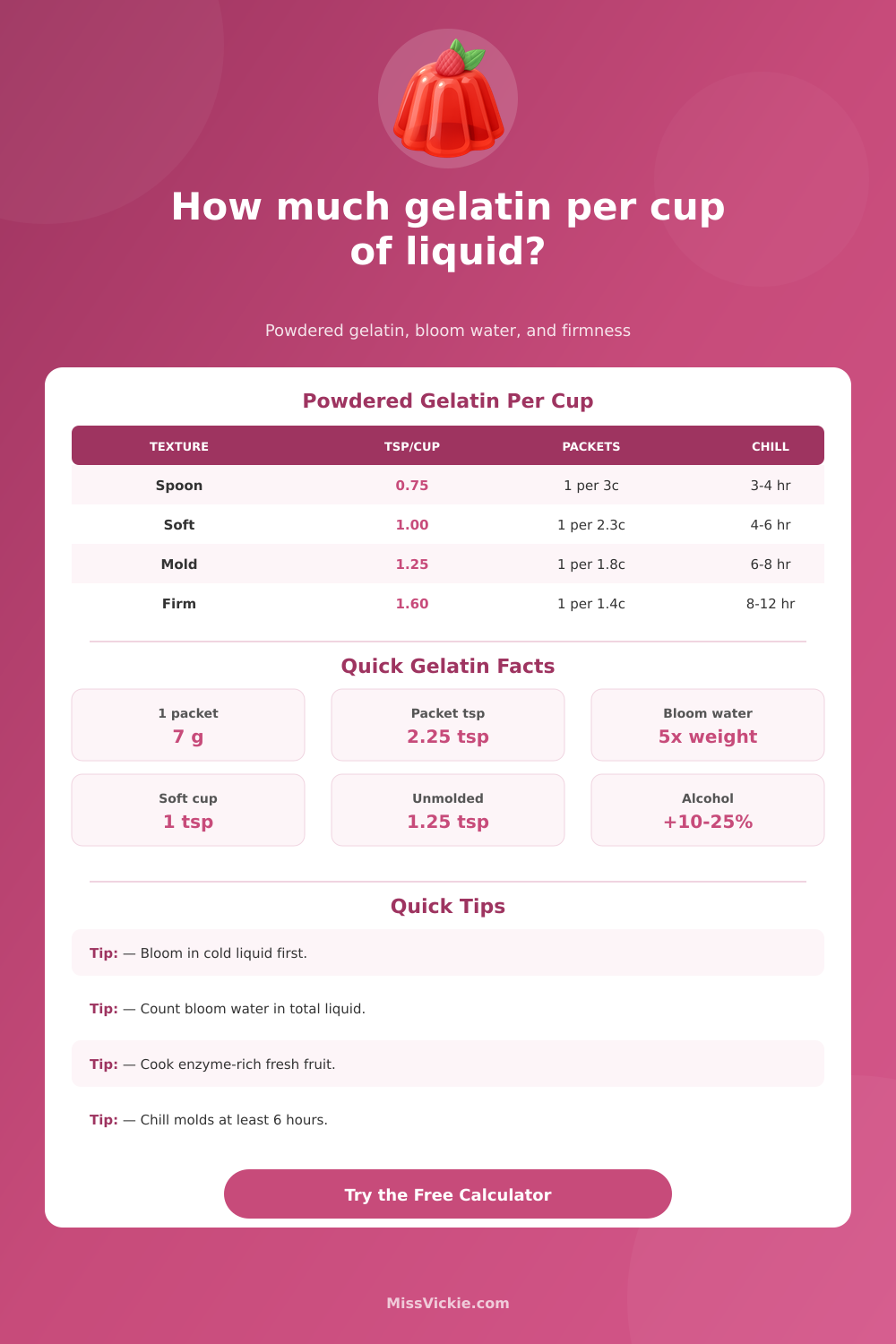
| Target Texture | Powdered Gelatin per Cup | Best Dessert Use | Chill Expectation |
|---|---|---|---|
| Spoonable soft set | 0.65 to 0.85 tsp | Panna cotta cups, custards, creamy desserts | 3 to 5 hours in shallow cups |
| Soft slice or cup dessert | 0.90 to 1.10 tsp | Fruit jelly cups, cheesecake stabilizer, mousse | 4 to 6 hours before serving |
| Clean unmolded slice | 1.15 to 1.35 tsp | Ramekin unmolds, loaf molds, layered gelatin | 6 to 8 hours for a clean release |
| Firm cut squares | 1.45 to 1.75 tsp | Party cubes, decorative molds, transport trays | 8 hours or overnight |
| Extra firm set | 1.80 to 2.10 tsp | Very sturdy layers or warm-room serving | Overnight gives the best texture |
| Ingredient Signal | Why It Matters | Gelatin Move | Kitchen Note |
|---|---|---|---|
| Cream, coconut milk, or custard base | Fat softens the perceived gel | Add 3 to 6 percent | Heat gently after blooming so gelatin dissolves fully |
| Yogurt, buttermilk, lemon, or wine | Acidity weakens the set slightly | Add 8 to 15 percent | Keep the mixture below a hard boil after gelatin is added |
| Alcohol above 5 percent of liquid | Alcohol interferes with gel strength | Add 15 to 25 percent | High-proof batches need longer chilling and modest portions |
| Very sweet syrup or glaze | Sugar changes water availability and body | Add 5 to 10 percent | Bloom gelatin before mixing into concentrated syrup |
| Fresh pineapple, kiwi, papaya, or fig | Enzymes can break gelatin down | Cook or use canned fruit | Raw enzyme-rich fruit may never set properly |
| Powdered Gelatin | Approx Teaspoons | 7 g Packets | Typical Liquid Range |
|---|---|---|---|
| 3.5 g | 1 1/8 tsp | 1/2 packet | 1 cup firm or 1 1/2 cups soft |
| 7 g | 2 1/4 tsp | 1 packet | 2 cups molded or 2 1/2 cups soft |
| 14 g | 4 1/2 tsp | 2 packets | 4 cups molded or 5 cups soft |
| 21 g | 6 3/4 tsp | 3 packets | 6 cups molded or 7 cups soft |
| 28 g | 9 tsp | 4 packets | 8 cups molded party batch |
| Batch Setup | Depth or Container | Minimum Chill | Best Serving Window |
|---|---|---|---|
| Small panna cotta cups | 1/2 to 3/4 cup each | 3 to 4 hours | Same day, well covered |
| Fruit jelly cups | 3/4 to 1 cup each | 4 to 6 hours | Serve cold from the refrigerator |
| Simple ramekin unmold | About 1 cup each | 6 hours | Dip mold briefly in warm water before turning out |
| Loaf, ring, or decorative mold | 2 inches or deeper | 8 hours | Overnight is safest for clean edges |
| Firm cut squares | Shallow tray | 8 to 12 hours | Use a warm dry knife for tidy cuts |
Use a soft rate for cups, then add a little more only when unmolding.
Extra support helps fruit stay suspended and slices release cleanly.
Alcohol weakens the gel, so use more gelatin and chill longer.
Sweet, thin layers need enough gelatin to slice without flowing.
Gelatin: Get your proportions correct with whatever liquid base you’re using, as it’s this detail which will decide if your dish set properly or if it becomes a wobbly failure. This becomes particulerly apparent when you transition from spoonable panna cotta to a firm decorative mold that cleanly releases onto a plate. If there isn’t sufficient gelatin, the exterior won’t set enough to be sliced, while excess gelatin result in a chewy texture before anyone has time to take a bite.
To work this method, know what each ingredient are actualy doing to the finished gel. It all starts with liquid volume, but the nature of that liquid determine the amount of powder required. Clear juice have less substance than cream or coconut milk. Cream and coconut milk will soften its set, and a teaspoon of powder here goes further then it would in a clear base. Wine or lemon adds acid to the mix, weakening the network slightly; if there’s alcohol involved, anything over a modest percentage messes up the network even more. Some fruits has a lot of enzymes (hello, fresh pineapple) and will not set at all without being cooked first. Too much sugar also alters the water balance, which is why very sweet glazes often need a little extra something-something in the form of more gelatin.
How to Get Your Gelatin Amount Right
Choose the category of your dessert. Consider its dairy content, potential acid risk, alcohol content, and sugar load. The calculator do the rest.
But there’s one other variable in most of these recipes… Bloom water, that is treated as bit of an afterthought. First, the powder has to soak up the cold liquid until it swells; then it melts into solution gradually when heated. What happens if you add this bloom water outside the overall recipe volume? The resulting dessert turn out to be just a little bit thinner (or firmer) than desired.
The calculator accounts for that option, telling you if your batch will be softer or firmer than the setting you chose. It also tallies up how much of the overall weight are represented by standard packets, and says how long the mix should take to chill before it reaches safe-to-unmold status.
It’s easy to under-estimate chill time. Deep molds takes longer to cool than shallow ones; higher sugar content or alcohol in the mix will stretch out the clock even more. What appears rock-hard at four hours might actualy remain too loose to cleanly pop away from a complex shape. Enter the desired firmness, mold complexity, and depth into the calculator. It determine how long your actual chill period lasts. This helps you adjust your gelatin to match (maybe upping the amount a bit) or lets you know when to start the process earlier.
This is all true at any scale: when making for a crowd, too, you can’t just double everything, including the liquid. This won’t work if you change the style of serving or even the depth of the container. Twice as much liquid doesn’t mean twice as much gelatin. A larger serving, like a party tray of firm cubes, requires more structure per cup than individual ones held snugly in their own ramekin.
Knowing how many servings you have give you an idea of what each one contains. This helps if you want a similar texture across multiple molds, or if you need extra protection to make sure no edges melts while moving your dessert.
Once you get to this point, though, where you can see all these factors interacting, it’s no longer so much guesswork: It’s a few thoughtful decisions, one after another. Pick out your desired texture, identify whatever is already present in the liquid, then do the math to see if you’re on track for the bowl conditions. And that’s really all there is to it; with that one test, you eliminate nearly all the last-minute twists that can send an otherwise well-thought-out dish right back to the drawing board.