Curing Salt Per Pound of Meat Calculator
Calculate Cure #1 or Cure #2 from meat weight, ppm target, dry cure or brine method, water weight, salt percentage, meat type, thickness, cure days, and safety range flags.
🧂Curing presets
Load a common curing setup, then edit the Cure #1 or #2 choice, target ppm, water weight, salt percentage, meat type, thickness, and cure time.
⚖Units
🥩Meat and cure target
Curing salt result
Calculation breakdown
Safety range flags
📌Cure math reference
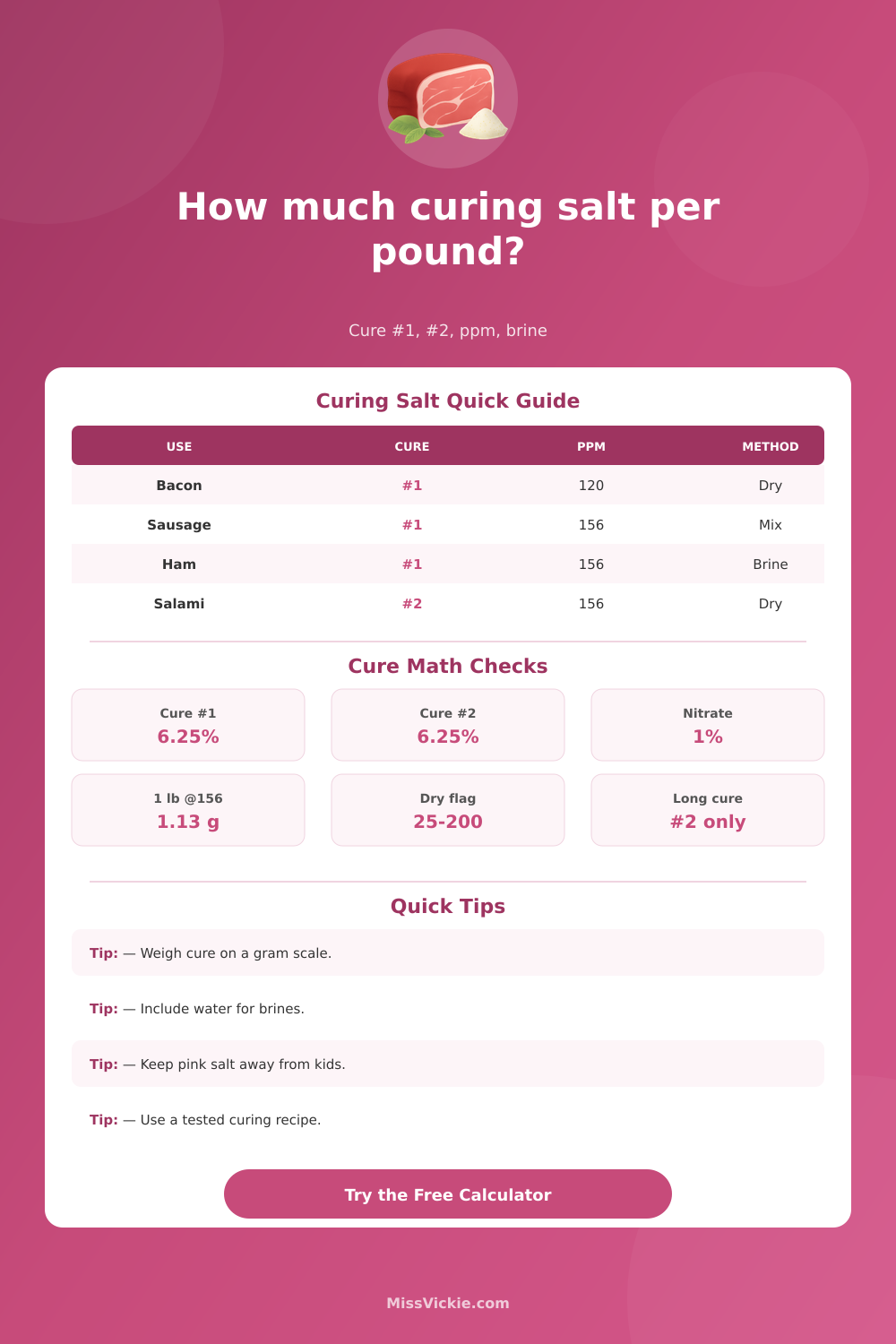
Standard pink curing salt nitrite concentration used in the calculator.
Cure #1 amount for one pound of meat when no brine water is included.
Common savory equilibrium target for many dry cures before sweetness or spices.
Used where nitrate reserve is part of a tested long dry-cure process.
📋Typical target ranges
| Meat or cure style | Usual cure | Typical nitrite ppm | Salt target | Planning note |
|---|---|---|---|---|
| Bacon or pork belly | Cure #1 | 120 to 156 ppm | 1.8% to 2.5% | Keep belly cures cold and use a tested bacon process. |
| Smoked sausage | Cure #1 | 120 to 156 ppm | 1.6% to 2.2% | Mixed meat distributes cure quickly but still needs even mixing. |
| Ham or corned beef brine | Cure #1 | 120 to 156 ppm | 2.0% to 3.0% | Equilibrium brine should count meat plus water weight. |
| Jerky strips | Cure #1 | 100 to 156 ppm | 1.8% to 2.8% | Thin strips cure quickly; dry safely after curing. |
| Dry-cured salami | Cure #2 | 100 to 156 ppm | 2.3% to 3.0% | Requires starter, pH, humidity, temperature, and weight-loss control. |
| Whole muscle dry cure | Cure #2 | 100 to 200 ppm | 2.5% to 3.2% | Long cures need verified chamber conditions and proven recipes. |
⏱Thickness and cure time guide
| Shape | Thickness | Dry cure timing | Brine timing | Check before cooking |
|---|---|---|---|---|
| Jerky strips | 0.25 in / 0.6 cm | 4 to 24 hr | 4 to 12 hr | Even color, cold handling, no thick folded pieces. |
| Bacon slab | 1 to 2 in / 2.5 to 5 cm | 5 to 10 days | 5 to 8 days | Firm texture and full cure time at refrigerator temperature. |
| Brisket flat | 2 to 3 in / 5 to 8 cm | 7 to 14 days | 7 to 12 days | Turn daily and keep fully covered if brined. |
| Ham section | 3 to 5 in / 8 to 13 cm | 14 to 35 days | 10 to 28 days | Large pieces may need injection in tested recipes. |
| Dry sausage | Mixed grind | Process specific | Not typical | Use pH, humidity, and weight-loss targets. |
⚠Curing safety tips
Use grams for cure. Measuring curing salt by spoon can miss the target by enough to matter, so weigh the cure directly.
Count the brine water. For equilibrium brines, nitrite and salt are spread through meat plus liquid, not meat alone.
Match the cure type. Cure #1 fits short cooked cures; Cure #2 belongs only in long dry cures built from a tested recipe.
Do not freestyle safety. Keep curing meat cold, label pink salt clearly, and confirm the final process with a trusted curing source.
People aren’t always fully aware how important getting the correct level of curing salt is initially. If you don’t use enough, you will never achieve the right flavor or protection in meat. If you use too much, the flavor can become unpleasantly strong, or even worse, the cure can make the meat taste off instead. All of that hangs on some rather complicated mathematics involving your starting meat weight, what type of recipe you’re making (brined, dry cure, etc.), and how strong of a curing salt you selected.
Curing salt is never just salt. The pink ones has a specific percentage of nitrite (sometimes nitrate as well) and when you weigh it out, that’s the direct determinant of the final number of parts per million in whatever you’re curing. That’s what helps keep certain bacteria at bay while you are curing meat. Once you figure out the desired parts per million and the meat itself, it’ll tell you exactly how much cure to add.
How Curing Salt Works
The calculator above does the math for you once you input how much meat you want to cure, what kind of cure you’re using, and so on. If you’re making an equilibrium brine, it factors in water as well since the nitrite will need to distribute throughout the entire system, not just in the meat itself.
In practice, your choice of curing method affect outcome. For example, with a slab of bacon (dry cured), the cure works through the surface and moves inward over days. But brined? The liquid moves the cure more quickly to the inside, assuming that you accounted for water weight. With ground sausage, mixing well disperse the cure nearly instantly; so the cure time is reduced.
The calculator accounts for all this… Based off thickness, meat type and number of days intended for the cure application. Why does height matter? Two inches will take longer to reach an even cure than a quarter inch of thickness.
Not all combinations are wise and that’s why we have safety flags. For example, using cure number two in a short-term bacon cure adds extra steps without any benefit. It belongs in long dry cures where the nitrate has time to slowly convert. Very low percentages of salt can leave your meat vulnerable and very high ones may result in an unappealingly salty or dried out final product. The tool flags these scenarios so that you can adjust accordingly before you get started.
Common errors typically involve people forgetting to account for the brine liquid or measuring by volume rather than weight. Both of those throw the parts per million off enough to matter. Most of the guesswork is taken out when you weigh the cure on a gram scale. Then follow a tested recipe for what you are making. Label the curing salt clearly. Keep the meat cold during the process.
You’re not trying to memorize formulas. You’re trying to learn what’s going on with each input so that when you get results back from your calculator, you know what those numbers mean and how they apply to the meat you have in front of you. When you grasp how thickness, water, cure type, and meat weight all relate to one another, it won’t seem like magic anymore. It’ll feel like a process you can adjust comfortabley and replicate repeatedly.