Green Beans Blanching Time Calculator
Estimate green bean blanching time from bean thickness, batch weight, water volume, salt level, fresh or frozen state, altitude, crunch preference, ice bath ratio, storage goal, and pot recovery speed.
🫘Green bean blanch presets
Choose a common blanching setup, then adjust the bean size, water-to-bean ratio, salt, storage plan, and cooling bath.
⚖Units
📏Beans, batch size, and boiling water
🧂Salt, crunch target, ice bath, and storage goal
Green bean blanching estimate
Blanching breakdown
Use enough ice water to stop carryover cooking.
📋Quick blanching targets
Minutes for haricot verts or pencil-thin beans served crisp.
Minutes for everyday green beans before salad or saute.
Minutes for plump garden beans or freezer prep.
Use at least twice as much ice water as hot beans.
⏱Green bean blanching reference table
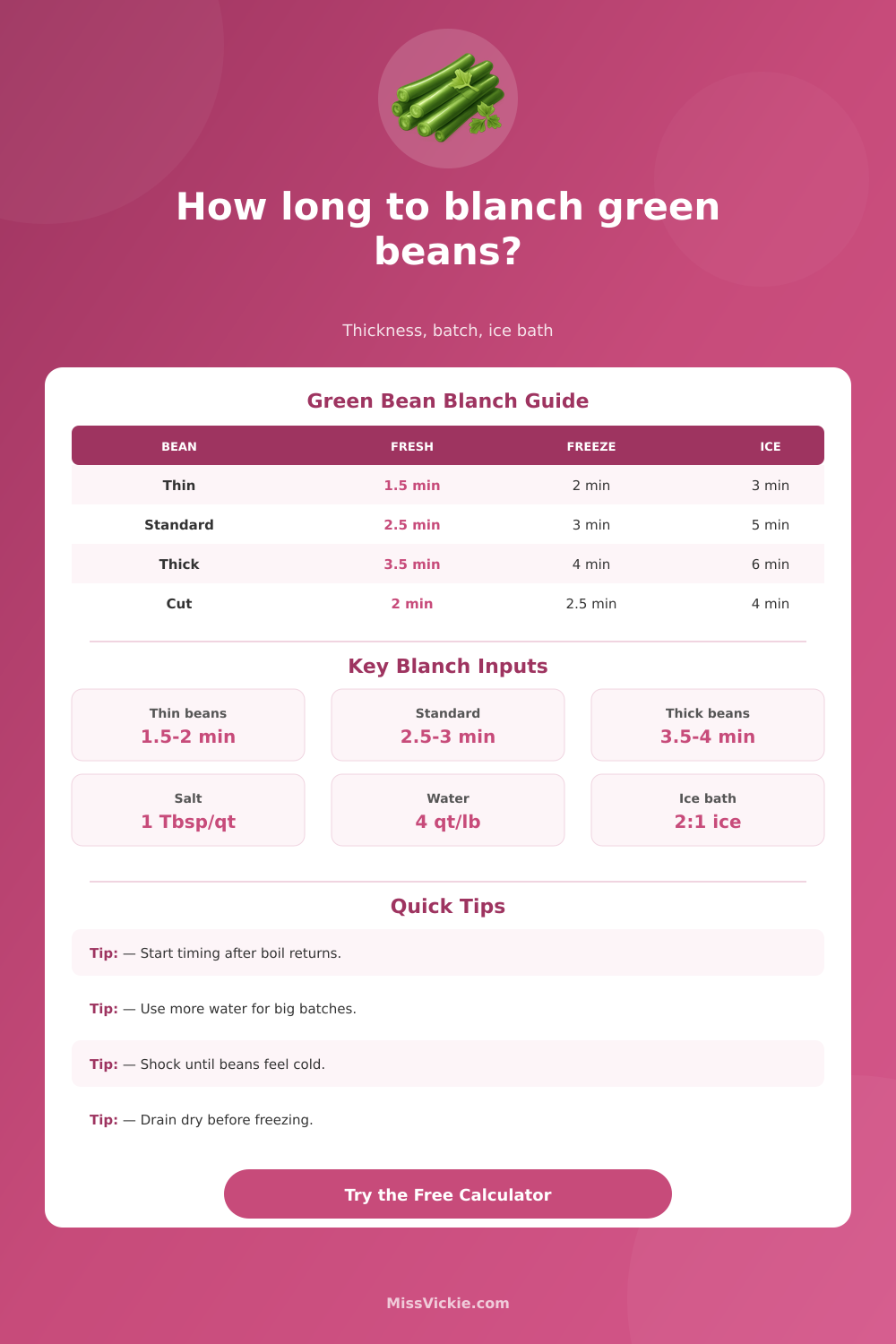
| Bean thickness | Salad or crisp side | Freezer blanch | Best ice bath | Timing note |
|---|---|---|---|---|
| Haricot verts or pencil-thin beans | 90 to 120 seconds | 2 minutes | 3 minutes, plenty of ice | They overcook quickly; shock immediately. |
| Standard supermarket green beans | 2 to 3 minutes | 3 minutes | 4 to 5 minutes | This is the most common blanching range. |
| Thick garden beans | 3 to 4 minutes | 4 minutes | 5 to 6 minutes | Check the thick end before draining. |
| Cut green bean pieces | 90 seconds to 2 minutes | 2 to 3 minutes | 4 minutes | Pieces cool faster but can waterlog if left too long. |
🚰Water, salt, and batch load guide
| Batch size | Water target | Standard salt | Recovery expectation | Best use |
|---|---|---|---|---|
| 8 ounces / 225 grams | 2 quarts / 2 liters | 2 tablespoons | Fast on most burners | Small dinner side or salad topping |
| 1 pound / 450 grams | 4 quarts / 4 liters | 4 tablespoons | Good baseline ratio | Family side, meal prep, freezer tray |
| 2 pounds / 900 grams | 8 quarts / 8 liters | 1/2 cup | Use a large stockpot | Party platter or several freezer bags |
| 4 pounds / 1.8 kilograms | 16 quarts / 15 liters | 1 cup | Split if boil recovery is slow | Garden harvest or batch freezing |
❄Cooling and storage guide
| Goal | Blanch texture | Ice bath time | Drain method | Storage note |
|---|---|---|---|---|
| Serve warm right away | Crisp-tender | Optional brief shock | Drain well, toss hot | Use a shorter ice bath if serving warm. |
| Cold salad or platter | Snappy and bright | 4 to 6 minutes | Drain, pat dry | Dry beans hold dressing better. |
| Meal prep | Slightly under tender | 5 minutes | Drain on towels | Cool fully before lidding containers. |
| Freezing | Enzyme-stopping blanch | At least as long as blanch time | Dry thoroughly | Freeze flat first to reduce clumps. |
💡Blanching notes
Timing: Drop beans into a hard boil, cover briefly if needed, then start timing once the water returns to a boil.
Cooling: If the ice bath warms quickly, add more ice or change the water so the beans stop cooking fast.
Freezing: Use the freezer goal for thicker beans, then drain very dry before packing to limit ice crystals.
Altitude: At high elevations, boiling water is cooler, so the calculator adds time and lowers confidence slightly.
To have a bowl of crispy, colorful green beans, it’s not just about throwing them in some boiling water. You also need to control your timing and your cooling. You must consider how these relate to each other and to the variety of beans you are using.
Thicker beans takes longer to cook since heat travels more different depending on thickness. If you set both a thin and thick bean into boiling water and plan to cook them the same amount of time, the thick one will be overcooked on the outside and still raw inside. That’s what the calculator does, the math, when you input thickness, batch weight, and water volume of your beans.
Why This Calculator Helps You Cook Green Beans
The speed at which the pot comes back to a boil depend on the water-to-bean ratio. Too few beans? The interior will be lagging far behind the cooked-outside exterior when temperature plummets. Too many beans? All that extra water require more heat. Adding salt helps maintain bean color and seasons the outer skin… But won’t substitute for coolin’ the beans post-cook.
Beans take a little longer to cook in altitude then they do at sea level (because water boils at a different temp in altitude). How cold your beans are when you start also matter; colder (refrigerator) beans extract more of the cooking waters heat than ones that has come up to room-temp. Frozen ones vary as well, since most commercially available frozen ones is blanched before being frozen.
The ice bath step can rob many cooks of their texture: Even when quickly drained, beans will still be cooking because they’re continuing to cook from there own residual heat after leaving the water. This calculator factors that into play, along with your desired storage time. If you plan to serve as a side dish on the same night, blanch for a shorter amount of time than you would if you were freezing them.
One common misstep is beginning the timer when you drop the beans in instead of waiting for water to return to a boil. You might leave the ice bath in the sun so it’s no longer icy-cold, or tuck way-too-many beans into a tiny pot. All these factors alter the beans’ true exposure time, despite what your timer says.
The calculator is helpful because it tells you exactly what every input represents. Instead of remembering a set of static values, you can tweak based off your exact setup, the kind of pot, type of bean, and what you intend to do with it. It fits the specific situation better than one-size-fits-all rules.
You should of used this calculator to avoid overcooked green beans.